






My Friend in The Orchid Room. Exclusive; Italy Prime Minister; “Africa Isn’t Poor, it just Exploited .
In an interview inquiring closely into African nations’ ups and downs, Italy’s prime minister Giorgia Meloni finds that external polluted-spoilers are the ones exploiting Africa.
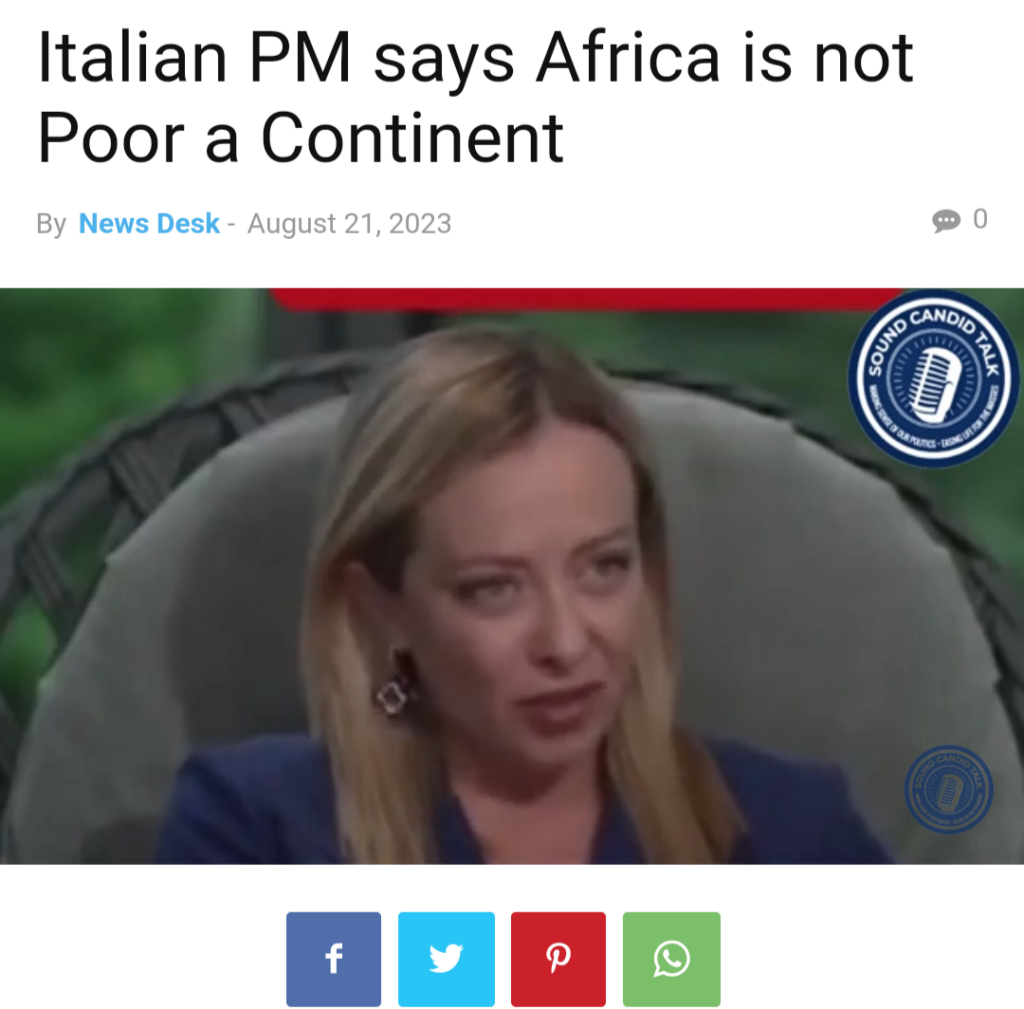
Italian Prime Minister Giorgia Meloni has said Africa as a continent is not as poor as it is perceived.
In a viral video monitored by News Ghana, Giorgia Meloni highlights that Africa’s trust in Europe and the Western world has significantly diminished. This loss of trust stems from the perception that Africa has been exploited as a continent.
She emphasises the necessity for a change in approach towards Africa. Pointing out that Africa is abundant in resources, including rare earth metals and raw commodities.
Additionally, she highlights that approximately 50% of arable land in Africa have not been effectively managed.
“What I want is to bring investment in Africa. Bring investment not to say we want to help. That is not geopolitics. For example, now, we have a problem in Europe with energy sources, But Africa is potentially an enormous producer of every kind of energy: Green energy, hydrogen energy, geothermic and gas.
In a world grappling with energy security and sustainable development, Meloni’s perspective underscores the need to recognize Africa’s untapped capabilities and engage in partnerships that leverage its resources for mutual benefit.
Why Africa remains poor
The African continent is undeniably one of the most mineral-rich regions worldwide, with some sources even claiming it to be the most mineral-rich. Africa is estimated to possess around 30% of the global mineral deposits, including valuable resources like gold, diamonds, uranium, lithium, petroleum, and coltan.
Notably, over 75% of the world’s coltan supply is currently extracted from Africa. Coltan is a source of tantalum, which is used in the production of cellphones, computers, cameras, automotive electronics, and weapon systems.
These African minerals play a vital role in industries that generate immense wealth globally. However, many African countries lack the necessary industrial capabilities to effectively extract minerals, particularly petroleum.
Moreover, even when minerals are successfully extracted, there is a lack of technological expertise to add value to these resources. Establishing refineries for petroleum products and other technologically advanced value-adding centers within Africa would greatly contribute to maximizing the continent’s wealth from its mineral deposits.
The way forward
Experts say by assisting Africa in harnessing and producing energy such as green energy, hydrogen and geothermal sources and by establishing strong ties with Europe, a myriad of challenges in Africa could be collectively resolved.
They advocate for a transformative approach—one that aligns the interests of all parties involved, shifts the dynamics of aid, and propels Africa toward unleashing its vast potential for the betterment of its people and the world at large.

Therefore these external polluted–spoilers, necessarily drag African leaders’ wisdom as well as Africa’s flourishing culture down into decadence.
An exploited country refers to a nation that faces significant economic, political, or social disadvantages due to various factors. It’s important to note that the term “exploited” can be subjective and may vary based on different perspectives and contexts. However, some countries have faced historical and ongoing challenges that have hindered their development and contributed to their exploitation.

Factors such as colonization, neocolonialism, internal conflict, corruption, and unequal distribution of resources can contribute to the exploitation of a country. It’s crucial to approach this topic with sensitivity and respect for the complex dynamics involved in each specific case.
A country’s historical challenges refer to significant obstacles or difficulties that a nation has faced in its past, which have shaped its development and continue to impact it in various ways. These challenges can be diverse and multifaceted, encompassing political, economic, social, and cultural aspects.
Some examples of historical challenges could include colonization or foreign domination, civil wars or internal conflicts, economic exploitation, prolonged poverty or underdevelopment, ethnic or religious tensions, systemic inequality, and struggles for independence or self-determination.
These challenges often leave a lasting impact on a country’s institutions, infrastructure, social fabric, and overall trajectory. Understanding a country’s historical challenges can provide insights into its present-day circumstances and help shape strategies for future development and progress.

Can Understanding a country’s historical challenges can provide insights into its present-day circumstances and help shape strategies for future development and progress?
Absolutely! Understanding a country’s historical challenges can provide valuable insights into its present-day circumstances and help shape strategies for future development and progress. History often leaves a lasting impact on a nation’s social, economic, and political landscape. By studying past challenges and their outcomes, policymakers can learn from successes and failures, identify recurring patterns, and make informed decisions to address current issues.
Historical knowledge helps policymakers understand the root causes of existing problems, such as social inequalities, political conflicts, or economic disparities. It allows them to analyze the long-term effects of certain policies or events, providing a broader perspective on the challenges faced by the country.
Furthermore, historical analysis can help identify resilient or adaptive strategies that enabled the country to overcome similar challenges in the past. By recognizing successful approaches, policymakers can draw inspiration and adapt those strategies to the present context, thereby fostering sustainable development and progress.

Additionally, understanding historical challenges fosters empathy and promotes social cohesion by acknowledging past injustices, conflicts, or divisions. This awareness can guide efforts towards reconciliation, social integration, or transitional justice processes, leading to a more harmonious and inclusive society.
In summary, studying a country’s historical challenges equips policymakers with knowledge, insights, and lessons learned to address current issues effectively, shape future strategies, and pave the way for development and progress.
How can citizens recognise when a way is paved for development and progress?

Citizens can recognize when a way is paved for development and progress by observing certain indicators and factors. Here are a few ways:
- Infrastructure improvement: Notice if there are new roads, bridges, public transportation systems, or utilities being built or upgraded in your area. These indicate a focus on improving the infrastructure and creating an environment for development.
- Economic growth: Look for signs of a thriving economy, such as increased job opportunities, new businesses opening, rising incomes, and a growing tax base. These are positive indications that development is taking place.
- Educational and healthcare investments: Check if there are investments in education and healthcare facilities. The presence of quality schools, universities, hospitals, and medical centers demonstrates a commitment to human development and progress.
- Technological advancements: Observe if there are advancements in technology, such as the availability of high-speed internet, smart city initiatives, or innovative solutions being implemented. These show a dedication to embracing cutting-edge technologies and fostering progress.
- Community engagement: Pay attention to public participation and involvement in decision-making processes. When citizens have opportunities to voice their opinions, contribute ideas, and participate in local initiatives, it often indicates a commitment to inclusive development.
Remember, recognizing development and progress is subjective and can vary based on individual perspectives and local contexts. It’s important to stay informed, engage your community, and assess the long-term impact of these changes for a more comprehensive understanding.
In what ways can you say the Italian prime minister is better than most of the current leaders in Europe and Africa?

I will refer to her as an Authentic leader, referring to her quality being genuine, true, or original.
It is the state of her being true to herself or to the characteristics, values, and beliefs that define her individuality.
She is honest, transparent, and sincere in her actions, words, and intentions. This often implies being true to one’s own identity and not trying to imitate or conform to others’ expectations. In human relationships, authenticity is valued as it fosters trust and genuine connections. Thank you .