





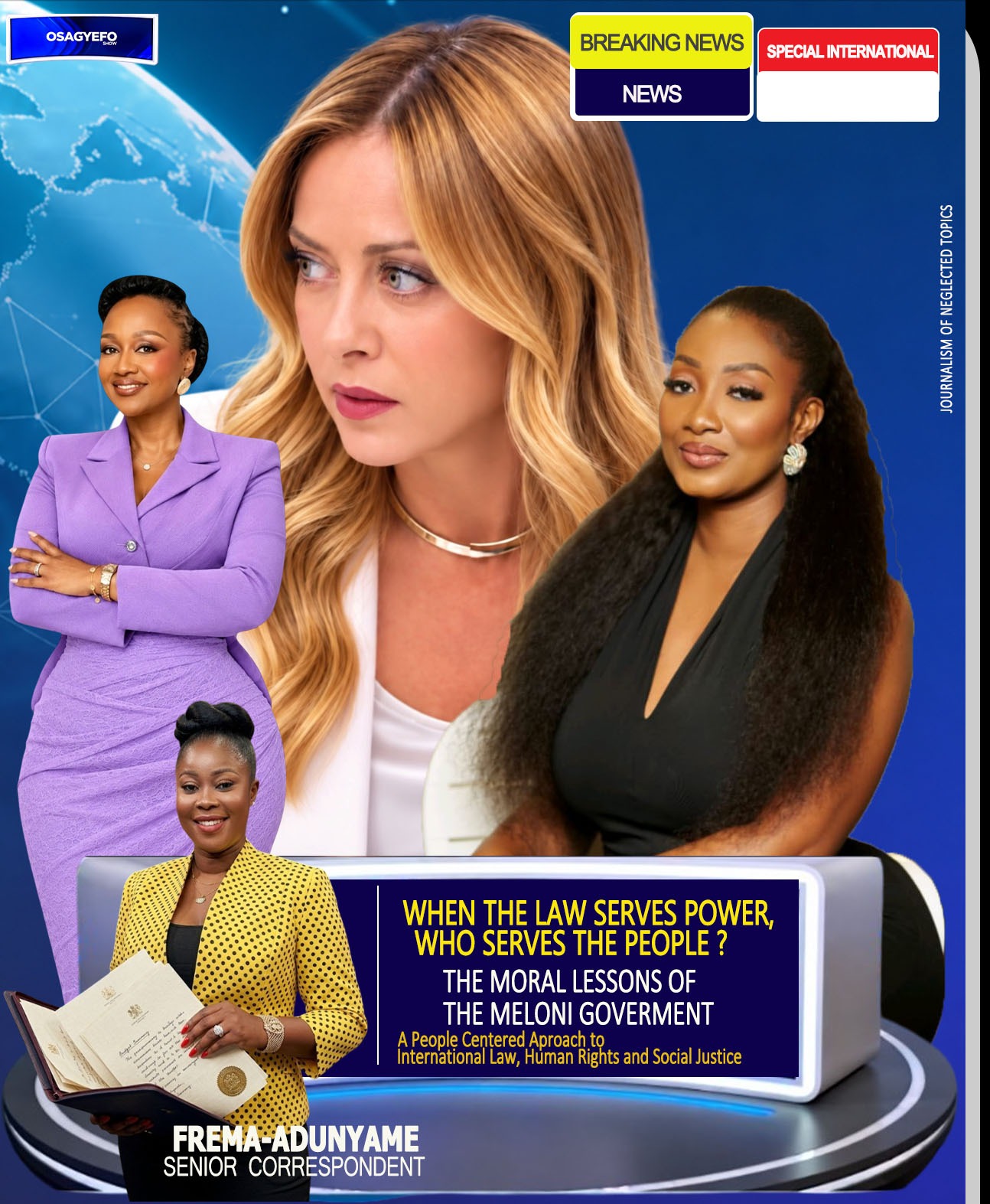

📰 OSAGYEFO NEWSLETTER MAGAZINE
PRESENTS “ONWARD” WITH FREMA ADUNYAME
A SPECIAL INTERNATIONAL EDITION
COMING MONDAY, 26 OCTOBER 2026
🌍 Worldwide Release — International Readers Edition
🌐 Read exclusively at: https://assumptagh.live/















.://www.instagram.com/hairsenta?rpxt=MXAzOThhNGZ0Nm15dQ==
Elevate Your Crown with The Hair Senta
Why settle for “good enough” when you can wear the gold standard? At The Hair Senta, we don’t just sell hair; we deliver the confidence that comes with knowing your look is flawless, authentic, and built to last.
Based in the heart of Accra and shipping globally, we’ve turned the art of human hair extensions into a world-class experience.
Why the World Chooses Hair Senta
- Actual Proof of Quality: No filters needed. Our extensions are sourced for longevity, natural lustre, and a seamless blend. Whether it’s raw or virgin hair, the quality is visible in every strand.
- The Confidence Factor: We believe your hair is your power. Our pieces are designed to give you that “just stepped out of the salon” feeling every single day.
- Unbeatable Value: Luxury shouldn’t be out of reach. We offer premium, trademarked quality at prices that respect your investment.
- Global Reach, Local Roots: From our flagship in Ghana to doorsteps in London, New York, and beyond—we bring the best of West African hair retail to the world.
Ready to Transform Your Look?
| Feature | What You Get |
|---|---|
| Origin | Premium Sourcing |
| Shipping | Worldwide Delivery |
| Location | 24 Jungle Avenue, Accra, Ghana |
| Status | Trademarked Excellence |
Get in Touch Today
Don’t wait for your best hair day—create it.
Visit Us: www.hairsenta.com
Call/WhatsApp: (+233) 0544354455 / 0248629769
In-Store: 24 Jungle Avenue, Accra, Ghana
“Your hair is the crown you never take off. Make sure it shines.”
TALY: WHEN THE LAW, PUBLIC MONEY AND SOCIAL JUSTICE COLLIDE
Who Does the System Serve—the Institution, the Powerful, or the People?
An investigation into judicial remuneration, political responsibility and the meaning of fairness in a democratic society.
THE PRINCIPAL ARTICLE
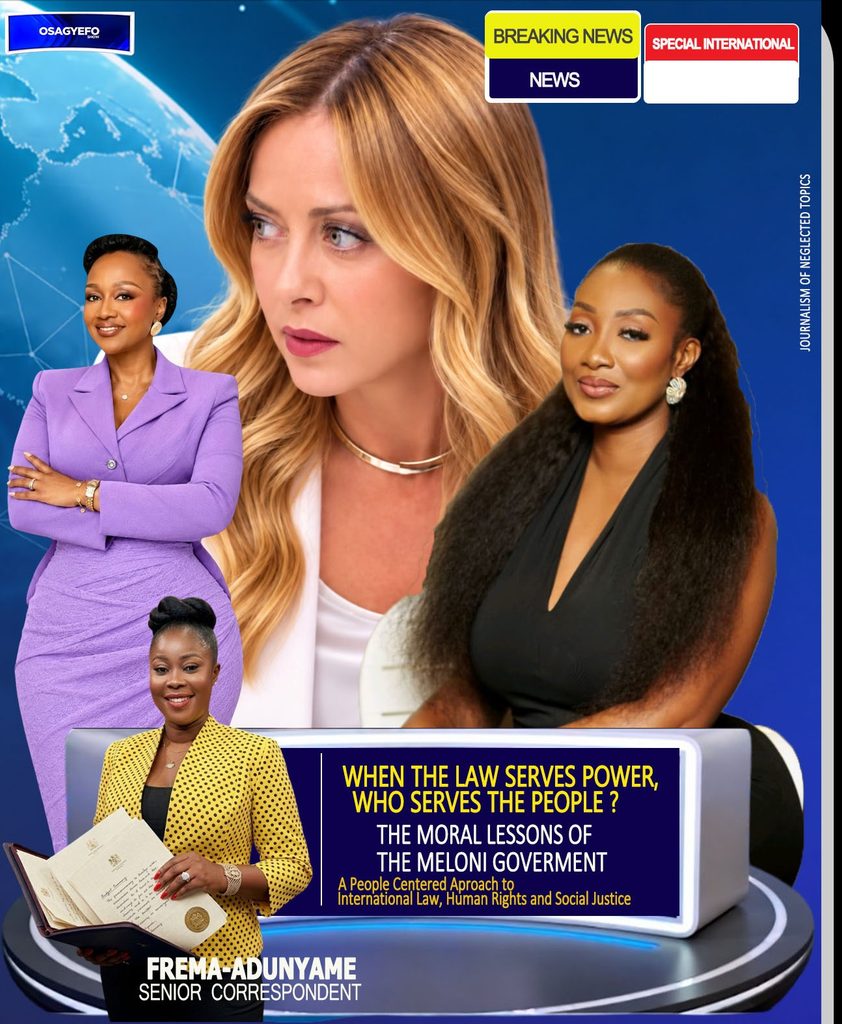
WHEN THE LAW SERVES POWER, WHO SERVES THE PEOPLE?
A People-Centered Approach to International Law, Human Rights and Social Justice
THEME: THE MORAL LESSONS OF THE MELONI GOVERNMENT
Equality • Human Rights • Public Money • The Rule of Law • The Responsibility of Leadership
When political decisions, legal obligations and the demands of social justice collide, what should guide a democratic government?
WELCOME TO OUR INTERNATIONAL READERS
From Italy to Africa, from Europe to the wider international community, the relationship between law, political power and human dignity remains one of the defining questions of democratic governance.
In this special edition of OSAGYEFO Newsletter Magazine, presented through ONWARD with Frema Adunyame, we invite our international readers to look beyond political headlines and examine the institutions, principles and decisions that shape public life.
Our starting point is Italy, where Prime Minister Giorgia Meloni’s refusal to sign a decree implementing disputed salary adjustments for magistrates has brought public expenditure, judicial independence and fairness into sharp focus.
But this is not simply a story about salaries.
It is an opportunity to examine how governments should balance lawful entitlements, competing public needs, institutional independence and accountability to taxpayers.
Our purpose is not to prejudge the individuals involved. It is to ask difficult questions, examine the evidence and encourage a deeper understanding of what public service should mean in a democratic society.
Because the real measure of governance is not merely the power to make decisions, but the responsibility to ensure that those decisions serve the common good.
MEET OUR CONTRIBUTORS AND FEATURED VOICES

FREMA ADUNYAME
Broadcast Journalist | Channel One TV | Host of ONWARD
A respected journalist and media professional whose work focuses on public accountability, governance, information and the evolving role of the media in shaping public discourse across Africa.
Through informed conversations and thoughtful engagement, Frema’s role as host provides a platform for examining the issues that affect societies and the people who live in them.

GWEN ADDO
Author of DIRECTION | Entrepreneur | Wellness Coach | Food Educator
Founder and co-founder of multiple social enterprises, Gwen advocates transformation through health, personal development, entrepreneurship and purposeful living.
Through her work and her book DIRECTION, she inspires people to discover purpose, embrace growth and become agents of positive change.
Her people-centred perspective invites reflection on the connection between personal wellbeing, social responsibility and human dignity.

DZIGBORDI KWAKU-DOSOO
Global Speaker | Entrepreneur | Consultant
A prominent voice on leadership, mindset transformation, human development and inclusive growth.
Her work emphasises the importance of dignity, opportunity and human-centred development, encouraging individuals and institutions to recognise that lasting progress must benefit people, not merely systems.

GIORGIA MELONI
Prime Minister of Italy | Central Political Figure in This Investigation
Italy’s prime minister is the central political figure examined in this special edition. Her decision not to sign the disputed decree implementing magistrates’ salary adjustments provides the starting point for our inquiry into political responsibility, public expenditure, legal obligations and competing social priorities.
Her government’s position and the responses of the magistrates’ representatives will be considered as part of a wider examination of democratic accountability.
Editorial clarification: Giorgia Meloni is featured as the subject of the investigation, not presented as a confirmed participant in the ONWARD discussion.
WHAT THIS ISSUE UNPACKS
This special edition takes readers through seven interconnected questions.
01 — The law and judicial remuneration
Why do Italian magistrates have a distinct statutory salary-adjustment mechanism, and what did the relevant court rulings require the government to recalculate?
02 — The nearly €1 billion controversy
Where did the widely reported estimate originate? What does it include, and why have questions been raised about the final amount?
03 — Equality between public servants
How should society understand differences between magistrates’ remuneration arrangements and the bargaining systems used by other essential workers?
04 — Political responsibility and leadership
What does a prime minister’s refusal to sign a decree mean politically, and what are its legal implications?
05 — Accountability for public expenditure
Who must explain the calculations, the administrative decisions and the financial consequences?
06 — Reform and the rule of law
Can governments reform remuneration systems while respecting judicial independence, binding court decisions and legitimate legal entitlements?
07 — Human rights and the common good
How can public money, legal frameworks and social policy work together to protect human dignity and maintain public confidence?
ABOUT THIS ISSUE
Beyond the Headline, Towards Understanding
A headline can capture attention. A serious investigation must go further.
The dispute in Italy presents an opportunity to examine a difficult but essential question of democratic governance: how should public institutions respond when legal obligations appear to conflict with competing social and economic priorities?
The reported financial liability is substantial, but the precise amount remains disputed. The magistrates’ representatives maintain that the adjustments arise from legal entitlements, while Meloni has emphasised the financial burden and the government’s competing priorities.
Neither position should be accepted without examination.
The courts’ rulings, the government’s calculations, the relevant legislation and the responses of the parties must be considered together.
Our investigation therefore looks beyond the personalities involved. It asks whether the institutions responsible for public expenditure operate transparently, whether the law is administered consistently, and whether public resources are managed in a way that sustains trust.
The purpose is not to turn one profession against another. It is to understand how a democratic system can protect lawful rights while remaining accountable to the wider public.
WHY THIS MATTERS
Because Public Decisions Have Human Consequences
Public finances are not abstract figures on a government spreadsheet. They affect the services people depend on, the taxes they pay, the opportunities available to their children and the security of their communities.
The same is true of the law. Its legitimacy depends not only on the rules it establishes but also on the fairness, consistency and accountability with which those rules are applied.
This is why the Italian controversy matters beyond Italy.
For readers in Africa, Europe and elsewhere, it raises questions about the allocation of national resources, the independence of institutions, unequal bargaining power and the responsibility of political leaders to explain their decisions.
For workers, it raises questions about equal dignity and the recognition of different forms of public service.
For governments, it highlights the need to balance lawful obligations, financial sustainability and competing public needs.
And for citizens, it reinforces the importance of asking questions, examining evidence and holding institutions accountable without abandoning fairness or due process.
The challenge is not to choose between the law and the people. It is to ensure that the law protects the people while public institutions fulfil their responsibilities.
THE OPENING QUESTION
What happens when a government says it cannot justify nearly one billion euros for salary adjustments for magistrates, while seeking a fraction of that amount to support the transport sector?
And what happens when the people entitled to that money argue that the payment is not a political favour, but the implementation of court rulings?
This is the dilemma confronting Italy following Prime Minister Giorgia Meloni’s announcement on 18 October 2026 that she would not sign the decree intended to implement disputed salary adjustments for magistrates.
At first glance, this appears to be a straightforward dispute about public spending. Look more closely, however, and a much deeper question emerges:
Does a system serve the public interest merely because it operates according to the law, or must society also examine whether the rules themselves produce fair and sustainable outcomes?
That is the question this investigation seeks to explore.
THE INVESTIGATION
1. THE FACTS BEHIND THE CONTROVERSY
Italy has a statutory framework for adjusting magistrates’ salaries. Unlike many other public-sector workers, magistrates have a mechanism under which their remuneration is adjusted periodically according to statutory criteria linked to public-sector pay changes.
The system is designed in part to safeguard the independence of the judiciary from direct political control over its remuneration.
The immediate controversy concerns the calculation of salary adjustments for 2018–2020 and 2021–2023. Following legal challenges, the Council of State ruled in favour of revising the relevant calculations.
The issue is therefore not simply a new pay rise proposed at the government’s discretion. It concerns recalculations and possible arrears arising from legal rulings.
Sources for readers:
- ANSA — Meloni refuses to sign the decree, 18 October 2026
- Pagella Politica — Explaining the magistrates’ salary dispute, 20 October 2026
The distinction matters. If money is legally owed, a government cannot simply make that obligation disappear by expressing political disagreement with its cost.
But citizens are equally entitled to ask how the calculation was made, why the dispute arose and what the consequences will be for public finances.
2. ONE BILLION EUROS: WHAT DO WE ACTUALLY KNOW?
The figure that captured public attention was approximately €970 million, reportedly covering salary adjustments and arrears affecting thousands of magistrates.
However, the final cost remains uncertain in the publicly available reporting.
The government’s estimate has been challenged by representatives of the magistracy, who argue that the amounts actually payable may be substantially lower. The headline figure should therefore not be confused with a confirmed net payment to each magistrate.
There is also an important distinction between the state’s total expenditure, which may include employer contributions, and the amount an individual receives after deductions.
A responsible investigation must resist sensationalism.
The question is not merely whether €1 billion sounds excessive. It is whether the government has provided a transparent, independently verifiable account of the sums legally due, the calculations behind them and the long-term cost to taxpayers.
Public money deserves accurate accounting, not political arithmetic.
Source: Pagella Politica — What is known about the estimated cost?
3. TWO SETS OF WORKERS, TWO DIFFERENT SYSTEMS
Consider the wider public-sector landscape.
Teachers negotiate over their employment conditions. Nurses and other healthcare workers seek better pay and staffing conditions. Police officers work within their own remuneration frameworks. Road-haulage operators face economic pressures that can threaten the movement of goods across the country.
Magistrates, by contrast, have a special remuneration mechanism designed partly to protect the judiciary from political interference.
These arrangements are not identical, and their differences cannot automatically be treated as evidence of unfairness.
Judicial independence is a public good. Judges must be able to make decisions without fear that politicians will punish them financially for unwelcome rulings.
Nevertheless, an important question remains: how can a democratic state protect the independence of the judiciary while maintaining public confidence that defensible principles govern remuneration across essential services?
The answer cannot be to deny one group its lawful rights simply because another group is struggling.
Nor should the existence of a special system make that system immune from scrutiny.
Fairness requires both legal protection and public accountability.
4. IS THE PRIME MINISTER CONFRONTING THE PROBLEM OR THE CONSEQUENCE?
Meloni has framed her refusal in terms of conscience and competing priorities. She has compared the amount involved with the smaller sum her government is seeking to address the problems of the transport sector.
This comparison raises a legitimate budgetary question: how should limited public resources be allocated when different sectors have pressing needs?
But there is a further question.
If the courts have ruled that previous calculations were incorrect, refusing to sign an implementing decree does not, by itself, settle the legal dispute.
Reporting by Italian media has indicated that further legal proceedings and the possible appointment of a commissioner could be considered to secure implementation of the relevant rulings.
The political consequences of refusal and the legal consequences of non-compliance are two different matters.
A prime minister may question the cost of an obligation, seek lawful changes to future arrangements and demand transparent calculations. But a democratic government must also respect binding judicial decisions.
The deeper test of leadership is whether political resistance leads to a credible solution or merely postpones an unavoidable obligation.
5. WHO SHOULD BE HELD ACCOUNTABLE?
It is tempting to make magistrates the centre of the controversy. Yet the evidence points to a broader institutional problem.
If government authorities applied a calculation method that courts subsequently found unlawful, the public deserves an explanation of how that method was approved, why it remained in use and what safeguards will prevent similar disputes.
Accountability should not stop with the people who receive the money. It must also examine the institutions responsible for calculating, authorising and administering public expenditure.
At the same time, magistrates should not be presumed to have acted improperly merely because a court ruling may entitle them to substantial arrears.
Receiving a payment lawfully owed is not equivalent to creating the administrative error that made the payment necessary.
The relevant questions are therefore institutional:
- Who designed and approved the disputed calculations?
- What did the law require, and how did the administration interpret it?
- What will the final liability be after the calculations are independently verified?
- Can the government reform the rules prospectively without undermining judicial independence or disregarding accrued legal rights?
- How can public-sector remuneration become more transparent and equitable?
These questions shift the discussion from resentment between occupational groups towards responsibility for the system as a whole.
6. THE PEOPLE MUST NOT BECOME SPECTATORS IN THEIR OWN DEMOCRACY
There is a fundamental principle at stake: the public purse belongs to the public, and institutions exercise authority on behalf of the people.
Taxpayers should not be expected to accept major expenditure without a clear explanation. But neither should public anger be encouraged through exaggerated figures or by portraying lawful recipients as enemies of ordinary workers.
When workers are placed in competition with one another, the institutions responsible for designing employment and remuneration systems can escape examination.
A teacher’s need for a fair salary does not invalidate a magistrate’s legal entitlement. A magistrate’s legal entitlement does not remove the government’s responsibility to support teachers adequately.
The same principle applies to nurses, police officers, transport workers and every other group whose work sustains society.
The task of government is not to declare one profession more deserving of dignity than another. It is to establish fair rules, allocate resources responsibly and explain its decisions honestly.
7. REFORM WITHOUT DESTROYING THE RULE OF LAW
If Italy’s existing remuneration mechanism produces unexpected or disproportionate financial consequences, reform deserves serious consideration.
But reform must be undertaken carefully.
First, transparency. The government should publish a clear account of the calculations and the final amount legally due.
Second, legal compliance. It should implement binding judicial decisions and address valid arrears in accordance with the law.
Third, responsible reform. Parliament should examine whether the statutory mechanism remains appropriate for future adjustments. Any amendment should be transparent, constitutionally sound and designed to protect judicial independence.
Fourth, broader fairness. Policymakers should examine principles of public-sector remuneration, including predictability, affordability and fairness across essential services.
Finally, public accountability. The government should explain how these commitments fit within its budget priorities and what trade-offs are involved.
Such an approach would address both dimensions of the problem: the immediate legal obligation and the longer-term public-policy question.
It would also avoid a dangerous precedent in which governments treat court decisions as optional whenever compliance becomes politically inconvenient.
8. THE VERDICT BELONGS TO THE PUBLIC
The controversy in Italy presents neither a simple story of an irresponsible judiciary nor an uncomplicated story of a courageous politician defending taxpayers.
It is a test of institutions.
The judiciary must remain independent. Public officials must administer the law correctly. Governments must manage public finances responsibly. And citizens must be able to question arrangements that affect the distribution of public resources.
These obligations are not mutually exclusive.
Indeed, a mature democracy must be capable of holding all of them together.
The central question is not whether magistrates deserve lawful remuneration. It is whether the system that determines that remuneration is transparent, defensible and consistent with the public interest.
Nor is the central question simply whether Meloni signs a decree. It is whether the government can resolve the present dispute lawfully while developing a more transparent and sustainable framework for the future.
Public trust is not secured by asking citizens to choose between the law and fairness. It is secured when institutions demonstrate that the law is administered fairly, public money is accounted for honestly, and the dignity of every worker is taken seriously.
QUESTIONS FOR OUR INTERNATIONAL READERS
We invite readers across continents to consider the following questions.
1. Equality before the system
Should any public-sector profession have an automatic remuneration mechanism that differs substantially from the arrangements governing other workers?
2. Judicial independence
How can governments protect judicial independence while ensuring transparency and accountability in judicial pay?
3. Institutional responsibility
When a court rules that the government has miscalculated salaries, who should bear responsibility for the resulting financial consequences?
4. The limits of political power
Should governments be permitted to change the rules governing future remuneration, and what safeguards are necessary to protect legitimate rights?
5. The meaning of fairness
What does fairness mean when one group has a legally protected entitlement while other essential workers struggle to secure better pay and working conditions?
6. The purpose of public institutions
How should citizens assess whether a government is using public resources to advance the common good?
OUR EDITORIAL POSITION
OSAGYEFO Newsletter Magazine believes that public institutions must be judged by more than their formal authority. They must also be examined through the principles of accountability, human dignity, social responsibility and the common good.
We defend the rule of law without treating existing systems as beyond criticism. We support fair remuneration without assuming that every financial claim is accurate. And we believe that political leadership must be measured not only by its declarations, but by the quality and consequences of the solutions it delivers.
The public interest is not served when one group of workers is turned against another. It is served when the institutions responsible for public life are held accountable to the same fundamental demand: that power, law and public resources be exercised responsibly for the benefit of society.
Because the ultimate purpose of public institutions is not to preserve privilege, political advantage or bureaucratic convenience. It is to serve the people.
OUR KEY TAKEAWAY
THE ENGINE, THE STEERING WHEEL AND THE DESTINATION
Public money is the engine, the law is the steering wheel, and social justice is the destination.
Public money provides the resources to move society forward. The law establishes the rules, directs the exercise of power and holds institutions accountable. Social justice gives governance its ultimate purpose: to improve human lives, protect dignity and ensure that the benefits and burdens of society are distributed fairly.
When any of these three elements is neglected, the system loses its direction.
Public money without social justice can become an instrument of inequality and privilege.
Social justice without sustainable public funding risks remaining an unrealised ideal.
And without a strong, fair and accountable legal framework, both public resources and social objectives can be manipulated, mismanaged or denied to those who need them most.
The true measure of good governance is not simply how much money a government spends, how many laws it passes or how powerful its institutions become. It is whether public resources are managed responsibly, the law is applied fairly, and the resulting policies advance the common good.
Ultimately, the purpose of government is not merely to keep the machinery of the state running. It is to ensure that the machinery serves the people.
A PEOPLE-CENTRED APPROACH TO INTERNATIONAL LAW AND HUMAN RIGHTS
The same principle extends beyond Italy’s borders.
International law must protect human dignity, limit arbitrary power and provide meaningful remedies when rights are violated. Governments and international institutions must be assessed not only by the principles they proclaim, but also by how effectively those principles are implemented.
A people-centred international order must respect national sovereignty while upholding fundamental human rights. It must promote economic cooperation without treating people merely as instruments of economic growth, political influence or institutional convenience.
The Universal Declaration of Human Rights offers a foundation for this approach by affirming the inherent dignity and equal rights of all human beings.
The challenge is to translate those principles into everyday reality: decent work, access to justice, meaningful participation, responsible public administration and equal protection under the law.
Public money is the engine. The law is the steering wheel. Social justice is the destination. Human dignity is the reason for the journey.
THE FINAL QUESTION
If public money is the engine, the law is the steering wheel, and social justice is the destination, then one fundamental question remains:
Who is the system ultimately designed to serve—the institutions themselves, the powerful, or the people whose lives those institutions are meant to improve?
We invite you to reflect, discuss and share your perspective.
Because democracy is strengthened when citizens do more than observe public decisions: they examine them, question them and participate in shaping a fairer society.
ABOUT OSAGYEFO NEWSLETTER MAGAZINE
Journalism of Neglected Topics
We explore the questions behind the headlines, the people behind the policies and the human consequences of decisions made in positions of power.
Our commitment is to thoughtful inquiry, responsible journalism and international dialogue that encourages readers to look beyond familiar narratives.
ONWARD WITH FREMA ADUNYAME
Conversations that move public understanding forward.
Investigating the issues that deserve more than a headline.
Connecting perspectives. Challenging assumptions. Keeping humanity at the centre.
SPECIAL INTERNATIONAL DIALOGUE EUROPE: LEADERSHIP, PUBLIC MONEY AND SOCIAL JUSTICE

A Global Conversation Hosted by Frema Adunyame Featuring Gwen Addo, Dzigbordi Kwaku-Dosoo and Giorgia Meloni, Prime Minister of Italy
🎙️ OPENING THE DIALOGUE
Frema Adunyame — Host and Moderator
Good day to our cherished readers across Europe, Africa, and every corner of the world.
It is a pleasure to welcome you to this special international dialogue, where we bring together different perspectives to examine questions that touch the foundations of democratic society: leadership, public money, equality, the rule of law, and social justice.
Wherever we live, whatever our profession, and whatever our political convictions, we share an interest in how public institutions function, how public resources are distributed, and whether the decisions of those in authority reflect the needs and aspirations of ordinary citizens.
Today, we turn our attention to Italy and to a debate that raises important questions about the relationship between judicial independence, public-sector remuneration, and the fair management of taxpayers’ money.
Before we begin, allow me to extend my warm greetings to our distinguished panellists.
- To Gwen Addo, entrepreneur and business leader, welcome. Your perspective on enterprise, responsibility, and the relationship between institutions and society will bring a valuable dimension to our conversation.
- To Dzigbordi Kwaku-Dosoo, entrepreneur, leadership development advocate, and human-capital expert, welcome. Your insights into leadership, human dignity, organisational culture, and the responsibilities that accompany influence will help us explore the human side of public policy.
- And to Prime Minister Giorgia Meloni, head of the Italian government, thank you for joining this important discussion. Your government’s approach to public expenditure and the debate surrounding magistrates’ remuneration provide an opportunity to examine the difficult balance between legal obligations, institutional independence, and public expectations of fairness.
My name is Frema Adunyame, and I am delighted to serve as your host and moderator for this international conversation.
On behalf of our editorial team, I warmly welcome each of you to this dialogue. We hope our exchange will encourage thoughtful reflection rather than division, informed discussion rather than assumption, and a deeper appreciation of the responsibilities that come with public authority.
Welcome, distinguished panellists, and welcome to OSAGYEFO NEWSLETTER MAGAZINE, where we bring neglected topics into the public conversation and invite readers worldwide to examine the questions that shape our common future.
EUROPE: LEADERSHIP, PUBLIC MONEY AND SOCIAL JUSTICE
GIORGIA MELONI AND THE MAGISTRATES’ PAY DISPUTE: WHO DECIDES HOW PUBLIC MONEY IS SPENT?
When public salaries rise automatically, while essential workers negotiate for modest increases, questions of equality, accountability and fairness become unavoidable.
Frema Adunyame — Introducing the Principal Question
Prime Minister Meloni, let us begin with the issue at the centre of today’s discussion.
You have publicly challenged a proposed expenditure approaching €1 billion associated with salary adjustments and arrears for Italian magistrates, raising concerns about whether such a substantial financial commitment can be justified while other essential workers continue to negotiate their remuneration.
The controversy concerns a longstanding mechanism governing magistrates’ pay. Unlike many public-sector employees whose salaries are determined through collective bargaining, magistrates are subject to a distinct statutory framework intended, among other things, to protect the independence of the judiciary.
The mechanism is associated with legislation introduced in 1981. The dispute over its application and calculation has reportedly led to claims for additional payments. However, the precise total, the legal basis of the amounts involved, and the potential individual payments must be established through official documentation and the relevant legal decisions.
For our readers, this distinction is important. We must examine the legal facts carefully while also considering the broader social and ethical questions the controversy raises.
⚖️ THE QUESTION BEYOND THE MONEY
The central issue is not simply whether magistrates are entitled to remuneration established by law. It is whether the mechanisms determining public-sector pay are transparent, proportionate, and defensible across the different professions that serve society.
- Nurses care for the sick.
- Teachers educate future generations.
- Police officers help maintain public safety.
- Truck drivers sustain supply chains and the movement of essential goods.
- Many other workers keep public services and the wider economy functioning, often while negotiating for improvements in their working conditions.
Magistrates, meanwhile, carry a distinct constitutional responsibility. Their independence is essential to ensuring that cases are decided according to the law rather than political pressure, financial influence, or public popularity.
These responsibilities should not be reduced to a simple competition over who deserves more. Nevertheless, the differences between remuneration systems invite legitimate questions about transparency, accountability, and the distribution of public resources.
🏛️ A TEST OF LEADERSHIP AND PUBLIC TRUST
Prime Minister, this debate presents five important questions for democratic society:
- Equality Are public-sector remuneration systems fair and defensible across different professions, taking account of their responsibilities, qualifications, working conditions, and institutional roles?
- Human rights How should a government balance fair working conditions, the dignity of all workers, and the independence of institutions responsible for protecting fundamental rights?
- Public money Who is accountable when a long-established legal formula produces a substantial financial obligation, and how should that obligation be explained to taxpayers?
- The rule of law Can a government refuse to honour a lawful entitlement on political grounds, or must it respect the applicable legal framework while pursuing any desired reform through lawful procedures?
- The responsibility of leadership How can political leaders address legitimate public concerns about disparities in remuneration without undermining judicial independence or disregarding legal obligations?
Prime Minister, the debate extends beyond your government and the magistrates themselves. It concerns the relationship between law, public expenditure, and the citizens whose taxes sustain the state.
If a remuneration mechanism has operated for decades, the appropriate response is to examine its legal foundation, transparency, operation, and consequences—not simply to assign blame to those who may be legally entitled to receive payment.
The fundamental question remains: When the law determines how public money is distributed, how can democratic leadership ensure that legality, institutional independence, and social fairness remain in balance?
Prime Minister Giorgia Meloni, we would now like to hear your perspective.
How do you understand the moral and institutional responsibilities of government in this dispute? What principles should guide the allocation of public money when legal obligations, the independence of the judiciary, and citizens’ expectations of fairness intersect?
Thank you, Prime Minister. The floor is yours.
Editorial Note This dialogue is presented as an editorial discussion of public policy and democratic accountability. The questions addressed to Prime Minister Giorgia Meloni are invitations for reflection; the response has not been supplied or endorsed by the Prime Minister. Specific financial figures and legal claims should be verified against official Italian government statements, judicial decisions, and other authoritative documentation before publication.

GIORGIA MELONI — THE GOVERNMENT’S POSITION ON THE MAGISTRATES’ PAY DISPUTE
An imagined dialogue response based on the remarks supplied for this editorial. It is not a verified verbatim transcript.
Thank you, Frema Adunyame, and greetings to Gwen Addo, Dzigbordi Kwaku-Dosoo, President Xi Jinping, and our readers around the world.
Let me begin by addressing the central issue directly: the responsibility of a government to manage public money fairly, transparently, and in the interests of its citizens.
I have said that I would not approve an expenditure approaching one billion euros for magistrates under the circumstances described in this dispute. My conscience would not allow me to overlook the needs of other workers while confronting such a substantial financial commitment.
Consider the truck driver. Consider the nurse, the teacher, the professor, and the police officer. These are people whose work keeps our society functioning. Many must negotiate their remuneration and working conditions, sometimes for relatively modest increases.
Yet the system governing magistrates’ remuneration operates differently.
According to the account at the centre of this debate, a mechanism established in 1981 provides for automatic adjustments every three years. A subsequent dispute over the calculation of those adjustments reportedly resulted in a substantial financial claim, with estimates suggesting significant arrears and additional annual payments.
This raises an important question: how did a mechanism operating for decades produce a financial obligation of this magnitude, and why has its operation not received more sustained public scrutiny?
Let me be clear: the issue is not simply the existence of magistrates’ salaries. It is the mechanism that determines how those salaries are adjusted and the public consequences of that mechanism.
The question is whether the system remains transparent, sustainable, and defensible when considered alongside the remuneration of other people who serve our country.
However, we must also distinguish between questioning a remuneration system and disregarding a legal obligation. If the applicable law establishes an entitlement, the government must respect the law while examining any lawful options for reform.
The responsibility of political leadership is not merely to identify a problem. It is to explain its origins, establish the facts, account for the financial consequences, and pursue solutions that serve the public interest.
For too long, according to the argument I am making, this mechanism has continued without sufficient political debate about its implications. A longstanding arrangement should not be beyond scrutiny simply because it has existed for decades.
Our responsibility is to ask whether public institutions are operating under rules that can be explained to citizens and defended in the context of the wider public interest.
We must protect judicial independence. We must respect the rule of law. But we must also recognise the legitimate concerns of workers who contribute to the prosperity and security of our country.
The answer is not to create hostility between magistrates and truck drivers, or between the judiciary and other public servants. It is to establish a remuneration framework that respects legal obligations while ensuring transparency, accountability, and responsible management of public resources.
Ultimately, taxpayers deserve to understand why public money is being spent, how financial obligations arise, and what safeguards exist to ensure that the system remains fair and sustainable.
The real question is not whether one profession deserves dignity more than another. It is whether the rules governing public money can be justified to the people who provide it.
Thank you, Frema.
Frema Adunyame — Acknowledging Giorgia Meloni and Inviting Dzigbordi Kwaku-Dosoo

FREMA:
Thank you, Prime Minister Giorgia Meloni, for sharing your perspective on this important issue.
You have drawn our attention to the financial implications of a longstanding remuneration mechanism and raised a fundamental question about how public money should be managed when different groups of workers operate under different salary arrangements.
Your response also highlights a tension at the heart of democratic governance: the responsibility to respect legal obligations while ensuring that public expenditure remains transparent, accountable, and responsive to the needs of society.
As we have heard, magistrates have a distinct constitutional responsibility, while truck drivers, nurses, teachers, professors, and police officers perform essential duties that sustain our communities and economies. The challenge is to address concerns about disparities in remuneration without creating unnecessary divisions between these groups or compromising the rule of law.
This brings us to another important dimension of our discussion: the human side of leadership, fairness, and institutional responsibility.
Dzigbordi Kwaku-Dosoo, as an entrepreneur, leadership development advocate, and human-capital expert, I would now like to invite you to share your perspective.
When workers performing essential duties must negotiate for modest salary increases, while another professional group operates under an automatic remuneration adjustment mechanism, what does this tell us about the design of compensation systems and the way institutions recognise human contribution?
How can leaders create a culture in which fairness is not measured solely by what one group receives, but also by whether every worker is treated with dignity, transparency, and respect?
And, perhaps most importantly, how can governments address legitimate concerns about public expenditure while protecting judicial independence and ensuring that reforms do not undermine the rights of those who may already be legally entitled to their remuneration?
Dzigbordi, from your perspective on leadership, organisational culture, and human development, what practical lessons can governments and institutions draw from this debate?
Dzigbordi Kwaku-Dosoo, the floor is yours.

🎙️ DZIGBORDI KWAKU-DOSOO — Responding to Prime Minister Meloni’s Position
Thank you, Frema.
Prime Minister Meloni’s statement brings an important issue into focus: the relationship between political responsibility, the obligations of the state, and the fair distribution of public resources.
I understand the concern she expresses. When a government is seeking resources to support truck drivers and other essential workers, a reported financial obligation approaching €1 billion naturally invites questions about how that obligation arose and how public finances should be managed.
However, we must distinguish between the political decision to establish a remuneration system, the legal interpretation of that system, and the government’s obligation to comply with judicial decisions.
According to reporting published on 18 October 2026, the dispute concerns the recalculation of magistrates’ salary adjustments for earlier periods. Judicial bodies reportedly ruled in favour of recalculating the amounts, while magistrates’ representatives disputed the suggestion that the sums were new bonuses or discretionary gifts. The precise amounts payable to individuals remain contested.
This distinction matters because a government must be able to question how public money is calculated without assuming that every legally established entitlement is optional.
If the mechanism is flawed, reform the mechanism. If a legal obligation has been established, address it through the law. And if workers are being treated unfairly, investigate that inequality and pursue remedies.
The rights of one group should not be used to obscure the legitimate needs of another.
Prime Minister Meloni’s comparison with truck drivers raises a serious social question: why might a government struggle to find resources for workers whose services are essential to the economy while facing a substantial liability arising from a longstanding remuneration system?
Yet the answer cannot simply be that magistrates should lose an entitlement because another profession receives less. The more constructive question is whether the government has established fair, transparent, and sustainable arrangements for all the people who contribute to society.
Nor should we overlook the importance of judicial independence. If governments could disregard legal obligations whenever they considered them politically inconvenient, the protection of rights could become dependent on the preferences of those in power.
At the same time, judicial independence should exist alongside transparency, accountability, and responsible financial administration.
Italy must therefore address two responsibilities together: respect for the applicable law and a credible commitment to the dignity and welfare of its wider workforce.
Let the government explain the calculations, the relevant judgments, the fiscal consequences, and the lawful options available. Let the concerns of truck drivers, nurses, teachers, police officers, and other workers receive serious attention. And let any reform proceed without compromising the independence of the courts.
That is how a difficult dispute can become an opportunity to strengthen public trust rather than deepen divisions between professional groups.
💡 A Final Reflection
Frema, I would conclude with this principle:
Public money must be managed with prudence, the law must be administered with integrity, and the dignity of the people must remain central to governance.
A government should not be forced to choose between justice and social welfare as though the two were natural enemies. Its responsibility is to build institutions capable of protecting both.
The deepest question is not simply whether one group receives more money than another. It is whether the rules governing public resources are transparent, lawful, and defensible—and whether the state takes its responsibilities towards all its citizens seriously.
📰 OSAGYEFO NEWSLETTER MAGAZINE
🎙️ Frema Adunyame — Acknowledging Dzigbordi Kwaku-Dosoo and Inviting Gwen Addo

FREMA ADUNYAME’
Thank you, Dzigbordi, for that thoughtful contribution.
You have reminded us that the debate over public money is not merely a question of figures, salaries, or financial obligations. It is also a question of leadership, institutional responsibility, and how societies recognise the dignity and contributions of the people who sustain them.
Your distinction between respecting lawful entitlements and addressing inequalities across the wider workforce is particularly important. A society should not have to diminish the rights of one professional group to recognise the legitimate concerns of another. Rather, responsible leadership should seek solutions that protect the rule of law while strengthening fairness, transparency, and public trust.
You have also challenged us to consider how compensation systems influence the way people perceive their value within an organisation or society. When workers believe that their contributions are overlooked, misunderstandings can grow into resentment. Leaders therefore have a responsibility to create opportunities for dialogue, mutual recognition, and constructive reform.
This brings us to another essential dimension of our discussion: the power of human connection, generosity of spirit, and the willingness to recognise the worth of others.
🌟 Gwen Addo — Your Perspective on Unity, Recognition, and Leadership
Gwen Addo, as an entrepreneur and business leader, I would now like to invite you to share your perspective.
There is a deeper lesson in this conversation that extends beyond Italy, beyond the judiciary, and beyond the question of public-sector salaries.
Perhaps one of the most important things we can learn, even when previous generations did not fully grasp it, is that a beloved country is not built by each group insisting on its own importance. It is built when people recognise that their different contributions form part of a shared national purpose.
Unity is not created by demanding that everyone be the same. It is created when people learn to recognise one another’s dignity, respect their different responsibilities, and work towards a common good.
Prime Minister Giorgia Meloni’s position, as presented in this dialogue, gives us an opportunity to examine the importance of affirmation: the willingness to acknowledge concerns, challenge established arrangements, and encourage difficult conversations about fairness.
Such a spirit of affirmation can give people the courage to challenge one another constructively, work through misunderstandings, and reconsider assumptions—especially when individuals or professional groups believe that their own work deserves more attention or recognition than the work of others.
The challenge is to ensure that such conversations do not become contests of pride, but opportunities to develop greater mutual understanding.
Gwen, from your perspective on entrepreneurship, leadership, and human development:
- How can we cultivate this generous spirit of affirmation in our institutions and communities?
- How can leaders encourage people to recognise the value of work beyond their own professional boundaries, while addressing legitimate differences in remuneration, responsibility, and opportunity?
- And how can we build a society in which fairness does not mean that everyone must receive identical recognition, but that no person’s contribution is dismissed simply because it is different from our own?
Gwen Addo, we invite you to share your reflections on how mutual recognition, constructive disagreement, and a shared sense of purpose can help build stronger institutions and a more united society. The floor is yours.

🎙️ GWEN ADDO — Unity, Recognition, and the Human Responsibility of Leadership
Thank you, Frema, for that thoughtful introduction.
My greetings to Prime Minister Giorgia Meloni, Dzigbordi Kwaku-Dosoo, President Xi Jinping, and our readers joining us from across Europe, Africa, and the wider world.
I believe this conversation invites us to look beyond the immediate dispute over salaries and public expenditure. It asks us to examine something deeper: how we recognise one another’s contributions, how we manage our differences, and what kind of society we are building through our decisions.
As a business leader, I have come to appreciate that no organisation succeeds because one individual or one department claims to be more important than everyone else. An organisation succeeds when people understand how their different responsibilities contribute to a shared purpose.
The same principle applies to a country.
- A truck driver may never enter a courtroom to deliver a judgment, but the goods that driver transports sustain businesses, hospitals, shops, and households.
- A nurse may not determine national economic policy, but the care provided to patients preserves human life and enables families to function.
- A teacher may not command the authority of a government minister, but the knowledge and confidence that teacher develops in a child can influence the future of an entire nation.
- And a magistrate, whose responsibility is to interpret and apply the law, performs a vital function in protecting justice and the rights of citizens.
These contributions are different, but their differences should not become a reason for people to disregard one another.
A society becomes stronger when people learn to recognise the value of contributions beyond their own immediate experience.
1. A Beloved Country Is Built Through Mutual Recognition
Frema, you raised a powerful idea: that perhaps one of the lessons we must learn in our time is that a beloved country is not formed by each group insisting on its own importance, but by recognising the shared purpose that brings us together.
I would take that thought a step further.
Unity is not simply a declaration that we belong to the same nation. It is a responsibility we demonstrate through our conduct, our institutions, and our willingness to consider the experiences of people whose circumstances differ from our own.
We can speak about national unity every day, but if workers feel that their contributions are invisible, if institutions refuse to listen to legitimate concerns, or if disagreements are treated as threats rather than opportunities for understanding, that unity becomes difficult to sustain.
Real unity requires us to ask ourselves a difficult question: Can I recognise the dignity of another person even when their interests, responsibilities, or expectations differ from mine?
That question matters in government, in business, in families, and in every community.
When we answer it honestly, we begin to understand that a shared national identity is not weakened by acknowledging differences. It is strengthened when those differences are managed with fairness and respect.
2. The Generous Spirit of Affirmation
Prime Minister Meloni’s position, as presented in this discussion, allows us to consider the meaning of affirmation in leadership.
Affirmation does not mean agreeing with everything another person says. Nor does it mean avoiding difficult questions to preserve appearances.
It means recognising that a concern may deserve to be heard, even when we do not agree with the proposed solution.
It means having the courage to challenge a system while remaining willing to listen to those affected by the challenge.
It also means being prepared to examine our own assumptions.
When one professional group believes its responsibilities deserve greater recognition, while another believes its own contribution has been overlooked, leaders must resist the temptation to turn these competing perceptions into a struggle for superiority.
Instead, they should create space for honest conversations about responsibilities, remuneration, working conditions, and the principles that determine how recognition is distributed.
In this sense, affirmation is not a weakness. It is a leadership discipline.
We can challenge one another without humiliating one another. We can disagree without denying one another’s dignity. And we can seek reform without treating every person who benefits from an existing system as an enemy.
That is the spirit required to work through misunderstandings constructively.
3. Fairness Requires More Than Comparing Salaries
The comparison between the reported remuneration of magistrates and the earnings of truck drivers, nurses, teachers, and other workers raises a legitimate question about how society values different forms of work.
However, I would caution against assuming that fairness can be achieved simply by comparing two salaries and deciding that one person should receive less because another receives less.
The deeper question is how the system determines remuneration in the first place.
- Are the rules transparent?
- Are the responsibilities of different professions properly considered?
- Are workers given meaningful opportunities to negotiate their conditions?
- Are legal entitlements respected?
- Are public resources managed sustainably?
- And are there effective ways to address concerns when a system produces outcomes that the public finds difficult to understand or justify?
These questions require careful consideration.
Magistrates have a particular responsibility to uphold the law, and safeguards protecting their independence matter. At the same time, the essential work performed by nurses, teachers, drivers, police officers, and other workers deserves serious attention from policymakers.
We should not have to choose between respecting the judiciary and improving the circumstances of other workers.
A more constructive approach is to examine the different remuneration arrangements, identify legitimate concerns, and pursue reforms that are lawful, transparent, and responsive to the wider public interest.
The objective should be to improve the system, not to create resentment between the people who work within it.
4. Leadership Begins When We Stop Asking Only, “What About Me?”
Dzigbordi, you have raised important questions about human capital and the recognition of contributions. I believe this is where the conversation becomes especially relevant to leadership.
In organisations, misunderstandings often arise when people evaluate their own contribution in detail but see the contributions of others only from a distance.
A manager may believe that the strategic decisions deserve the greatest recognition. A frontline worker may believe that the practical work deserves more attention. Both may have legitimate reasons for their perspectives, yet neither perspective alone provides the complete picture.
Leadership requires the ability to see the whole system.
The same applies to national governance. A government must consider the requirements of the judiciary, the needs of essential workers, the sustainability of public finances, and the expectations of taxpayers.
This does not mean that every demand can be met or that every difference can be eliminated. Resources are finite, and public decisions involve difficult choices.
But those choices should be explained honestly, assessed carefully, and made through legitimate processes.
The question should not be: “How can my group secure the greatest advantage?”
It should also be: “How can the system work more fairly, and what responsibility do I have towards the people whose contributions make my own work possible?”
That shift in perspective can transform the quality of leadership.
5. The Human Cost of Unresolved Misunderstandings
When people repeatedly feel overlooked, the consequences extend beyond wages and budgets.
Trust can deteriorate. Cooperation can weaken. Workers may become less willing to listen to one another, and institutions may find it increasingly difficult to explain their decisions to the public.
In business, this can affect organisational culture and productivity. In public life, it can deepen divisions between institutions and the citizens they serve.
That is why leaders must address disagreements before they harden into permanent hostility.
In the present debate, the government must be able to explain its concerns about the financial implications of the remuneration mechanism. The legal basis of any entitlement must be established, and lawful obligations must be respected. Other workers’ concerns about remuneration and working conditions must also be taken seriously.
If the mechanism requires reform, that reform should be pursued transparently and through the appropriate legal procedures.
The process matters because people are more likely to understand difficult decisions when they can see the evidence, understand the principles being applied, and trust that their concerns have been considered.
We cannot promise that everyone will agree with every decision. We can, however, insist that disagreement be handled with dignity and responsibility.
6. My Message to Leaders, Institutions, and Citizens
Frema, I would like to leave our readers with three practical lessons:
- Recognise before you compare. Before asking why another professional group receives a particular benefit, understand the responsibilities, legal arrangements, and circumstances behind it. Recognition does not eliminate scrutiny; it makes scrutiny more informed.
- Challenge systems without diminishing people. It is possible to question a remuneration mechanism, request greater transparency, and advocate reform without attacking the dignity of those who may benefit from it.
- Make the common good the purpose of disagreement. When differences emerge, the objective should be to develop better arrangements for society, not merely to prove that one group deserves more respect than another.
These principles apply far beyond Italy. They matter wherever governments allocate public resources, businesses distribute rewards, and communities seek to build a future together.
🌍 A Final Reflection — The Society We Choose to Become
Let me return to the idea of a beloved country.
A beloved country is not built simply because its people share a flag, a history, or a national anthem. It is built through the daily choices people make about how they treat one another.
It is built when leaders are willing to listen, when institutions explain their decisions, when workers recognise one another’s contributions, and when citizens demand accountability without abandoning mutual respect.
It is built when we understand that the dignity of one person does not require the humiliation of another.
Prime Minister Meloni’s position has brought a difficult question into public discussion. The important task now is to ensure that the discussion leads to greater understanding of the legal framework, more transparent management of public money, and serious consideration of the needs of all workers.
We should not confuse unity with silence, fairness with identical treatment, or leadership with the power to impose one’s will.
True unity allows us to speak honestly about our differences while remaining committed to a shared future.
And true leadership gives us the courage to ask not only what we deserve, but also what we owe to one another.
A nation is not made stronger when one group wins an argument against another. It becomes stronger when its people build institutions and relationships in which justice, dignity, and mutual recognition can flourish together.
Thank you, Frema, and thank you to our distinguished panelists.
May this conversation remind us that our greatest responsibility is not merely to defend our own place in society, but to help create a society in which every person’s contribution can be recognised with fairness, and every disagreement can become an opportunity to build a better common future.
🎙️ Frema Adunyame — Acknowledging Gwen Addo & Framing the Core Theme
Thank you, Gwen, for bringing such profound depth and human-centred clarity to our conversation.
You have reminded us that true leadership is not about enforcing dominance or competing for status, but about holding space for mutual recognition, dignity, and a shared purpose. When you speak about unity as a daily responsibility rather than a passive declaration, it challenges us to rethink how our public institutions navigate their deepest conflicts.
Your insistence that we can challenge systems without diminishing people lays a crucial foundation for how democratic societies must approach questions of public money, accountability, and the rule of law.
🏛️ THEME: THE MORAL LESSONS OF THE MELONI GOVERNMENT
- Equality
- Human Rights
- Public Money
- The Rule of Law
- The Responsibility of Leadership
When political decisions, legal obligations, and the demands of social justice collide, what should guide a democratic government?
This question sits at the very heart of the investigation we present to our global readership today.
When a prime minister refuses to sign a decree implementing statutory pay adjustments and arrears for magistrates—invoking conscience, limited public resources, and the pressing needs of essential workers such as truck drivers and transport operators—it creates a profound constitutional and moral dilemma.
- Is leadership demonstrated by taking a political stand against automatic expenditure that appears disproportionate in times of widespread economic pressure?
- Or is leadership defined by upholding binding legal obligations and judicial decisions, even when compliance is politically difficult or financially heavy?
- How does a state maintain public trust when statutory rights for one vital profession appear to distance them from the bargaining realities of nurses, teachers, police officers, and frontline workers?
These are not merely legal technicalities or temporary budget calculations. They are fundamental questions about the moral obligations of governance, the preservation of judicial independence, and the obligation to manage public funds with both fairness and integrity.
🇮🇹 Inviting Prime Minister Giorgia Meloni’s Perspective
Prime Minister Meloni, our panelists—and our readers across Europe, Africa, and the wider international community—have laid out the delicate balance that democratic leaders must maintain between legality, public expectations, and social justice.
We now turn to you to hear the perspective of your government on these central questions:
- On Moral & Institutional Responsibility: When legal formulas and court rulings generate substantial financial obligations, how do you define a government’s responsibility to taxpayers alongside its duty to respect judicial rulings and statutory frameworks?
- On Balancing Competing Priorities: How can a democratic executive address public concerns over economic disparities and support essential sectors—such as transport and public services—without eroding confidence in the independence of the judiciary?
- On the Meaning of Fairness: In your view, what foundational principles should guide the allocation of public money when legal rights, financial sustainability, and the broader demands of social fairness collide?
Prime Minister Giorgia Meloni, we welcome your reflections. The floor is yours.

🇮🇹 PRIME MINISTER GIORGIA MELONI — Executive Responsibility, Public Expenditure, and Social Justice
Thank you, Frema, for the invitation to participate in this international exchange. Greetings to you, to our co-panelists Gwen Addo and Dzigbordi Kwaku-Dosoo, and to readers across Europe, Africa, and the global community.
The questions you have raised go to the heart of what it means to lead a nation in times of profound economic and social challenge.
When a government faces competing claims on public money, governance cannot be reduced to administrative automaticity. Leadership requires conscience, political judgment, and an unflinching duty to the citizens whose sacrifices sustain the state.
Allow me to share my perspective on the principles guiding our decisions.
1. The Principle of Conscience in Executive Leadership
In recent days, my government has been asked to sign an implementing decree (Dpcm) that would allocate nearly €1 billion in salary adjustments and arrears for Italian magistrates.
My position has been straightforward and unambiguous: In good conscience, I cannot place my signature on a decree that directs nearly one billion euros toward magistrate salary increases at this moment.
This is not a decision taken lightly, nor is it born out of disrespect for the judiciary. It is a deliberate recognition of political responsibility.
- The Rule of Law is not a one-way street. It must embody proportional fairness across the entire fabric of society, not merely the technical enforcement of an automatic legal index introduced decades ago.
- When a statutory formula produces financial consequences of this magnitude, an executive leader has a duty to pause, to question, and to demand that all parties take full responsibility for the fiscal realities facing the country.
2. Fiscal Responsibility vs. Competing Social Priorities
To understand why this choice is a matter of governance and social justice, one must examine the broader context of national priorities.
At this very moment, our government is working tirelessly to find roughly €100 million to support essential transport workers and road hauliers—the truck drivers and logistics workers who keep fuel flowing, food on grocery shelves, and supply chains moving across Italy.
“When we are searching for a fraction of that sum to prevent our national distribution network from grinding to a halt and to protect families from soaring fuel and living costs, how can any government justify signing off on nearly ten times that amount—nearly €1 billion—for pay adjustments in a single, highly protected public category?”
This is where the moral responsibility of political leadership intersects with the management of public funds:
- Protecting the Vulnerable: Public money belongs to taxpayers. In times of budget constraints, our duty must prioritise the weaker economic sectors, essential service workers, and citizens struggling with the cost of living.
- Equity Across the Public Sector: Millions of Italian workers—nurses, teachers, police officers, and municipal staff—negotiate their contracts under strict fiscal limits through collective bargaining. Automatic mechanisms that insulate one branch from economic reality risk creating deep social imbalances.
3. Institutional Independence and Constitutional Balance
It is frequently argued that special statutory mechanisms for judicial pay are necessary to protect judicial independence.
My government fully respects the constitutional role of the judiciary and the independence of our courts. But independence must never be equated with immunity from public scrutiny or exemption from national economic accountability.
- Respecting Rulings While Pursuing Reform: If judicial decisions interpret administrative laws in a manner that creates massive retroactive liabilities, the executive branch has the right to utilize legal remedies, seek clarification, and propose prospective legislative reforms.
- Institutional Accountability: If judicial bodies or appointed authorities determine that these sums must be executed, let the formal legal procedures take their course—including the appointment of an ad hoc commissioner if required by administrative law. Each institution must take responsibility before the Italian public for its choices and their financial consequences.
4. A Message to Our International Readers
To our readers across Europe, Africa, and globally: this debate is not unique to Italy. It is a fundamental dilemma of modern constitutional democracy.
- Can democratic leadership simply act as an automatic stamp for public spending, or must elected leaders stand up for fiscal sustainability and social fairness?
- Can a nation maintain social cohesion if statutory frameworks create growing disparities between different types of essential public services?
Our answer is clear: Governance requires choices.
When legal interpretations, statutory formulas, and social demands collide, leadership must be guided by fairness, public accountability, and a commitment to protecting the common good.
We will continue to defend the rule of law, respect our institutions, and manage public money with the integrity and discipline that the Italian people expect and deserve.
Thank you, Frema, and thank you to the editorial team at OSAGYEFO NEWSLETTER MAGAZINE for hosting this essential conversation.
🎙️ FREMA ADUNYAME — Acknowledging Prime Minister Giorgia Meloni’s Response
On Executive Responsibility, Judicial Remuneration and the Welfare of the People
Thank you, Prime Minister Giorgia Meloni, for bringing us face to face with a question that every government must answer: For whose benefit does the state exist?
A government is not established merely to maintain administrative procedures, protect institutions, or balance figures in a national budget. It exists to organise the resources and collective energies of society in the service of human welfare.
In my understanding of nation-building, political independence must lead to economic and social progress.
- The worker must experience dignity in employment.
- The teacher must have the means to educate.
- The nurse must be able to care for the sick.
- The transport worker must receive fair compensation.
- The farmer must obtain a just return for labour.
- And the administration of justice must remain independent, accessible and trustworthy.
The dignity of one occupation must never be purchased at the expense of the dignity of another.
⚖️ The Law Must Serve Justice, Not Become Detached from Society
Prime Minister Giorgia Meloni raises an important question about the government’s responsibility for public expenditure. If a longstanding salary-adjustment mechanism produces substantial financial obligations, a government may reasonably examine its design, its sustainability and whether reform is necessary.
When public money is allocated automatically through formulas established decades ago, while other essential workers—from truck drivers to healthcare professionals—must negotiate within tight national constraints, citizens are entitled to ask whether the system remains fair.
At the same time, we must remember why special safeguards for judicial remuneration were established in the first place. Judicial independence is not a privilege granted to magistrates for their personal benefit; it is a protection created for the public, ensuring that those who administer justice can do so without political pressure or economic coercion.
🏛️ The Responsibility of Leadership: Balancing Law and Equity
The challenge before any democratic leadership is to resolve this tension without undermining either principle:
- Upholding the Rule of Law: A government cannot treat binding judicial decisions or accrued legal entitlements as purely optional when compliance becomes politically difficult.
- Protecting Social Cohesion: A state cannot allow widening disparities in public compensation to erode public confidence or pit one class of public servants against another.
- Transparent Reform: If an existing statutory mechanism produces unsustainable or unexpected outcomes, the answer lies in transparent, constitutional reform through Parliament—ensuring future sustainability while respecting existing legal rights.
Key Takeaway for International Readers A mature democracy does not force a choice between the rule of law and the common good. Real leadership ensures that the law is administered with integrity, public funds are managed with prudence, and the dignity of every worker is upheld across society.
.🌟 Closing Inquiries for Our Panellists
And now, as we approach the close of this discussion, I would like to invite our distinguished panellists, Dzigbordi Kwaku-Dosoo and Gwen Addo, to offer their final reflections.
- Dzigbordi, your contribution has consistently highlighted leadership responsibility, institutional integrity and the importance of making decisions that preserve public confidence. After hearing Prime Minister Giorgia Meloni’s position, the reflections of our other contributors and the perspective inspired by Osagyefo Nkrumah, what final lesson would you leave with leaders who must balance legal obligations, competing public needs and the demands of social justice?
- And Gwen, I would also like you to reflect on the human relationships behind this debate. How can leaders encourage mutual recognition among people whose occupations, responsibilities and financial circumstances differ, without allowing disagreements over resources to become divisions between citizens?
I invite both of you to bring our discussion to a close with your final thoughts—not simply on the Italian dispute, but on the wider lessons it offers to governments, institutions, employers and citizens around the world.
Because, ultimately, the challenge before every society is not merely how to distribute resources, but how to build a system in which:
The law is respected, public money is responsibly managed, workers are treated with dignity and the common good remains the purpose of leadership.
- Dzigbordi, the floor is yours, followed by Gwen.
To our readers worldwide, thank you for joining us in this important exchange. We look forward to concluding our dialogue with reflections that move us beyond disagreement towards understanding, accountability and a shared commitment to human dignity.
🎙️ FINAL REFLECTIONS: Dzigbordi Kwaku-Dosoo and Gwen Addo
Dzigbordi Kwaku-Dosoo — Leadership, Integrity and the Common Good
Dzigbordi Kwaku-Dosoo:
Thank you, Frema Adunyame, for that thoughtful invitation and for guiding this important dialogue with such care. I appreciate the opportunity to offer a final reflection alongside Gwen Addo, Prime Minister Giorgia Meloni and the perspectives shared by our other contributors.
I am particularly grateful that you have brought us back to the question of leadership—not simply as the exercise of authority, but as the responsibility to make decisions that affect people’s lives, livelihoods and confidence in the institutions that govern them.
What stands out to me throughout this discussion is that leadership is often tested most severely when competing responsibilities cannot all be satisfied in the same way or at the same time.
A government may face substantial legal obligations, limited financial resources and urgent demands from workers and families. In such circumstances, leaders must do more than announce a decision. They must explain the principles behind it, demonstrate that the facts have been examined and show that the process respects both the law and the people affected.
For me, three lessons are particularly important:
First, integrity requires consistency.
If a government argues that public funds must be managed responsibly, that principle should apply across institutions and professions. Public scrutiny should not depend on whether the people receiving the money are politically popular or institutionally powerful.
At the same time, accountability must not become a means of undermining legitimate legal rights. Where an entitlement exists under the law, it must be addressed through lawful procedures. Where a mechanism requires reform, that reform should be pursued transparently and with appropriate safeguards.
Integrity is demonstrated when leaders apply principles consistently, even when doing so is difficult.
Second, fairness requires more than comparing figures.
It is understandable that citizens may question why one group appears to receive substantial remuneration adjustments while other essential workers struggle to secure improvements in their own conditions.
But comparison alone does not establish injustice. We must understand the legal arrangements, responsibilities, working conditions and financial circumstances involved.
The better question is whether the country has a coherent and transparent framework for recognising work, fulfilling legal obligations and distributing public resources responsibly.
A fair society should not require the nurse to resent the magistrate, the teacher to resent the truck driver or the public employee to resent another public employee. It should establish principles that allow every group to understand how decisions are made and how legitimate concerns can be addressed.
Third, trust is built through the quality of the decision-making process.
Citizens may disagree with a government’s decision and still respect its institutions if they can see that the decision was reached lawfully, that evidence was considered and that affected people were treated fairly.
Conversely, even a decision presented as financially necessary may weaken confidence if its reasoning is unclear or if similar principles are applied inconsistently.
This is why leadership requires transparency, meaningful consultation and the courage to acknowledge when existing arrangements need improvement.
💡 My Final Message to Leaders
Prime Minister Meloni’s position raises questions about executive responsibility and the sustainability of public expenditure. The contributions of our other participants remind us that these questions cannot be separated from legal certainty, judicial independence and the dignity of workers.
The challenge is to bring these responsibilities together rather than allow one to erase another.
My message to leaders everywhere is this: do not measure success solely by the amount of money saved, the number of obligations fulfilled or the strength of the position defended. Examine whether your decisions strengthen public confidence, improve institutional accountability and create conditions in which people can live and work with dignity.
Leadership is not simply the power to decide who receives resources. It is the responsibility to establish a fair, transparent and lawful system through which those decisions can be justified to the people.
Thank you, Frema, for allowing us to explore these questions. And thank you to our readers worldwide for engaging with a discussion that reminds us that the quality of leadership is inseparable from the quality of the institutions we build.
2Gwen Addo — Mutual Recognition, Human Dignity and Social Cohesion
Gwen Addo:
Thank you very much, Frema, for your thoughtful invitation and for the space you have created for us to engage in this important conversation.
I appreciate the way you have framed our final reflections around the human relationships behind public policy. It is easy to discuss budgets, legal provisions and institutional responsibilities without recognising that every decision ultimately affects people, their families, their sense of security and their understanding of whether society values their contribution.
I would also like to acknowledge Dzigbordi’s reflection on leadership integrity. I agree that consistency, transparency and accountability are essential. But I would add that the way we communicate decisions and treat one another during disagreements is equally important.
A society is not held together by laws and financial arrangements alone. It is also held together by relationships, mutual respect and the belief that every person has a meaningful place within the wider community.
🤝 We Must Learn to Recognise One Another
Consider the workers at the centre of this discussion:
- The truck driver may spend long hours on the road, helping to keep businesses supplied and communities connected.
- The nurse may work under intense pressure, caring for people at their most vulnerable.
- The teacher may devote years to developing the abilities of young people.
- The magistrate may carry the responsibility of making decisions that affect rights, freedoms and the administration of justice.
These responsibilities are different, but each contributes to society in a particular way.
The problem begins when recognition becomes a competition—when one group believes that acknowledging another group’s contribution somehow diminishes its own.
True recognition is not a limited resource. We do not have to withhold respect from one person to give it to another.
This principle matters in government, in the workplace, in business and in our personal relationships. When people feel that their efforts are consistently overlooked, frustration can grow into resentment. When that resentment is left unaddressed, a disagreement about resources can become a deeper conflict about dignity and belonging.
Leaders have a responsibility to prevent that outcome by listening to people’s concerns, explaining decisions honestly and creating opportunities for constructive engagement.
⚖️ Fairness Must Be Built Into the System
I would also distinguish between treating everyone identically and treating everyone fairly.
Different occupations have different responsibilities, qualifications, working conditions and legal arrangements. Fairness does not necessarily mean equal salaries or identical benefits. It means that differences should be understandable, defensible and consistent with principles of justice.
If a public remuneration mechanism has become outdated or creates financial difficulties, it should be examined through a transparent and lawful process. If workers have established legal entitlements, those rights deserve respect. If other essential workers have legitimate concerns about pay and working conditions, those concerns should not be dismissed simply because another dispute has attracted public attention.
We should not ask which group deserves to be heard and which group must remain silent.
We should ask how institutions can listen to all affected groups, explain their obligations and develop sustainable arrangements that preserve both fairness and public confidence.
That is the kind of approach that turns disagreement into an opportunity for institutional improvement.
🌿 The Human Side of Leadership
Frema, you asked how leaders can encourage mutual recognition without allowing disputes over resources to divide citizens.
I believe they must begin by changing the nature of the conversation.
- Instead of asking, “Why are they receiving so much when we receive so little?” leaders can help society ask, “What principles should determine fair remuneration, and how can those principles serve everyone?”
- Instead of presenting one profession as a burden on the public purse, they can explain the responsibilities involved, the applicable legal framework and the options available for reform.
- Instead of using public frustration to deepen divisions, they can acknowledge legitimate concerns while refusing to turn workers against one another.
- And instead of treating consultation as a formality, they can make it a genuine opportunity to understand the people affected by policy decisions.
This does not mean avoiding difficult choices. Responsible leadership sometimes requires decisions that not everyone will welcome. But those decisions should be made with evidence, respect and a clear explanation of the public interest they are intended to serve.
🌍 My Closing Reflection
As an entrepreneur and someone who values human development, I believe that the strength of a society is revealed not only by its economic performance, but also by how its institutions recognise and respond to the people who sustain it.
Money matters. The law matters. Institutional independence matters. But the human purpose behind them must never disappear.
A legal system must protect rights. Public finance must support the needs of society. Leadership must exercise authority responsibly. And citizens must be able to disagree without losing sight of their shared humanity.
The discussion surrounding Italy is therefore an opportunity to reflect on a challenge faced by societies everywhere: how to reconcile legal obligations, financial sustainability and social expectations without sacrificing the dignity of any group.
My hope is that we move away from a culture of comparison and towards a culture of mutual recognition—one in which people can raise difficult questions, challenge established arrangements and demand accountability without demeaning those whose circumstances differ from their own.
A society becomes stronger when its people no longer need to diminish one another in order to be seen, heard and valued.
Thank you, Frema, for this invitation. Thank you to Dzigbordi and all our contributors for sharing their perspectives, and to our readers worldwide for joining us in this conversation.
May we leave this dialogue with a deeper appreciation of the responsibilities we share: to question systems constructively, to treat people with dignity and to insist that the institutions we build remain accountable to the common good.
🌐 A Final Word to Our Readers Worldwide
Frema Adunyame — Host:
Thank you, Dzigbordi, and thank you, Gwen, for those thoughtful closing reflections.
Dzigbordi has reminded us that integrity, consistency and transparency are essential to public confidence. Gwen has brought us back to the human relationships that give public policy its meaning, reminding us that recognition need not be a competition and that disagreement should not become division.
Together, your reflections bring our discussion to a central principle: a responsible society must be able to respect the law, scrutinise public expenditure, protect institutional independence and recognise the dignity of every worker.
We may not agree on every decision, every financial priority or every proposed reform. But we should be able to insist on clear evidence, lawful procedures, fair treatment and accountability without losing sight of our common humanity.
The Italian debate has provided the setting for this conversation, but the questions reach far beyond Italy. They concern every country seeking to balance the demands of public institutions with the needs and aspirations of its people.
As we close, let us remember that the purpose of dialogue is not necessarily to make everyone think alike. It is to help us understand the issues more deeply, examine our assumptions and discover principles that can guide us towards more responsible decisions.
To Prime Minister Giorgia Meloni, Gwen Addo, Dzigbordi Kwaku-Dosoo and the perspective inspired by Osagyefo Dr. Kwame Nkrumah, thank you for contributing to this imagined international exchange.
And to our readers across the world, thank you for your time, your attention and your willingness to engage with questions that matter to our collective future.
Let the law serve justice. Let public money serve the people. Let leadership be measured by responsibility. And let human dignity remain at the heart of the society we seek to build.
This has been OSAGYEFO NEWSLETTER MAGAZINE—where neglected topics find a voice, diverse perspectives meet, and meaningful dialogue invites the world to think beyond the immediate dispute.
Until our next international dialogue, may we continue to question with courage, listen with humility and act with a commitment to the common good.
Thank you, and greetings to our readers worldwide.
Our Shared Humanity Soka Gakkai Buddhist Movement.
An introduction to the Soka Gakkai and Nichiren Buddhism. Where do the teachings originate from? What is the philosophy of Buddhism? How do Soka Gakkai members apply it in their daily lives?
:The Soka Gakkai is a global community-based Buddhist organisation that promotes peace, culture and education centred on respect for the dignity of life. Its members in 192 countries and territories study and put into practice the humanistic philosophy of Nichiren Buddhism.
Soka Gakkai members strive to actualise their inherent potential while contributing to their local communities and responding to the shared issues facing humankind. The conviction that individual happiness and the realisation of peace are inextricably linked is central to the Soka Gakkai, as is a commitment to dialogue and nonviolence.
Subscribe to our channel: / sgivideosonline
Visit our website: https://www.sokaglobal…
Like us on Facebook: / sgi.info
Follow us on Instagram: / sgi.info
Follow us on Twitter: / sgi_info



https://www.instagram.com/babiesandtodds_?cplk=MWs0ZHlsbjcxNXEyZg==
The Vision of Assumpta Gahutu, Esq.
The ideas of the Principal of Babies Todds Daycare, Assumpta Gahutu, Esq., have had an enduring impact not only in Africa but across the globe. Her vision emerged at a time when the lingering effects of imperial and oppressive structures appeared to limit the possibilities for African-centred educational development.
Yet, through determination, compassion, and clarity of purpose, she forged a new path for early childhood education. Under her leadership, Babies Todd’s Daycare has grown into far more than a childcare facility; it has become a value-creating environment where the character of the future is gently formed.
Through this mission, she has nurtured the growth of young children whose lives will embody the values the world will need in the centuries to come. Her work reflects a profound belief: that the foundation of a just and humane society begins with how we educate and care for our youngest generation. In this way, the philosophy behind Babies Todds represents not simply an institution, but a lifelong commitment to shaping the character, dignity, and future of humanity.
Babies Todds
A Safe and Nurturing Daycare and Preschool in the Heart of Windhoek
Babies Todds is a warm and welcoming space where young children are encouraged to grow, learn, share, and create in a supportive environment. Our daycare and preschool are dedicated to providing quality early childhood education that fosters curiosity, creativity, and confidence in every child.
- 📍 Location: Windhoek, Namibia
- 📞 Phone: +264 81 673 7599
- 🌐 Website: www.babiestodds.com
A beautiful place where the journey of learning begins and where every child is given the opportunity to flourish.
Key Improvements Made:
- Consistency: Used “Babies Todds” throughout to match the brand name at the bottom.
- Punctuation: Added a few necessary commas for better rhythmic flow in the longer sentences.
- Grammar: Changed “The daycare and preschool is…” to “Our daycare and preschool are…” (or “The centre is…”) for better subject-verb agreement, though “is” works if you view the school as a single entity.
- Clarity: Refined the “imperial structures” sentence to flow more naturally into her success story.
Would you like me to format this into a structured newsletter layout with a catchy headline and an editorial intro?