







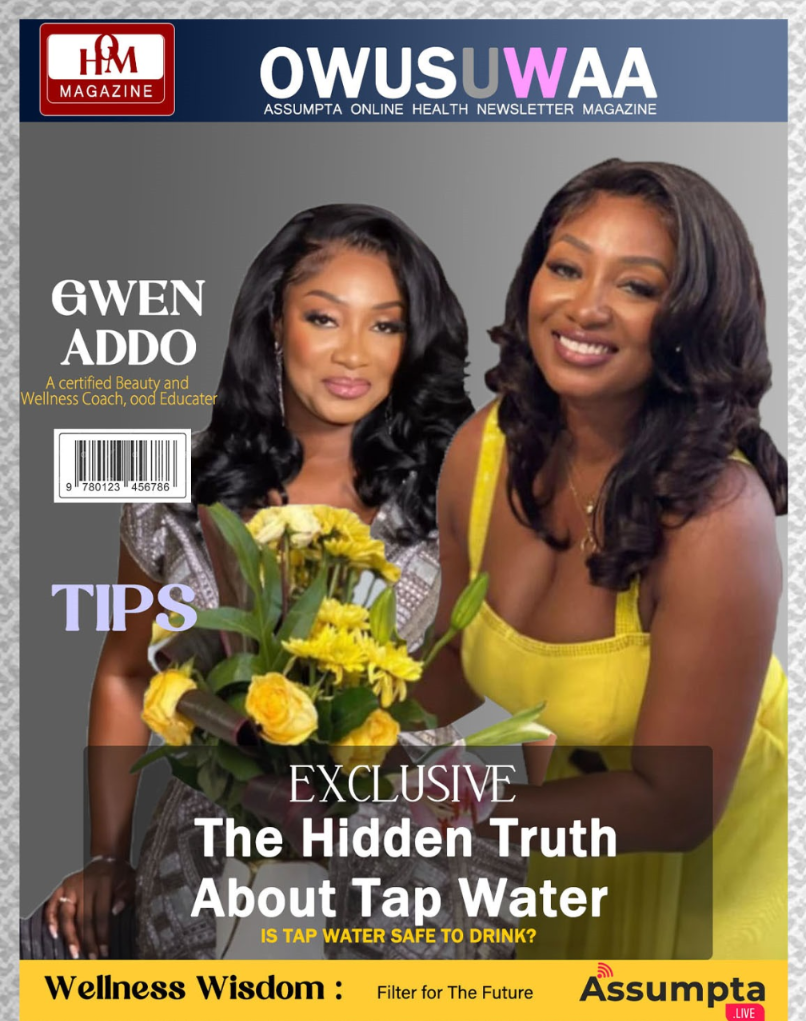
Presents Owusuwaa Health Magazine
A Vision Beyond Walls
Featuring: Gwen Addo

Certified Entrepreneur • Wellness Coach • Food Educator • Co-Founder of Owusuwaa WeeklyAs founder of Hair Senta, HIBS-Africa, and TLS—The Leading Senta, Gwen Addo is more than a business strategist:
She is a movement-builder shaping communities where health, beauty, and wellness are not luxuries—but rights.
Her mission is clear:
- 🌿 Empower everyday people with practical wellness tools.
- 🌟 Inspire young minds to become active contributors to a healthier future.
- 🤝 Redefine business as a community hub—a place of connection, trust, and transformation.
“Cultural exchange is at the heart of this vision.
It creates ripples of connection that unite hearts,” Gwen reflects.
For her, health is culture—and culture is a boundless force for growth.
This Week’s Feature: The Hidden Truth About Tap Water
Guest Conversation: Gwen Addo x Berla Mundi


In this exclusive wellness talk, Gwen Addo joins Berla Mundi—renowned Ghanaian broadcast journalist and global media voice—to uncover a topic many overlook:
how chlorine in everyday water may quietly affect our health and vitality.
The Science Behind Chlorine Exposure
Did you know that showering for just 10 minutes in regular city water can expose you to the same amount of chlorine found in 11 glasses of chlorinated water?
Here’s how a simple home test demonstrates it:
- Fill a glass with regular tap water and measure its chlorine level.
- Place your hand in the water for 30 seconds, remove it, and measure again.
- The chlorine level drops dramatically.
So where did it go?
👉 Much of it evaporated into the air, and a small amount was absorbed through your skin.
While chlorine plays a vital role in keeping water free from harmful bacteria, long-term exposure—especially through skin and inhalation—can irritate sensitive skin and may impact thyroid health in vulnerable individuals.
Wellness Wisdom: Filter for the Future
- Choose filtered water for both drinking and bathing.
- If a full-home system isn’t an option, start small—install a carbon shower-head filter.
- Support your body with iodine-rich foods (like seaweed, eggs, and fish) to keep your thyroid balanced.
- Remember, small choices today shape long-term wellness tomorrow.
🌱 Good Health Is Universal
Health remains our most precious possession—more valuable than wealth or power.
By understanding what flows through our taps, we reclaim not only control over our health but also our connection to nature, culture, and community.
Owusuwaa Weekly Health Magazine invites you to take one simple action this week:
✨ Drink wisely. Shower consciously. Live intentionally.
The Hidden Truth About Tap Water
Did you know that showering for just 10 minutes in regular city water can be equivalent to drinking 11 glasses of chlorinated water?
Here’s what research shows:
Take a glass of regular tap water — measure its chlorine level.
Now, place your hand in the water for 30 seconds, remove it, and measure again.
Surprisingly, the chlorine is gone.
Where did it go?
➡️ It was absorbed through your skin — directly into your body. This is why it’s important to filter your water — not only for drinking, but also for bathing and showering. If a full home filtration system is out of reach, consider installing a carbon filter on your shower head.
Remember: Chlorine is a halogen, a chemical known to disrupt thyroid function and affect overall health.
Protect yourself and your family — choose clean, filtered water every day. 💧✨
HAIR SENTA ADVERTISEMENT







https://www.instagram.com/hairsenta?utm_source=ig_web_button_share_sheet&igsh=ZDNlZDc0MzIxNw==
The Hidden Truth About Your Shower: A Simple Filter for a Healthier Home
Why the water you bathe in matters as much as the water you drink. A warm morning shower is meant to be a moment of pure rejuvenation. But what if that familiar, clean scent of city water is carrying a hidden cost?
Did you know that showering for just 10 minutes in regular city water can be equivalent to drinking 11 glasses of highly chlorinated water? That’s because your skin—your body’s largest organ—is rapidly absorbing and inhaling everything it touches.
The Science of the Vanishing Act
The key insight that changes everything is how chlorine enters the body. The classic demonstration is simple:
Take a glass of regular tap water and measure its chlorine level. Place your hand in the water for 30 seconds, remove it, and measure again. The chlorine is often gone.
Where did it go? It was absorbed directly through your skin. Even more critically, the heat of your shower causes chlorine to vaporize, meaning you are also inhaling concentrated chlorine gas and its byproducts (like chloroform) directly into your lungs. Both dermal absorption and inhalation bypass the liver and kidneys, delivering these compounds straight into your bloodstream.
The Health Link: Chlorine is a halogen known to potentially disrupt thyroid function and is a common culprit behind chronic dry skin, irritated eyes, and brittle hair. Reducing this exposure is a simple, powerful step toward protecting your overall health.
Reader Voice: “I Felt the Difference”
”For years, my morning shower left me feeling clean, but my skin was always dry, itchy, and tight. I had accepted it as normal—just the price of city water. I thought, I don’t drink the tap water, so I’m safe.
Then I learned the hidden truth: in the heat of my shower, I wasn’t just soaking up the water; I was breathing in the chlorine vapor.
When the Owusuwaa Health team explained that the chlorine is rapidly absorbed through the skin and lungs, and enters the bloodstream directly, it clicked. It wasn’t just my skin reacting; it was my whole body absorbing the chemical. I installed a simple carbon filter on my shower head. The change was immediate. My skin is calmer, my hair feels softer, and I no longer feel that dry, tight ‘chlorine hangover.’ Filtering my shower wasn’t about safety—it was about a new level of wellness I didn’t know I was missing.”
— Ama B., Accra Reader
🌿 Wellness Wisdom: Filtering for the Future
Protecting your family’s health doesn’t have to break the bank. Here are two ways to choose cleaner, filtered water every day:
| Option | Description | Why it’s great |
| \text{\(\mathbf{\text{💰 Budget-Friendly Upgrade}}\)} | Install a carbon filter on your shower head. | A quick, easy, and affordable DIY fix that significantly reduces chlorine exposure where it matters most: in your shower. |
| Premium Investment}}\)} | Invest in a whole-house filtration system. |
Health is Heritage: Our ancestors drew health from the purest streams of nature. Today, filters are our modern calabash—a simple tool to safeguard the wellness of our homes.
Share Your Story: How do you filter your wellness at home? Share your story at #OwusuwaaHealth
Coming Next Week: The Healing Power of Indigenous Nutrition—why African herbs are the next frontier of global wellness.
Global Introduction for Our Readers
Before we dive into our exclusive interview, let’s introduce the two inspiring women at the heart of today’s dialogue:

- Berla-Mundi (Berlinda Addardey): A powerhouse in Ghanaian media, Berla-Mundi is a celebrated broadcaster, TV host, and entrepreneur. Known for her eloquence, professionalism, and warm demeanor, she has carved a niche as one of the most respected voices in West Africa. Her influence spans entertainment, youth advocacy, and social commentary, making her the perfect host to guide nuanced discussions on wellness and societal impact.
- Gwen-Addo (Gwen Gyimah Addo): A formidable force in African entrepreneurship and wellness advocacy. Gwen-Addo is the visionary founder behind several successful ventures, including Hair Senta (a leading hair and beauty brand) and HIBS-Africa (Hair, I-Care, Beauty, and Spa). As a certified wellness coach and co-founder of Owusuwaa Weekly, she transcends traditional business, dedicating her life to transforming health, beauty, and entrepreneurial mindsets across the continent.
The Dialogue: A Vision Beyond Walls

Berla-Mundi: “Good evening, and welcome to a very special edition of Assumpta Weekly Magazine! Our focus is always on empowering you, our global reader, with knowledge that truly matters. Tonight, under our Special Feature: Owusuwaa Health, and our Spotlight Article: The Hidden Truth About Tap Water, we embark on a journey that challenges our everyday assumptions.”
Gwen-Addo: “Thank you, Berla. It’s an honor to be here. I’ve always admired the platform you’ve created—one that doesn’t shy away from important, even uncomfortable, truths. Thank you for inviting me to share this space with you and all the readers worldwide.”
A Vision Beyond Walls: Featuring Gwen Addo
Berla-Mundi: “It is truly our pleasure, Gwen-Addo. For our international audience, I want to take a moment to properly frame who you are, because you are much more than a business strategist—you are a movement-builder shaping communities where health, beauty, and wellness are not luxuries, but rights.”
”As a Certified Entrepreneur, Wellness Coach, Food Educator, and Co-Founder of Owusuwaa Weekly, and the brilliant mind behind Hair Senta, HIBS-Africa, and TLS—The Leading Senat, your mission is clear: you empower everyday people with practical wellness tools; you inspire young minds to become active contributors to a healthier future; and crucially, you redefine business as a community hub—a place of connection, trust, and transformation. You often say, and I quote, ‘Cultural exchange is at the heart of this vision. It creates ripples of connection that unite hearts. For you, health is culture—and culture is a boundless force for growth.’”
”In this week’s exclusive wellness talk, you join Ghanaians and myself to uncover a topic many overlook: how chlorine in everyday water may quietly affect our health and vitality.“
”As we are confronted with this danger, we must acknowledge that in the beginning, we as humans never thought that at a certain point in our existence, we would have to treat our most essential resource—water—with chemicals that pose a threat to our health. What are your initial thoughts on this fundamental paradox?“
Gwen-Addo: “Berla, you’ve hit the nail on the head with the word paradox. It is perhaps one of the most frustrating ironies of modern public health. Our ancestors revered water; it was life, purity, and spirit. Now, we are forced into a situation where we must trade one danger for another. On one hand, you have the very real and devastating threat of waterborne diseases like cholera and typhoid, which historically claimed millions of lives. The use of chlorination was a monumental step forward—a public health victory that dramatically reduced these fatalities.”
”However, the fundamental shift in our thinking is what concerns me most. We moved from simply accessing clean water to treating it with a powerful disinfectant. We didn’t solve the issue of a clean, natural source; we created a continuous chemical fix. My thought on this paradox is one of urgent re-evaluation: Are we so reliant on a single, aging solution (chlorination) that we are ignoring its long-term, subtle, systemic costs? When a life-saving measure—like chlorine—begins to show evidence of creating potential health stressors down the line, we have a cultural and ethical responsibility to seek safer, more sustainable, and truly clean alternatives.”
The Silent Threat: Chlorine and Disinfection Byproducts

Berla-Mundi: “That sense of urgent re-evaluation is precisely why we feature this topic. Gwen, when most people turn on their taps, they trust the system. They smell the faint chlorine and think, ‘This is safe; this is clean.’ But your work with Owusuwaa Health emphasizes the hidden truths. Can you elaborate for our readers on the specific health concerns related to chlorine itself, and more importantly, the chemical byproducts it creates once it interacts with organic matter in the water?“

Gwen-Addo: “Absolutely. This is where the simple narrative breaks down, and the science becomes critical. The danger isn’t just the chlorine we add; it’s what the chlorine creates. When chlorine reacts with naturally occurring decaying vegetation, soil runoff, and other organic matter in the water source—which is virtually unavoidable—it forms a class of compounds called Disinfection Byproducts (DBPs).”
”The most well-studied and concerning of these DBPs are the Trihalomethanes (THMs), which include chloroform, and Haloacetic Acids (HAAs). The problem is twofold:”
- 1. Long-Term Exposure Risks: DBPs, particularly THMs, are classified as potential human carcinogens by many international health bodies. Studies have consistently linked long-term exposure to these compounds—from drinking, cooking, and even showering—to an increased risk of certain cancers, specifically bladder cancer. Furthermore, there are growing concerns about potential links to liver, kidney, and central nervous system problems, and reproductive or developmental issues.”
- 2. Absorption Pathways Beyond Drinking: People often focus only on the water they drink, but we absorb more chlorine and DBPs through other routes. When you take a hot shower or bath, the chlorine and DBPs vaporize into the air. We inhale these chemicals—a much more direct route to the bloodstream and organs—and our skin also absorbs them. Think about the effect on hair and skin over time: dryness, irritation, and stripping away natural oils. It’s not just a drinking problem; it’s a whole-house exposure issue.”
”We introduced chlorine to eliminate immediate threats, which it does effectively. But now we are facing a chronic, low-level chemical exposure challenge that affects our cellular health and vitality over decades. This is why our advocacy for water filtration and purification is so relentless: it’s about mitigating the unintended consequences of a necessary, but ultimately flawed, public health intervention.”

Berla-Mundi: “That shifts the perspective dramatically, making the bathroom and shower perhaps as important as the kitchen tap. If these DBPs are present, and people are exposed daily, what are the practical, accessible steps that individuals and communities can take immediately to reduce their exposure without compromising the safety achieved by initial chlorination?“
Gwen-Addo: “That’s the empowering question. The good news is that we don’t have to wait for large-scale infrastructure change; individual action makes a massive difference.”
Practical Steps for Reducing Water Toxin Exposure
Gwen-Addo: “The core principle is filtration and ventilation. We need to install barriers between the tap water and our bodies, and we need to reduce the airborne vapor concentration. These steps are accessible and can be implemented right away:”
1. Focus on Point-of-Use Filtration (POU)
- The Kitchen Sink: For drinking and cooking, the most effective solution is a Carbon Filtration System. Activated carbon filters are highly effective at attracting and trapping chlorine, THMs, and other organic contaminants.
- Options include: Pitcher Filters (a budget-friendly start, though slower), Faucet-Mounted Filters (easy to install), or Under-Sink Filtration Systems (the most comprehensive for drinking water).
- The Shower: Since we inhale and absorb chemicals in the shower, a Shower Head Filter is crucial. These are inexpensive, easy to replace, and specifically designed to reduce chlorine exposure in hot water. This can often lead to softer skin and hair immediately.
2. Simple Water Management: The Decanting Method
- For those without access to advanced filters, especially in developing regions, a simple technique can help reduce free chlorine (not the DBPs, but the initial chlorine).
- Fill a large, open container (like a clean bowl or jug) with tap water and let it sit uncovered for at least 24 hours. Because chlorine is a gas, it will naturally dissipate into the atmosphere. This won’t remove DBPs, but it makes the water less harsh and is a vital, low-cost step.
3. Prioritize Ventilation During Hot Water Use
- Open a Window: Always ensure proper ventilation when running a hot bath or shower. Since the hot water causes chlorine and DBPs to off-gas (volatilize), opening a window, running an exhaust fan, or keeping the bathroom door ajar significantly reduces the concentration of these harmful vapors you inhale.
4. Smart Cooking Techniques
- When cooking with tap water, if you are boiling water (for pasta, rice, etc.), you are effectively off-gassing some of the chlorine. While this is helpful, it’s best to start with filtered water for the highest quality beverages and stocks, which concentrate nutrients and flavors.
”These steps move the power back into the hands of the individual. As a wellness coach, I emphasize that health starts with what we consume and what we are exposed to in our immediate environment. Filtering our water is not a luxury; it’s a foundational act of self-care and disease prevention.”

Berla-Mundi: “That is incredibly valuable, actionable advice, Gwen. You’ve given us the problem, the science, and the practical solutions. But let’s broaden this from the personal to the community. You are a movement-builder. How can organizations like Owusuwaa Weekly and figures like yourself inspire communities and policymakers to push for systemic changes—perhaps investigating alternative, non-chlorine disinfection methods—to secure a truly pure water future?“

Gwen-Addo: “That, Berla, is the ultimate goal, and it requires a multi-pronged strategy rooted in education and advocacy.”