








Assumpta Weekly Newsletter
Special Edition | Thursday, 28 May 2026
Presents: “The Grand Chef”
A Global Call to Wisdom in Leadership 🛎️
This special edition features an exclusive feature that invites contemporary global leaders to move beyond surface-level success and return to what truly sustains societies: genuine human wellbeing. Using the powerful metaphor of The Grand Chef, we explore a leadership philosophy rooted in care, dignity, and the profound power of belonging.
📅 COMING WEDNESDAY | 13th MAY 2026
🌐 Read the Full Feature: assumptagh.live/
🏛️Hosted by a Ghanaian lcon Presented by Cookieteegh- acclaimed media personality, philanthropist, and CEO of Nineteen57 Events, widely recognised as a co-host on TV3S New Day.











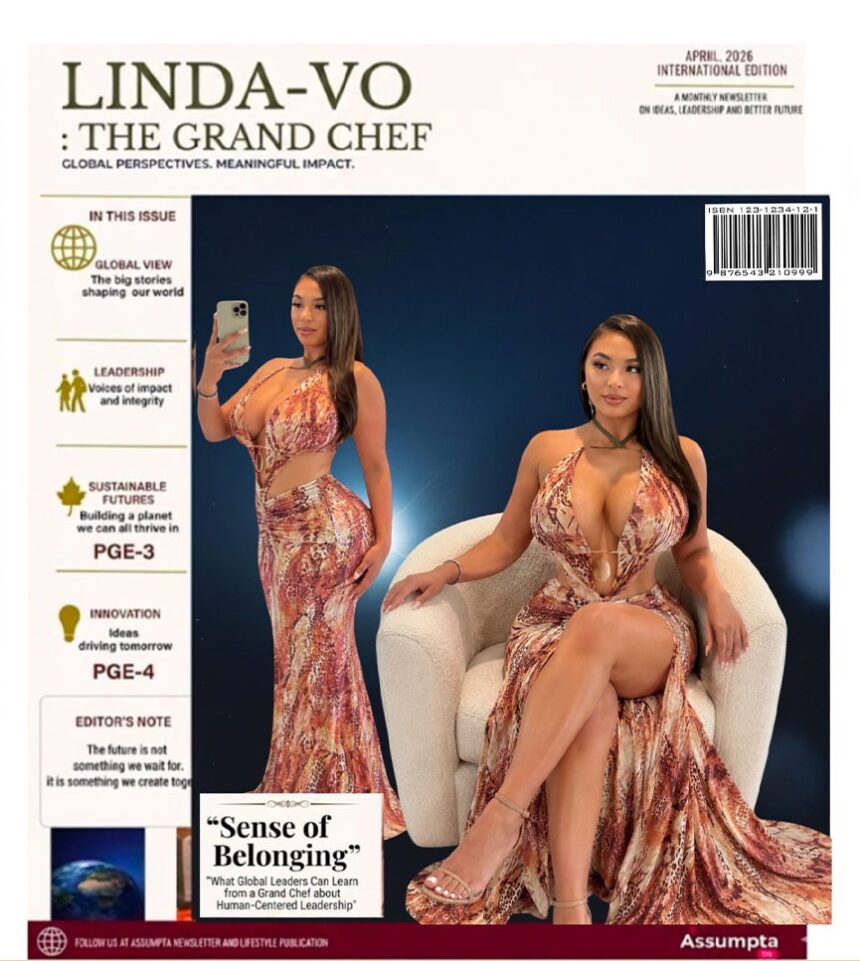
The Sense of Belonging
Where Leadership, Care, and Human Connection Meet
By Assumpta Weekly | Leadership & Wisdom Series
In an age when leadership is often measured by visibility, speed, and scale, the essential human purpose of leadership is at risk of dilution. Metrics dominate conversations, while meaning, dignity, and belonging can quietly disappear from boardrooms and institutions. Yet, the most sustainable forms of leadership have always drawn their strength not from spectacle, but from care.
This is where the philosophy of The Grand Chef offers an unexpected yet powerful lesson.
At LINDA‑VO, Linda VO — known by many as “The Grand Chef” — leads not through authority or hierarchy, but through intention. Her philosophy is simple, yet profound: the ultimate goal of any system, whether culinary or corporate, is human happiness.

Leadership Begins with Wellbeing
Linda believes that the well-being of every individual matters just as much as the outcome. In her world, the experience of every guest is as vital as the quality of the meal served. In leadership terms, this reframes success: results are important, but how people feel within the system determines whether those results endure.
At LINDA‑VO, hospitality goes far beyond food. Care and comfort are not auxiliary services—they are embedded into the very identity of the space. This mirrors high-wisdom leadership: cultures where people feel supported, not managed; valued, not used.
Two Foundations of Human-Centred Leadership
Linda’s philosophy rests on two essential foundations that resonate far beyond the restaurant:
- The Individual Dimension: Every human being seeks dignity, autonomy, and a sense of control over their own life—especially those navigating physical, emotional, or personal challenges. For leaders, this means recognising people not as resources, but as whole individuals with lived realities.
- The Communal Dimension: The universal human need for belonging. People want to feel welcomed, understood, and respected within the systems they inhabit. Organisations that fail to cultivate this sense of belonging may function, but they rarely flourish.
Food as a Metaphor for Decision-Making
In Linda’s kitchen, every ingredient is carefully chosen for its freshness and nutritional value. She believes that food should do more than satisfy hunger; it should nourish the body, uplift the spirit, and provide comfort.
For leaders, food becomes a metaphor. What are we feeding our organisations—fear or trust, pressure or purpose, short-term gains or long-term wellbeing? Just as poor ingredients lead to unhealthy outcomes, poor decisions erode human systems over time.
Space as a Statement of Values
Linda understands that people connect with their environments in different ways. Her restaurant reflects this awareness through thoughtfully designed spaces that accommodate diverse lifestyles, such as the elegant, inclusive smoking lounge—a deliberate space created not to judge, but to include.
In leadership, space is not only physical; it is cultural. Leaders design spaces every day through policies, behaviours, and unspoken norms. Are these spaces safe? Inclusive? Human? The environments we create silently communicate who and what truly matters.
The True Measure of Leadership
At LINDA‑VO, people do not simply arrive to eat. They arrive to feel seen, respected, and connected. The same standard applies to leadership.
True leaders do not simply direct outcomes; they create conditions where people can belong, contribute, and thrive. In a world hungry for meaning, the wisdom of The Grand Chef reminds us that leadership, like hospitality, is ultimately an act of service.
The defining question for today’s global leaders is this:
When people leave our organisations, do they leave feeling nourished—or merely processed?
Explore More at assumptagh.live/


The Global Leadership Dialogue
Feature: The Sense of Belonging
Theme: What Global Leaders Can Learn from a Grand Chef about Human-Centred Leadership
Host: Cookieteegh
Guest: Linda VO (“The Grand Chef”)
Location: Global Broadcast | Assumpta Weekly Special Edition
The Opening
Cookieteegh (Host):
Warm greetings to our readers and viewers around the world—from every continent, culture, and calling. It is a privilege to welcome you to this special global dialogue, hosted by Assumpta Weekly, where leadership, wisdom, and humanity intersect.
Today, I am especially honoured to welcome a remarkable guest—Linda VO. Linda, it is a pleasure to have you with us, and thank you for joining this conversation.
For our global audience, allow me to introduce Linda VO.
Linda VO is a hospitality visionary and culinary figure whose philosophy centres on care, wellbeing, and human connection, expressed through both food and environment. Known widely as “The Grand Chef,” Linda believes that a restaurant should be far more than a place to eat—it should be a place where people feel seen, valued, and restored.
Her approach beautifully combines nutritious cooking, emotional comfort, and social inclusion, creating what she calls a “sense of belonging” for every client and guest.
At the heart of her philosophy are two essential ideas:
- Individual Wellbeing: Respecting each person’s dignity, comfort, independence, and personal preferences.
- Community and Belonging: Creating welcoming spaces where people feel accepted, relaxed, and genuinely connected.
Through LINDA‑VO Restaurant, Linda emphasises fresh and nutritious ingredients that support healthier living, elegant spaces designed for social interaction, and hospitality rooted in emotional wellbeing. In this dialogue, Linda VO represents a modern hospitality identity where food, atmosphere, and human happiness are treated as equally essential to the experience.
The Dialogue Begins
Cookieteegh:
Linda, welcome. This special edition features an exclusive piece that invites contemporary global leaders to move beyond surface-level success and return to what truly sustains societies: genuine human wellbeing.
Using the powerful metaphor of The Grand Chef, you explore a leadership philosophy rooted in care, dignity, and the profound power of belonging. In a world increasingly overwhelmed by the politics of appearance and performance-based leadership, one question remains unanswered: Who is truly serving humanity?
Your article dares global leaders to rethink power, presence, and purpose. You write that leadership is not “fast food.” Through your lens, leaders are challenged to study leadership the way a master studies a menu—with intentionality, patience, responsibility, and care.
In the leadership landscape of 2026, service is no longer a philosophical debate; it has become an existential necessity. As global institutions wrestle with leadership by performance—where growth metrics often mask human depletion—you argue that the way forward lies with those who lead through the lens of Human Sustainability.
According to your philosophy, true service is not found in the spectacle of authority, but in the quiet, intentional act of nourishment. You describe a widening leadership divide in 2026 between leaders who perform and leaders who truly serve:
- Performance vs. Peace: One prioritises visibility and scaling; the other prioritises long-term human happiness and peace.
- Resources vs. Individuals: One treats people as resources to be managed; the other sees individuals to be nourished.
- Reactive vs. Resilient: One reacts to crises with damage control; the other summons hardship to build resilience.
- Elitism vs. Empowerment: One clings to prestige and elitism; the other fosters and entrusts the youth.
You speak of radical pacifism—not as passivity, but as courageous leadership that refuses to fear hardship. You speak of the architecture of belonging—where service is measured by whether people feel seen, respected, and restored within systems of power. And you speak of intergenerational trust—where the ultimate act of leadership is the willingness to let go and prepare others to lead.
So, Linda, let me ask you—and I ask this on behalf of leaders everywhere:
In a world of AI-driven efficiency and geopolitical volatility, is the true test of leadership this question: When people leave my presence, are they merely processed—or are they replenished?
And in 2026, are those leaders who can honestly answer “replenished” the ones truly steering our world toward peace?
The Response: A Philosophy of Presence
Linda VO | The Grand Chef
Linda VO:
Thank you, Cookieteegh—and warm greetings to our readers across the world. I receive this dialogue with deep humility and gratitude. When conversations like this are held, it reminds me that leadership, like hospitality, is ultimately an act of listening before it is an act of speaking.
To your question—who is truly serving humanity?—I would say this: those who serve are often the least visible. True service does not announce itself loudly. It happens quietly, intentionally, and consistently, in the choices leaders make when no audience is watching.
The Discipline of Nourishment
When I say leadership is not “fast food,” I speak from lived experience. Fast food is convenient, attractive, and designed for speed—but it is rarely nourishing. In the same way, leadership by performance is efficient, impressive, and measurable, yet it often leaves people depleted. Human beings are not systems to be optimised alone; they are lives to be sustained.
In my kitchen, every ingredient matters. I study its origin, its effect on the body, and its harmony with other elements. Leadership requires the same discipline. Before acting, a leader must ask:
- Will this decision nourish or exhaust?
- Will it create dignity or dependency?
- Will it strengthen tomorrow, or merely satisfy today?
The Architecture of Belonging
You spoke of human sustainability, and this is where my philosophy rests firmly. Feeding people well is not about indulgence; it is about responsibility. Likewise, serving societies well is not about power; it is about stewardship.
Belonging, in my understanding, is architecture. It must be designed deliberately. When people enter a restaurant—or an organisation, or a nation—they should feel safe enough to breathe, respected enough to be themselves, and valued enough to stay. If a space strips a person of dignity, no amount of success can justify it.
Resilience and Succession
Radical pacifism, as you mentioned, is not softness. In the kitchen, heat is constant—yet we learn to work with it, not against it. Leaders who refuse fear, who remain grounded in compassion during hardship, are not weak. They are resilient. They are preparing people to endure, not merely to obey.
And yes, intergenerational trust is the final test. A true Grand Chef teaches others to surpass her. A true leader does not hoard authority; they distribute capability. Any leadership that is afraid of the youth is already exhausted.
The Foundation of Peace
So when you ask whether those who leave people replenished are the ones steering the world toward peace, my answer is this: peace does not begin at negotiation tables—it begins in how people are treated daily.
When individuals feel nourished, respected, and included, they defend peace naturally. When they feel processed, ignored, or diminished, conflict becomes inevitable.
The Final Inquiry
Leadership in 2026 must stop asking, “How powerful do I appear?”
It must begin by asking, “How whole are the people in my care?”
That, to me, is service. And that is the quiet work of belonging.
The Dialogue Continues: Strength Under Restraint
Host Perspective & Core Inquiry
Cookieteegh (Host):
Linda, thank you for that profound response. What strikes me most is your insistence that service is often invisible—that the work which sustains people is rarely accompanied by applause. Your words remind us that leadership, like hospitality, is revealed not in moments of performance but in moments of pressure.
You spoke about resilience, and I would like to reflect on that with a short story.
I once observed a small kitchen during a period of intense demand. Orders were relentless. The heat was unyielding. What amazed me was not speed, but calm. Instead of fighting the heat, the chef adjusted pace, repositioned flames, communicated clearly, and conserved energy. The kitchen did not panic—it adapted. And by the end of the service, not only were the plates excellent, but the people were still standing.
That moment stayed with me. Because resilience is not about avoiding pressure; it is about learning how to work with heat without burning people out.
This is why your phrase resonated deeply: radical pacifism is not softness. It is strength under restraint. It is a discipline that refuses to collapse into fear or aggression. And what you said about succession is equally powerful—that a true Grand Chef trains others to surpass her. In leadership, that is still rare. Too many structures prepare systems to survive leaders, but not people to replace them.
The Three Essential Questions
Which brings me to three essential questions I would like you to help us unpack. Linda:
I. On Radical Pacifism
When you speak of radical pacifism—not as passivity, but as courageous leadership—what does that truly mean in practice for leaders operating in volatile, competitive, and often hostile environments?
II. On the Architecture of Belonging
You introduced a beautiful idea—the architecture of belonging. How do leaders intentionally design this architecture within organisations, governments, or communities? What does it look like when belonging is not accidental, but built?
III. On Intergenerational Trust
In a world where power is often clung to, how can leaders genuinely build intergenerational trust? How do they prepare, empower, and entrust the youth without fear—and without losing their own sense of relevance?
I invite you to take us deeper into these ideas, because the future of leadership may depend on how honestly we answer them.
The Response: Mastering the Heat
Linda VO | The Grand Chef
Linda VO:
Thank you, Cookieteegh. Your story captures something essential—not just about kitchens, but about leadership itself. Pressure is unavoidable, but harm is not. Let me respond to your questions with that spirit.
I. On Radical Pacifism
When I speak of radical pacifism, I do not mean avoidance of conflict or refusal to engage with reality. I mean something far more demanding: Radical pacifism is the discipline of remaining human under pressure.
In volatile environments, leaders are often tempted to react quickly, to dominate situations, or to harden themselves emotionally in the name of efficiency. Pacifism resists that instinct. It chooses containment over explosion, and presence over panic. Practically, this means:
- Refusing to lead by fear, even when fear would deliver faster obedience.
- Rejecting humiliation as a tool for control.
- Choosing calm clarity over emotional volatility.
This is not weakness; it is strength refined. Leaders who stay centred when everyone else is reactive create stability—and stability is the foundation of peace.
II. On the Architecture of Belonging
Belonging does not happen by chance. It is designed. When I speak about the architecture of belonging, I am talking about the intentional construction of spaces—physical, emotional, and cultural—where people feel safe enough to exist as they are.
In leadership, belonging is built when:
- Systems restore dignity, rather than erode it.
- Policies recognise human limits, rather than deny them.
- Diversity is valued as richness, not tolerated as an inconvenience.
When someone enters an organisation and feels immediately small, anxious, or replaceable, belonging has failed—no matter how impressive the structure looks. A leader must ask: Do people have space to breathe, speak, and grow? If the answer is yes, trust follows. When trust exists, people contribute far more than compliance—they bring commitment.
III. On Intergenerational Trust
Intergenerational trust is perhaps the most difficult—and most necessary—form of leadership work today. It begins with humility. A Grand Chef knows when her role changes: from performing to mentoring, from leading every step to guiding from the side.
Leaders build intergenerational trust when they