








📰 Assumpta Newsletter | Special Edition
PRESENTS: PUBLIC BETRAYAL
Release Date: Friday, May 8, 2026
Access: assumptagh. live
This Week’s Guest Feature
Article Title: How Broken Systems Turn Africans Against Africans.
Subtitle: Why Africa Must Choose Compassion Over Division
🗓 MARK YOUR CALENDAR Friday, May 8, 2026 Exclusively at assumptagh. live
HAIR SENTA ADVERTISEMENT














https://www.instagram.com/hairsenta?igsh=MXAzOThhNGZ0Nm15dQ==
💖 Discover the Power of Confidence with Hair Senta! 💖
Hair Senta Shopping & Retail: Ghana’s Finest Hair, Loved Worldwide
Hair Senta, a trusted, trademarked leader in beauty, proudly delivers the finest Human Hair Extensions from Ghana to a global audience. We believe true beauty goes beyond appearance. Our premium extensions are designed to inspire a new era of beauty, confidence, wellness, and hope for women everywhere.
Feel the quality, embrace the transformation, and step boldly into your most radiant self!
Connect With Us Today!
📞 Call Us:
(+233) 054 435 4455
(+233) 024 862 9769
🌐 Visit Us Online:
www.hairsenta.com�
📍 Find Our Store:
24 Jungle Avenue, Accra, Ghana 00233
If you’d like, I can also tailor this advertisement for Instagram, Facebook, print media, or a website banner—just let me know!
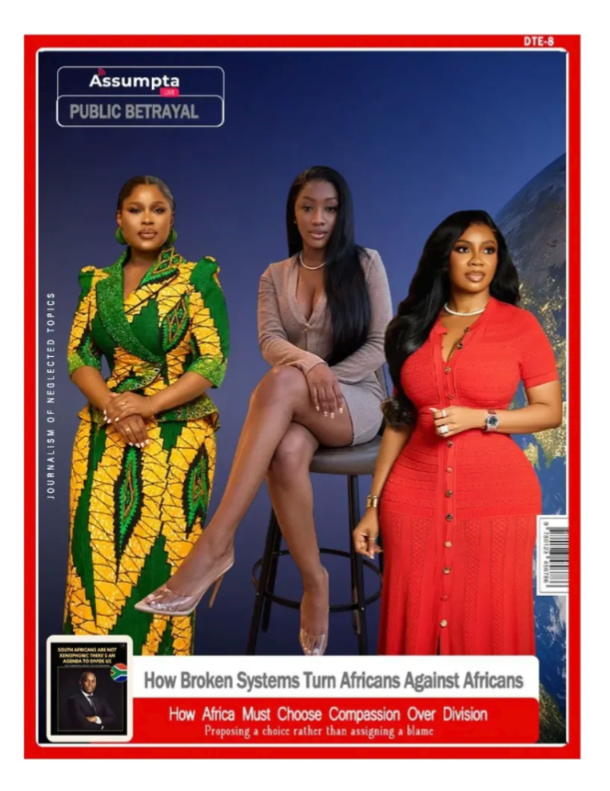
The Core Inquiry
In an era of unprecedented connectivity, why are our global institutions failing to protect our shared humanity? This edition dives into the uncomfortable truths behind the headlines:
• Institutional Decay: Analysing the widening chasm between United Nations principles and tangible global action.
• A Moral Crossroads: Will the world’s powers continue to compete for dominance—or will they finally choose to compete for the preservation of human life?
This Week’s Guest Feature
Anchored by the acclaimed Berla Mundi, this special edition hosts a high-level dialogue on the erosion of global responsibility and the high price of institutional failure.

Two distinguished legal voices join us:

- Serwaa Amihere, Esq. (Ghana)

- Assumpta Gahutu, Esq. (Namibia)
Why It Matters
Public to Betrayal is more than an interview; it is a challenge to leaders, legal minds, and citizens alike to confront the consequences of inaction. It asks us to redefine what it means to lead in a world that has grown comfortable with the “cost of silence.”
Ubuntu, Pan‑Africanism, and the Cost of Losing Compassion
Recent attacks and hostility toward immigrants in South Africa have once again forced Africa to confront uncomfortable questions about identity, humanity, leadership, and Pan‑African solidarity.
Do Africans still live by Ubuntu — the conviction that “I am because we are”?
Across the continent, many people were deeply disturbed by images of violence, protests, and anti‑immigrant rhetoric directed at fellow Africans living in South Africa. For those who believe Africa’s future depends on unity rather than division, these scenes generated pain, fear, and disappointment.
At the same time, it is neither accurate nor just to condemn an entire nation for the actions of some individuals. Xenophobia exists — and its victims are real — but broad accusations risk obscuring deeper truths and reinforcing new divisions.
South African entrepreneur Vusi Thembekwayo, responding to allegations of widespread xenophobia, argued that the issue is sometimes amplified or politicised in ways that set Africans against one another. While acknowledging that violence and discrimination do occur, he cautioned against labelling all South Africans as xenophobic. His position highlights a critical point: Africa cannot build its future through fear, suspicion, or hostility among black people themselves.
What Africa urgently needs is not denial or defensiveness, but a renewed commitment to Ubuntu, Pan‑African consciousness, compassion, courage, and self‑awareness.
For generations, Africans were told that their cultures were primitive, their traditions inferior, and their institutions incapable of progress. Colonial systems often pushed societies away from communal values and toward models rooted in extraction, hierarchy, and competition. After independence, many African states inherited not only colonial borders but also institutions that weakened collective responsibility while intensifying inequality, dependency, and political fragmentation.
Yet pre‑colonial African societies were also built on powerful human principles: community, shared responsibility, hospitality, mutual respect, and dignity. In many cultures, visiting someone empty‑handed was considered disrespectful because relationships mattered more than transactions. Human connection mattered more than profit alone.
This is not romanticism. African societies were never free from corruption, injustice, or abuse of power. But many traditions were grounded in the understanding that humanity is interconnected — that one person’s dignity cannot be separated from another’s.
That understanding is the heart of Ubuntu.
The tragedy is that some African leaders have continued to nurture what might be called the evil tree: systems of corruption, division, dependency, fear, weak institutions, and political manipulation. Instead of healing historical wounds, these systems are often exploited for short‑term power. Instead of promoting Pan‑African solidarity, citizens are encouraged to blame one another while deeper structural failures remain untouched.
Economic hardship, unemployment, inequality, and frustration do not disappear under such conditions. They are simply redirected — toward immigrants, foreigners, and the most vulnerable — rather than toward the leadership failures and institutional weaknesses that produced them.
The question Africa must confront is not only how colonialism damaged the continent, but whether post‑independence leadership has done enough to rebuild compassion, courage, accountability, and collective confidence.
Have African societies invested sufficiently in civic education, historical literacy, and social cohesion? Have political leaders actively promoted unity across borders? Have citizens been empowered to see one another as partners in shared progress rather than competitors for survival?
Africa’s future cannot be built on fear between Africans themselves.
It must be built on Ubuntu, ethical leadership, accountability, Pan‑African cooperation, and active citizenship.
Africa’s greatest strength is not only its natural resources or youthful population, but its human values — the belief that the dignity of one African is inseparable from the dignity of all Africans.
Patriotism should never require the dehumanisation of others. Genuine progress will come when compassion is stronger than division, and when unity becomes a political and moral priority rather than an occasional slogan.
Introduction: A Choice of Two Traditions
Recent debates around migration and hostility in South Africa have reignited a profound conversation about the soul of the continent. While entrepreneur Vusi Thembekwayo has rightly cautioned against labelling an entire nation as xenophobic, the recurring friction between Africans has forced us to look at the deeper systems governing our behaviour.
At the heart of this tension lies a fundamental conflict between two opposing traditions.
In indigenous African cultures, human interaction is governed by a spirit of mutual respect and hospitality. There is a deeply rooted system where, if you visit your neighbour, you do not go empty-handed. This gesture is more than a social nicety; it is an acknowledgement of shared humanity and a rejection of transaction-based relationships. It is the practical application of Ubuntu.
In stark contrast stands the legacy of the Western colonial tradition—a system that historically demanded outcomes at “gunpoint.” This is a tradition rooted in extraction, where if the price cannot be paid, the burden is simply increased until the debtor breaks.
The tragedy of the post-independence era is that while we speak of liberation, many of our institutions still operate on this second, coercive model. Today, Africa stands at a crossroads. It is time for the continent to sit in contemplation of these two traditions and consciously pick one. We cannot claim a future of Pan-African solidarity while maintaining systems that treat our brothers and sisters as competitors or debtors. A tradition that brings its citizens to a point of predatory survival is not a tradition that can sustain a continent.
Key Context: Economic & Social Realities
To understand why the “tradition of the gun” or extraction still lingers, it is helpful to look at the structural pressures facing the region today. When resources are scarce and systems are extractive, Ubuntu is tested.
| Metric | South Africa Context (Approx. 2024-2025) | Impact on Solidarity |
|---|---|---|
| Unemployment Rate | 32% – 34% | High competition for entry-level jobs can fuel resentment. |
| Youth Unemployment | Over 44% | A large, frustrated population is more susceptible to populist rhetoric. |
| Gini Coefficient | 0.63 to 0.67 | Ranked as one of the most unequal societies in the world, heightening internal friction. |
| Migrant Population | ~2.9 million | Approximately 5% of the population; often scapegoated for systemic service delivery failures. |
By addressing these numbers through the lens of your “two traditions” argument, the piece moves from a moral plea to a sophisticated critique of how “pay at gunpoint” economics destroys the “culture of the gift.”
📰 Assumpta Newsletter | Special International Edition
PRESENTED BY: PUBLIC BETRAYAL
The Opening Dialogue

Berla Mundi (Host):
Good day to our readers around the world. Wherever you are joining us from — across Africa, throughout the Global South, or in the wider international community — welcome to this special edition of the Assumpta Newsletter, presented under the theme “Public Betrayal.”
It is a privilege to host this dialogue. My name is Berla Mundi. I am a Ghanaian media professional, broadcaster, and women’s advocate with TV3 Ghana, and I remain deeply committed to storytelling that elevates truth, responsibility, and African voices. Through my work in broadcasting and my B. Your initiative, I continue to engage young people — especially young women — on leadership, dignity, and purpose in an increasingly complex world.
Today’s edition invites us into a difficult but necessary conversation — one that crosses borders, disciplines, and historical memory.
Welcoming the Panellists
I am honoured to be joined by two distinguished panellists whose professional journeys reflect both intellectual rigour and lived engagement with Africa’s realities.

- From Ghana, we welcome Serwaa Amihere, Esq.
Serwaa is one of Ghana’s most respected broadcast journalists, a senior news anchor with GHOne TV, and a trailblazer in African media. In October 2025, she was officially called to the Ghana Bar, adding legal expertise to a career already marked by journalistic excellence. She is a three-time recipient of the RTP Award for Best TV Newscaster and the Chief Executive Officer of Oh My Hair, blending media influence with entrepreneurship.

- From Namibia, we welcome Assumpta Gahutu, Esq.
Assumpta is a legally trained professional holding a Bachelor of Laws degree from the University of Namibia, with experience within the magistrates’ court system. Beyond the legal field, she is also a widely recognised digital entrepreneur and public figure, known for her engagement across fashion, business, and youth-driven platforms. Her work reflects the intersection of modern African identity, professionalism, and enterprise.
To both of you — thank you for joining this dialogue.
The Feature Article
A Reflection on African History, Identity, and Afrophobia in South Africa

A little African history review reminds us that the story of Southern Africa did not begin with colonial borders, apartheid, or modern nationalism. Long before these systems existed, African communities were already moving, trading, intermarrying, and building civilisations across the continent.
Historical, linguistic, archaeological, and recent genetic studies continue to confirm that many Southern African ethnic groups — including the Zulu, Xhosa, Sotho, Tswana, Venda, and Tsonga peoples — trace deep ancestral roots to the great Bantu migrations that began near the Nigeria–Cameroon border region roughly 4,000 years ago. Over centuries, Bantu-speaking communities gradually spread across Central, Eastern, and Southern Africa, bringing agriculture, iron-working technology, language systems, and social structures that helped shape much of the continent.
By around 300 CE, some of these communities had reached present-day KwaZulu-Natal, while others settled in Limpopo by approximately 500 CE. Yet they did not arrive in an empty land. The San and Khoikhoi peoples had already inhabited Southern Africa for thousands of years before these migrations. African history, therefore, is not a story of one people replacing another, but of centuries of interaction, coexistence, adaptation, conflict, and cultural exchange.
Colonialism, Apartheid, and the Engineering of Division
Colonialism later disrupted these organic African connections. Under apartheid in South Africa, racial segregation was not only directed against Black South Africans internally, but also strategically designed to isolate them from the rest of Africa. White immigration into South Africa was encouraged to strengthen the apartheid state, while Black African immigration and continental solidarity were heavily restricted. Borders became political weapons. African unity became a threat to the regime.
For decades, apartheid policies severed cultural, economic, and intellectual ties between Black South Africans and other African nations. Many liberation movements across Africa supported the anti-apartheid struggle materially and diplomatically, yet apartheid propaganda simultaneously cultivated suspicion toward other Africans. The divide-and-rule strategy of colonialism created categories of belonging and exclusion that continued to shape social tensions long after apartheid officially ended in 1994.
Afrophobia in the Democratic Era
Since democracy, South Africa has experienced repeated waves of violence directed predominantly at Black African migrants. According to documented reports, xenophobic and Afrophobic attacks since 1994 have resulted in hundreds of deaths, thousands of businesses looted, and massive displacement. The major outbreaks in 2008, 2015, 2019, and recent years overwhelmingly targeted Black African migrants from countries such as Zimbabwe, Mozambique, Somalia, Nigeria, Ethiopia, Malawi, and the Democratic Republic of Congo.
Notably, these attacks have rarely focused on white European migrants or other economically influential foreign communities. This distinction has led many scholars, activists, and international observers to argue that the phenomenon extends beyond ordinary xenophobia. Increasingly, researchers describe it as “Afrophobia” — a hostility specifically directed toward Black Africans by fellow Africans.
The United Nations and several human rights organisations have documented cases where even South African citizens were attacked for appearing “too Black” or “too foreign,” revealing how deeply identity, language, class, poverty, and apartheid-era conditioning continue to influence perceptions of belonging.
Colonial Conditioning and Psychological Legacy
This raises an uncomfortable but necessary question: are these attacks simply xenophobia, or are they lingering psychological and structural consequences of colonial programming and apartheid social engineering?
Colonial systems across Africa often succeeded by fragmenting African identity — dividing people through ethnicity, nationality, language, and artificial borders. Apartheid intensified this process in South Africa through deliberate social isolation and racial hierarchy. When people are conditioned for generations to fear, compete with, or distrust those who resemble them, the effects do not disappear immediately with political freedom.
This does not remove individual responsibility for violence. But it does suggest that modern Afrophobia cannot be understood without examining the historical systems that manufactured separation among African peoples in the first place.
The Psychological Reality
The deeper tragedy is that many Africans attacking fellow Africans often share ancient ancestral connections that predate colonial borders by thousands of years. History reminds us that before passports and nation-states, African societies were already interconnected through migration, kinship, trade, and shared humanity.
Understanding this history i