







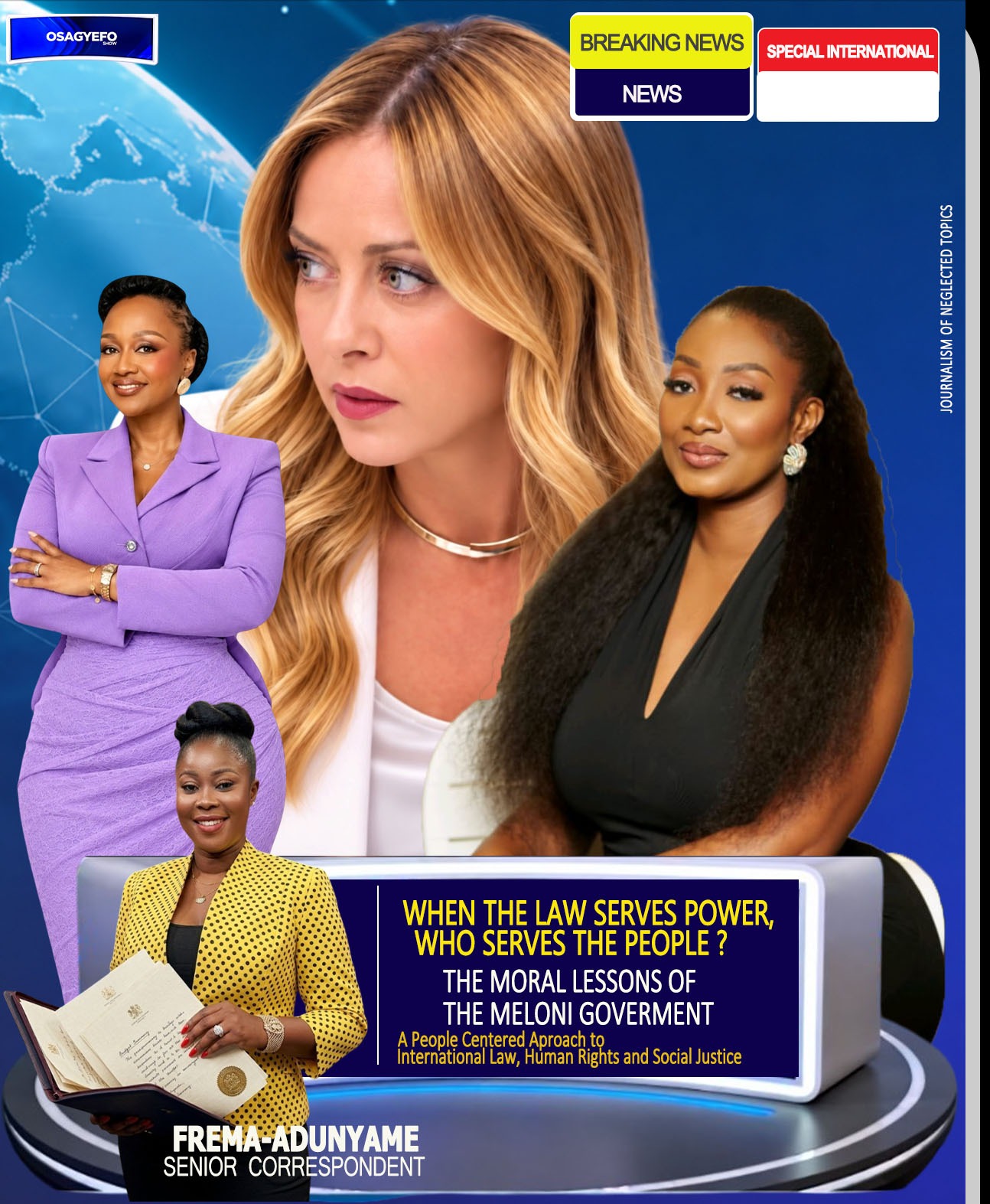

📰 OSAGYEFO NEWSLETTER MAGAZINE
PRESENTS “ONWARD” WITH FREMA ADUNYAME
A SPECIAL INTERNATIONAL EDITION
COMING MONDAY, 26 OCTOBER 2026
🌍 Worldwide Release — International Readers Edition
🌐 Read exclusively at: https://assumptagh.live/















.://www.instagram.com/hairsenta?rpxt=MXAzOThhNGZ0Nm15dQ==
Elevate Your Crown with The Hair Senta
Why settle for “good enough” when you can wear the gold standard? At The Hair Senta, we don’t just sell hair; we deliver the confidence that comes with knowing your look is flawless, authentic, and built to last.
Based in the heart of Accra and shipping globally, we’ve turned the art of human hair extensions into a world-class experience.
Why the World Chooses Hair Senta
- Actual Proof of Quality: No filters needed. Our extensions are sourced for longevity, natural lustre, and a seamless blend. Whether it’s raw or virgin hair, the quality is visible in every strand.
- The Confidence Factor: We believe your hair is your power. Our pieces are designed to give you that “just stepped out of the salon” feeling every single day.
- Unbeatable Value: Luxury shouldn’t be out of reach. We offer premium, trademarked quality at prices that respect your investment.
- Global Reach, Local Roots: From our flagship in Ghana to doorsteps in London, New York, and beyond—we bring the best of West African hair retail to the world.
Ready to Transform Your Look?
| Feature | What You Get |
|---|---|
| Origin | Premium Sourcing |
| Shipping | Worldwide Delivery |
| Location | 24 Jungle Avenue, Accra, Ghana |
| Status | Trademarked Excellence |
Get in Touch Today
Don’t wait for your best hair day—create it.
Visit Us: www.hairsenta.com
Call/WhatsApp: (+233) 0544354455 / 0248629769
In-Store: 24 Jungle Avenue, Accra, Ghana
“Your hair is the crown you never take off. Make sure it shines.”
TALY: WHEN THE LAW, PUBLIC MONEY AND SOCIAL JUSTICE COLLIDE
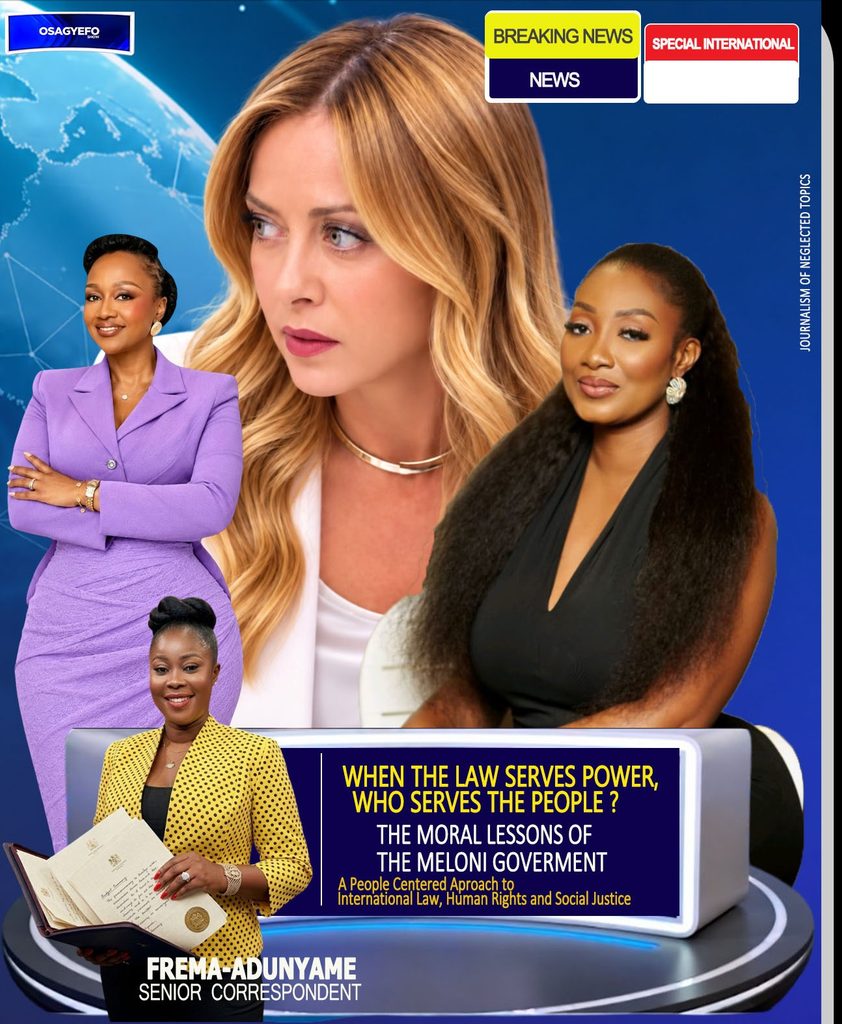
Who Does the System Serve—the Institution, the Powerful, or the People?
An investigation into judicial remuneration, political responsibility and the meaning of fairness in a democratic society.
THE PRINCIPAL ARTICLE
WHEN THE LAW SERVES POWER, WHO SERVES THE PEOPLE?
A People-Centered Approach to International Law, Human Rights and Social Justice
THEME: THE MORAL LESSONS OF THE MELONI GOVERNMENT
Equality • Human Rights • Public Money • The Rule of Law • The Responsibility of Leadership
When political decisions, legal obligations and the demands of social justice collide, what should guide a democratic government?
WELCOME TO OUR INTERNATIONAL READERS
From Italy to Africa, from Europe to the wider international community, the relationship between law, political power and human dignity remains one of the defining questions of democratic governance.
In this special edition of OSAGYEFO Newsletter Magazine, presented through ONWARD with Frema Adunyame, we invite our international readers to look beyond political headlines and examine the institutions, principles and decisions that shape public life.
Our starting point is Italy, where Prime Minister Giorgia Meloni’s refusal to sign a decree implementing disputed salary adjustments for magistrates has brought public expenditure, judicial independence and fairness into sharp focus.
But this is not simply a story about salaries.
It is an opportunity to examine how governments should balance lawful entitlements, competing public needs, institutional independence and accountability to taxpayers.
Our purpose is not to prejudge the individuals involved. It is to ask difficult questions, examine the evidence and encourage a deeper understanding of what public service should mean in a democratic society.
Because the real measure of governance is not merely the power to make decisions, but the responsibility to ensure that those decisions serve the common good.
MEET OUR CONTRIBUTORS AND FEATURED VOICES

FREMA ADUNYAME
Broadcast Journalist | Channel One TV | Host of ONWARD
A respected journalist and media professional whose work focuses on public accountability, governance, information and the evolving role of the media in shaping public discourse across Africa.
Through informed conversations and thoughtful engagement, Frema’s role as host provides a platform for examining the issues that affect societies and the people who live in them.

GWEN ADDO
Author of DIRECTION | Entrepreneur | Wellness Coach | Food Educator
Founder and co-founder of multiple social enterprises, Gwen advocates transformation through health, personal development, entrepreneurship and purposeful living.
Through her work and her book DIRECTION, she inspires people to discover purpose, embrace growth and become agents of positive change.
Her people-centred perspective invites reflection on the connection between personal wellbeing, social responsibility and human dignity.

DZIGBORDI KWAKU-DOSOO
Global Speaker | Entrepreneur | Consultant
A prominent voice on leadership, mindset transformation, human development and inclusive growth.
Her work emphasises the importance of dignity, opportunity and human-centred development, encouraging individuals and institutions to recognise that lasting progress must benefit people, not merely systems.

GIORGIA MELONI
Prime Minister of Italy | Central Political Figure in This Investigation
Italy’s prime minister is the central political figure examined in this special edition. Her decision not to sign the disputed decree implementing magistrates’ salary adjustments provides the starting point for our inquiry into political responsibility, public expenditure, legal obligations and competing social priorities.
Her government’s position and the responses of the magistrates’ representatives will be considered as part of a wider examination of democratic accountability.
Editorial clarification: Giorgia Meloni is featured as the subject of the investigation, not presented as a confirmed participant in the ONWARD discussion.
WHAT THIS ISSUE UNPACKS
This special edition takes readers through seven interconnected questions.
01 — The law and judicial remuneration
Why do Italian magistrates have a distinct statutory salary-adjustment mechanism, and what did the relevant court rulings require the government to recalculate?
02 — The nearly €1 billion controversy
Where did the widely reported estimate originate? What does it include, and why have questions been raised about the final amount?
03 — Equality between public servants
How should society understand differences between magistrates’ remuneration arrangements and the bargaining systems used by other essential workers?
04 — Political responsibility and leadership
What does a prime minister’s refusal to sign a decree mean politically, and what are its legal implications?
05 — Accountability for public expenditure
Who must explain the calculations, the administrative decisions and the financial consequences?
06 — Reform and the rule of law
Can governments reform remuneration systems while respecting judicial independence, binding court decisions and legitimate legal entitlements?
07 — Human rights and the common good
How can public money, legal frameworks and social policy work together to protect human dignity and maintain public confidence?
ABOUT THIS ISSUE
Beyond the Headline, Towards Understanding
A headline can capture attention. A serious investigation must go further.
The dispute in Italy presents an opportunity to examine a difficult but essential question of democratic governance: how should public institutions respond when legal obligations appear to conflict with competing social and economic priorities?
The reported financial liability is substantial, but the precise amount remains disputed. The magistrates’ representatives maintain that the adjustments arise from legal entitlements, while Meloni has emphasised the financial burden and the government’s competing priorities.
Neither position should be accepted without examination.
The courts’ rulings, the government’s calculations, the relevant legislation and the responses of the parties must be considered together.
Our investigation therefore looks beyond the personalities involved. It asks whether the institutions responsible for public expenditure operate transparently, whether the law is administered consistently, and whether public resources are managed in a way that sustains trust.
The purpose is not to turn one profession against another. It is to understand how a democratic system can protect lawful rights while remaining accountable to the wider public.
WHY THIS MATTERS
Because Public Decisions Have Human Consequences
Public finances are not abstract figures on a government spreadsheet. They affect the services people depend on, the taxes they pay, the opportunities available to their children and the security of their communities.
The same is true of the law. Its legitimacy depends not only on the rules it establishes but also on the fairness, consistency and accountability with which those rules are applied.
This is why the Italian controversy matters beyond Italy.
For readers in Africa, Europe and elsewhere, it raises questions about the allocation of national resources, the independence of institutions, unequal bargaining power and the responsibility of political leaders to explain their decisions.
For workers, it raises questions about equal dignity and the recognition of different forms of public service.
For governments, it highlights the need to balance lawful obligations, financial sustainability and competing public needs.
And for citizens, it reinforces the importance of asking questions, examining evidence and holding institutions accountable without abandoning fairness or due process.
The challenge is not to choose between the law and the people. It is to ensure that the law protects the people while public institutions fulfil their responsibilities.
THE OPENING QUESTION
What happens when a government says it cannot justify nearly one billion euros for salary adjustments for magistrates, while seeking a fraction of that amount to support the transport sector?
And what happens when the people entitled to that money argue that the payment is not a political favour, but the implementation of court rulings?
This is the dilemma confronting Italy following Prime Minister Giorgia Meloni’s announcement on 18 October 2026 that she would not sign the decree intended to implement disputed salary adjustments for magistrates.
At first glance, this appears to be a straightforward dispute about public spending. Look more closely, however, and a much deeper question emerges:
Does a system serve the public interest merely because it operates according to the law, or must society also examine whether the rules themselves produce fair and sustainable outcomes?
That is the question this investigation seeks to explore.
THE INVESTIGATION
1. THE FACTS BEHIND THE CONTROVERSY
Italy has a statutory framework for adjusting magistrates’ salaries. Unlike many other public-sector workers, magistrates have a mechanism under which their remuneration is adjusted periodically according to statutory criteria linked to public-sector pay changes.
The system is designed in part to safeguard the independence of the judiciary from direct political control over its remuneration.
The immediate controversy concerns the calculation of salary adjustments for 2018–2020 and 2021–2023. Following legal challenges, the Council of State ruled in favour of revising the relevant calculations.
The issue is therefore not simply a new pay rise proposed at the government’s discretion. It concerns recalculations and possible arrears arising from legal rulings.
Sources for readers:
- ANSA — Meloni refuses to sign the decree, 18 October 2026
- Pagella Politica — Explaining the magistrates’ salary dispute, 20 October 2026
The distinction matters. If money is legally owed, a government cannot simply make that obligation disappear by expressing political disagreement with its cost.
But citizens are equally entitled to ask how the calculation was made, why the dispute arose and what the consequences will be for public finances.
2. ONE BILLION EUROS: WHAT DO WE ACTUALLY KNOW?
The figure that captured public attention was approximately €970 million, reportedly covering salary adjustments and arrears affecting thousands of magistrates.
However, the final cost remains uncertain in the publicly available reporting.
The government’s estimate has been challenged by representatives of the magistracy, who argue that the amounts actually payable may be substantially lower. The headline figure should therefore not be confused with a confirmed net payment to each magistrate.
There is also an important distinction between the state’s total expenditure, which may include employer contributions, and the amount an individual receives after deductions.
A responsible investigation must resist sensationalism.
The question is not merely whether €1 billion sounds excessive. It is whether the government has provided a transparent, independently verifiable account of the sums legally due, the calculations behind them and the long-term cost to taxpayers.