
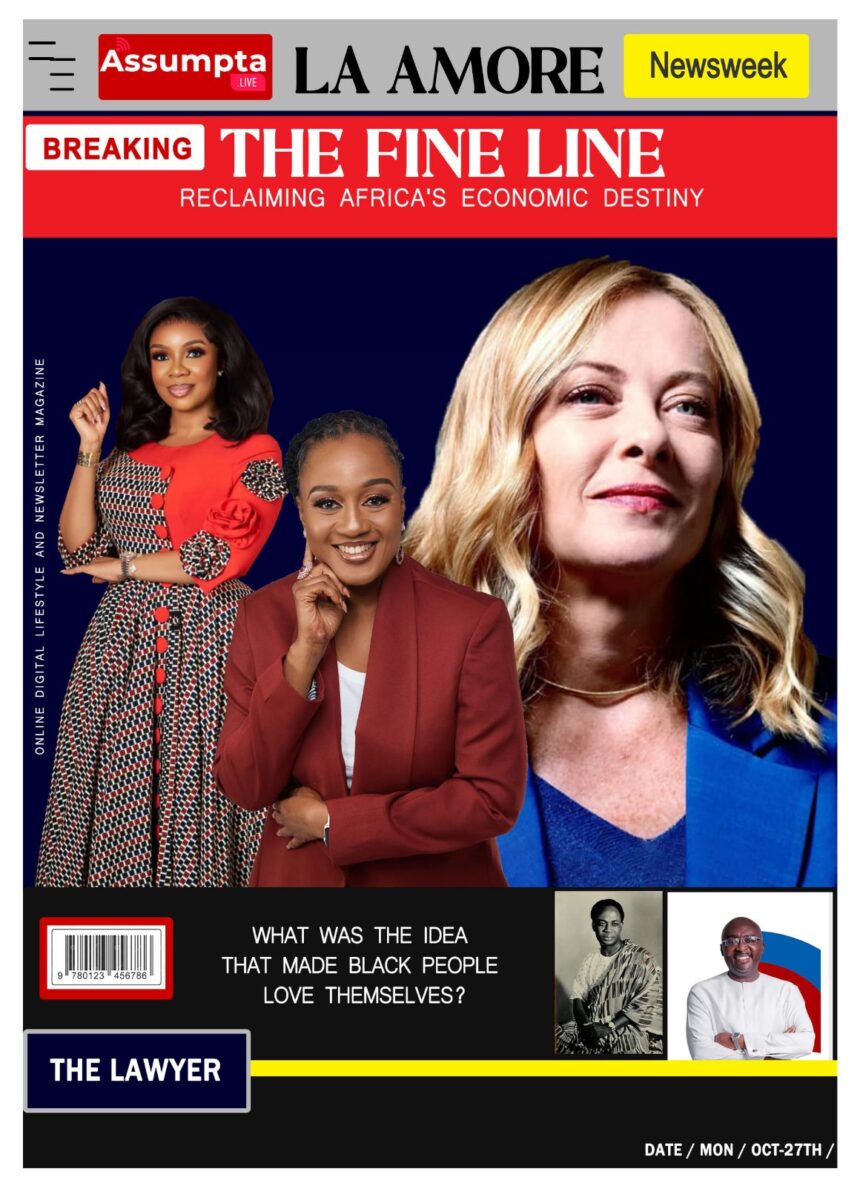
L’Amore Newsletter Magazine
Presents: “BREAKING NEWS”
Article Title: The Fine Line
Content: Reclaiming Africa’s Economic Destiny
📅 Release Date: Monday, October 27th, 2025
Special Edition: The Lawyer
HAIR SENTA ADVERTISEMENT


The Fine Line Between Patriotism and Politics no
Many leaders proclaim love for Ghana, but true patriotism demands sacrifice, integrity, and selflessness — not political gain. That thin distinction between serving the people and serving power is the “fine line” that determines whether leadership uplifts or destroys a nation.
🔑 Inside This Edition
Hosted by two powerful voices:

- Dzigbordi Kwaku-Dosoo – Ghanaian entrepreneur, humanitarian award winner, and one of Africa’s most exceptional change-makers.

- Serwaa Amihere, Esq. – fearless broadcast journalist and champion of social justice, now a lawyer.

Together, they guide us through Giorgia Meloni’s confrontation with empire, fear, and the hidden game of shadows.
Featuring Global Voices of Wisdom
“Great leadership sparks not just hope, but a generational shift in vision and values.”
Why Fine Line
We call it “The Fine Line” because the story of Ghana (and Africa as a whole) walks a delicate balance — between freedom and dependency, truth and illusion, love of country and self-interest.
Here’s what that means in depth:
1. The Fine Line Between Political Freedom and Economic Dependency
Ghana won political independence in 1957, but real freedom — economic independence — has remained just out of reach. Nkrumah warned that political freedom without economic power is an illusion. Today, by depending on the IMF and Western financial systems, Ghana walks a fine line between sovereignty and subservience.
2. The Fine Line Between Pan-Africanism and Western Influence
Pan-Africanism stands for unity, self-determination, and shared prosperity among African nations.
But modern governance, heavily influenced by Western policy, global finance, and corporate interests, pulls in the opposite direction. Ghana constantly teeters between these two paths — the African dream and the Western design.
3. The Fine Line Between Patriotism and Politics
Many leaders proclaim love for Ghana, but true patriotism demands sacrifice, integrity, and selflessness — not political gain. That thin distinction — between serving the people and serving power — is the “fine line” that determines whether leadership uplifts or destroys a nation.
4. The Fine Line Between Unity and Division
Ghanaians share one destiny, but politics often divides us into camps and colors.
The article ends by calling for curiosity, dialogue, and communication — because unity is fragile. The line between a proud, united people and a divided, distracted one is very fine.
5. The Fine Line Between Love and Betrayal of the Nation
Nkrumah’s vision was born of love — a love rooted in discipline, self-reliance, and collective purpose.
To abandon that vision for dependency or corruption is to cross that fine line — from love of country to betrayal of it.
So, the title “The Fine Line” perfectly captures the tension Ghana faces today:
The struggle to stay true to Nkrumah’s dream in a world still shaped by old powers and new forms of control. DWIt’s not just a title — it’s a warning and a reflection on the fragile balance between what Ghana could be and what it risks becoming.
The Fine Line: Reclaiming Africa’s Economic Destiny
With our heads held high, we continue to defend our ideas, our values, and our shared identity. Our motto remains what it was 68 years ago when Dr. Kwame Nkrumah introduced the bold vision of Pan-Africanism — the belief that the destiny of Africans is bound together in unity, independence, and self-reliance.
Yet, many Ghanaians today do not fully understand how deeply Nkrumah loved Ghana and the entire African continent. His life’s mission was to liberate us not only from colonial rule but also from the unseen hands of those who still do not want Africa to rise.
This is the fine line of history — and sadly, it remains the same game being played in Ghana today.
Symptoms of a Deeper Erosion
Consider, for example, the previous NPP government under President Nana Akufo-Addo. His vice president, Dr. Mahamudu Bawumia, as head of the Economic Management Team, oversaw the country’s financial direction. Instead of building upon Nkrumah’s Pan-African economic ideals of independence and industrial self-sufficiency, the government turned to the IMF — a Western financial institution rooted in policies that often keep African economies dependent rather than empowered.
This dependence is not accidental. As many have observed, global systems were never designed for Africa to win. The “aid” and “loans” often serve as subtle levers of control. The same applies to how political parties in Ghana are funded — puppets performing on a stage built by and for foreign capital.
During the NPP administration, galamsey (illegal mining) surged, and corruption scandals multiplied. These were not random missteps but symptoms of a much deeper problem — a carefully orchestrated structure of dependency and moral erosion.
The truth is painful but clear: Black people were granted political freedom, yet economic freedom remains deliberately out of reach. This is not coincidence; it is design. While we argue over party colors and slogans, the real power — economic power — continues to reside elsewhere.
The Choice Before Ghana
This brings us to the critical question:
Will Ghana continue down the path of IMF dependency — the financial system of the Rothschilds and Western dominance — or will we revive the spirit of Nkrumah’s Pan-African dream?
To build the future of this nation, we must return to that same love and conviction that guided Nkrumah.
Love for our land.
Love for our people.
Love that is not blind, but pure and firm.
He taught us that true patriotism comes from purity of heart and firmness of purpose — a love that stands as a dialogue between people, each with their own stories, dreams, and wounds, yet united by a shared destiny.
We all carry our pain and imperfections. But when we learn to communicate — to truly listen, understand, and connect — we begin to heal as a nation.
Effective communication builds trust, improves relationships, and strengthens both emotional and collective intelligence. It is how we move from division to dialogue, and from dependency to dignity.
Let us, therefore, stay curious instead of divisive.
Let us choose conversation over conflict, vision over vengeance, and unity over borrowed solutions.
Because the fine line between freedom and dependency — between love and loss — is drawn by how faithfully we carry forward the ideals of those who dreamed of an Africa that stands on its own feet.
Giorgia Meloni: Redefining Italy’s Credibility on the World Stage

Giorgia Meloni, Italy’s first female Prime Minister, has demonstrated a steadfast commitment to strengthening the Italian economy and safeguarding the nation’s interests through a careful balance of diplomacy and security.
Known for her conservative values, Meloni has taken firm positions on issues such as opposing same-sex marriage and curbing illegal migration into Italy. Her recent meeting with former U.S. President Donald Trump underscored her determination to elevate Italy’s international relationships to new heights, reinforcing the country’s strategic importance on the global stage.
Driven by conviction and national pride, Meloni seeks to restore Italy’s diplomacy to a place of prominence — ensuring that it once again flourishes at the center of world affairs.
Ultimately, Giorgia Meloni’s leadership will stand as a defining measure of Italy’s — and indeed Europe’s — credibility in the eyes of the world.
Editorial Introduction
Walking the Fine Line: Nations, Power, and the Pursuit of Credibility
Across continents and cultures, every nation walks a fine line — between independence and influence, pride and pragmatism, conviction and compromise.
In this issue, we explore how leadership shapes that balance — how vision, courage, and national will determine whether a country defines its own destiny or allows others to define it.
In Ghana, The Fine Line revisits the enduring legacy of Kwame Nkrumah’s Pan-African dream, questioning whether the country can reclaim its spirit of economic self-reliance amid modern dependency on foreign institutions. It is a reflection on the moral and historical tension between the love of nation and the lure of global finance.
In Italy, Prime Minister Giorgia Meloni embodies another fine line — that between national sovereignty and global diplomacy. Her conservative values and assertive leadership aim to restore Italy’s credibility on the world stage, testing Europe’s balance between unity and individuality.
Both Ghana and Italy, though worlds apart, confront the same fundamental challenge: how to protect their identity and pursue progress without surrendering the soul of their nations.
Their stories remind us that leadership, whether in Accra or Rome, is not merely about governing — it’s about walking that narrow, demanding path where ideals meet reality.
L’Amore Newsletter Magazine Presents: “BREAKING NEWS”
Article Title: The Fine Line | Content: Reclaiming Africa’s Economic Destiny

Serwaa-Amihere Esq: Good afternoon and a warm welcome to our global audience! I’m Serwaa-Amihere, and it is my profound pleasure to be your host for this very special edition of L’Amore Newsletter Magazine Presents: “BREAKING NEWS.”
Today, we’re diving into a crucial conversation stemming from our latest article, “The Fine Line: Reclaiming Africa’s Economic Destiny,” and I have two truly exceptional and powerful women joining me on the panel.
First, to my right, is a towering figure in business, diplomacy, and brand strategy: Dzigbordi Kwaku-Dosoo. As a celebrated Ghanaian entrepreneur, the founder of the Dzigbordi Consulting Group, and an internationally recognized expert, she has dedicated her career to fostering economic empowerment and shaping Africa’s narrative on the global stage. Her insights into how the continent can strategically manage its own wealth and destiny are invaluable. Welcome, Dzigbordi.
And joining us all the way from Italy, a historic figure who has commanded global attention, is Her Excellency, the Prime Minister of Italy, Giorgia Meloni. As Italy’s first female Prime Minister, she has been a powerful, often controversial, voice in European and international politics, particularly on issues of national sovereignty, economic policy, and migration. Prime Minister Meloni, it is an honour to have you here.
We are delighted to welcome both of you to this discussion on L’Amore Newsletter Magazine Presents: “BREAKING NEWS.”
On Establishing the Correct Teaching for the Peace of the Land

Serwaa-Amihere Esq: Before we get to the core of our newsletter article, I want to set a philosophical and ethical frame for our discussion, one that speaks directly to the responsibilities of leadership. I will first cite a treatise written by the Japanese Buddhist monk Nichiren Daishonin in July 1260, titled “On Establishing the Correct Teaching for the Peace of the Land.” This was famously submitted to the ruling clan of the Kamakura shogunate, and can also be found in The Teachings for Victory, vol. 7, pp. 153-67.
It reads:
“Emperors and kings have their foundation in the state and bring peace and order to the age; ministers and commoners hold possession of their fields and gardens and supply the needs of the world. But if marauders come from other regions to invade the nation, or if revolt breaks out within the domain and people’s lands are seized and plundered, how can there be anything but terror and confusion? If the nation is destroyed and people’s homes are wiped out, then where can one flee for safety? If you care anything about your personal security, you should first of all pray for order and tranquility throughout the four quarters of the land, should you not?..
When we examine this wide variety of our politicians today, we find that they all have been described as the Lotus Sutra stresses how grave they have slander[ed] the nation. How pitiful that politicians can all go out of their way to be corrupt and enter so deep into the prison of these distorted ideologies! How stupid that they should fall one after another into the snares of these evil ideologies and remain for so long entangled in this net of slanderous behavior! They lose their way in these mists and miasmas, and sink down amid the raging flames of hell.
How could citizens not grieve? How could citizens not suffer? Therefore, you must quickly reform the tenets that you hold in your heart and embrace the one true vehicle, the single good doctrine [of the Lotus Sutra]. If you do so, then the threefold world will become the Buddha land, and how could a Buddha land ever decline? The regions in the ten directions will all become treasure realms, and how could a treasure realm ever suffer harm? If you live in a country that knows no decline or diminution, in a land that suffers no harm or disruption, then your body will find peace and security, and your mind will be calm and untroubled. You must believe my words.”
Prime Minister Meloni, I’d like to start with you. What are your views or perspectives on Nichiren’s treatise and its relevance to the current state of global political leadership, particularly the strong critique of political corruption and “distorted ideologies”?
Prime Minister Meloni on Good, Evil, and Political Leadership

Giorgia Meloni: Serwaa-Amihere, thank you for your very beautiful and thorough introduction, and thank you for inviting me to this important discussion.
The treatise you cited is a powerful text. When viewed through the lens of Buddhist philosophy, it emphasizes a continuous internal and external struggle to overcome what is often termed fundamental ignorance (or “the evil of fundamental ignorance”) and transform negative forces into the highest good through practice.
My interpretation of the battle between good and evil—the heart of the critique against corrupt leaders—is therefore rooted in this internal struggle. The primary battle is against what are called the three poisons—greed, anger, and foolishness—which are seen as the root of all human suffering and negative tendencies, including political corruption.
Born and raised in Italy, with my Christian values, I was used to the word evil being used about a person to indicate someone wicked, bad, or immoral. This use of the word suggests a judgment that they are a thoroughly bad person, possibly unable to reform their ways.
Before becoming Prime Minister, I was not surprised, therefore, to find that the word ‘evil’ was operating in our politicians. Consider, for example, the then 5-Star Movement, which I believe was so evil that they allowed Italy’s shores to become a cemetery. They opened our borders, essentially for human trafficking, through their accord with Brussels, making Italy dangerously dependent on external powers. To me, that is the very definition of a destructive ideology at work, precisely what Nichiren Daishonin warns against when he speaks of political figures “entangled in this net of slanderous behavior.”
In contrast, the Lotus Sutra teaches that both good and evil are inherent within our lives and that evil can never completely disappear. As the Daishonin says: ‘Good and evil have been inherent in life since time without beginning.’ And these 5-Star movements, and others like them, appear to be all evil incarnate who love to oppress people.
So, the fundamental question that arises from this is: “Can Evil People Change?”

Serwaa-Amihere Esq: Prime Minister Meloni, that is a profoundly charged and fascinating response, particularly your melding of the Buddhist concept of inherent evil and the three poisons with your direct critique of specific political actions in Italy. The question, “Can Evil People Change?”, truly cuts to the core of political accountability and redemption, both personally and nationally.
Dzigbordi, I want to bring you into this conversation. When you hear Prime Minister Meloni talk about the “three poisons”—greed, anger, and foolishness—as the root of destructive political ideologies, and you look at Nichiren’s warning against leaders who “slander the nation” and lead people into “terror and confusion,” what is your perspective, especially in the context of Africa’s economic destiny?
How do these ancient warnings about moral integrity in leadership resonate with the challenges African nations face today in truly reclaiming their economic sovereignty from both internal corruption and external interests?

Dzigbordi Kwaku-Dosoo: Thank you, Serwaa. And Prime Minister Meloni, your analysis is striking.
My perspective, especially as someone deeply invested in the strategic and economic positioning of Africa, is that Nichiren’s treatise is not just an ancient religious text; it’s a timeless blueprint for governance and accountability.
When we look at the core issue of our article, “Reclaiming Africa’s Economic Destiny,” the central barrier is precisely what Nichiren warns against: leaders who lack integrity and prioritize personal gain (greed and foolishness) over the stability of the state.
We see this manifested in a few critical ways:
- Internal Corruption as an Economic Weapon: The “slander of the nation” that Nichiren speaks of is, in modern terms, the systemic corruption that bleeds our economies dry. When politicians fall into the “snare of evil ideologies,” it’s often the ideology of self-enrichment. They sign deals that are detrimental to their country’s long-term interests for short-term personal kickbacks. This is the ultimate betrayal of the foundational principle: “Emperors and kings have their foundation in the state and bring peace and order to the age.” They destroy the foundation, and the common people are left without safety.
- The Folly of Imitation and External Dependence: Prime Minister Meloni, you spoke about your nation’s dependence on Brussels. For many African states, the “distorted ideologies” are often the blind application of foreign-prescribed economic models that do not serve our unique contexts. This is the foolishness—the lack of intellectual sovereignty—that prevents us from charting our own course. We are so focused on pleasing “marauders from other regions” that we forget to nurture our own internal strength.
- The Necessity of Moral Transformation: The question, “Can Evil People Change?”, is less about the individual politician and more about the system they operate in. The treatise calls for the leaders to “quickly reform the tenets that you hold in your heart.” For Africa, reclaiming its destiny requires a revolution of political consciousness—demanding that our leaders stop seeing the state as a treasure chest to be plundered and start seeing it as a trust to be nurtured, so that the nation becomes a “treasure realm” that knows no decline.
The fine line we discuss in our article is between a leadership that serves self-interest and one that serves the state’s true economic future. This fine line is defined by the moral compass that Nichiren laid out centuries ago.

Serwaa-Amihere Esq: Dzigbordi, you’ve brilliantly synthesized Nichiren’s ancient wisdom with contemporary African economic realities. Your focus on internal corruption as an economic weapon and the need for a revolution of political consciousness is precisely the foundation of our special edition article: “The Fine Line.”
L’Amore Newsletter Magazine Presents: “BREAKING NEWS”
Article Title: The Fine Line | Content: Reclaiming Africa’s Economic Destiny
Serwaa-Amihere Esq: Our focus today, as detailed in our publication, is the critical boundary between genuine national service and self-serving ambition.
The special feature, “The Lawyer,” highlights this boundary explicitly:
“The Fine Line Between Patriotism and Politics… Many leaders proclaim love for Ghana, but true patriotism demands sacrifice, integrity, and selflessness — not political gain. That thin distinction between serving the people and serving power is the “fine line” that determines whether leadership uplifts or destroys a nation.”
Prime Minister Meloni, you began by discussing the destructive ideology of the 5-Star Movement in Italy and the question of whether “evil people can change.” This concept of a “fine line” between Patriotism and Politics is highly relevant to your own political journey, where you have positioned yourself as a staunch defender of Italian national interest and sovereignty.
In the context of this “fine line,” how do you, as a Head of Government, ensure that your administration’s pursuit of national interest—or patriotism—doesn’t cross into the realm of political expediency that ultimately harms the nation through ideological rigidity or isolating policy decisions?

Giorgia Meloni: Serwaa-Amihere, that is a challenging and essential question. The “fine line” you describe is, in my view, the very definition of the daily ethical struggle within political power.
My political movement, and indeed my government, was founded on the idea of reclaiming Italy’s sovereignty and national dignity. We believe true patriotism means making decisions here, in Rome, that are squarely in the interest of the Italian family, Italian businesses, and Italian workers.
The way we ensure this doesn’t degrade into mere political expediency is by anchoring our policies in a non-negotiable principle: long-term national interest over short-term electoral gain.
For example, on the issue of migration, my stance is seen by some as ideological rigidity. But for me, it is an act of patriotism to secure our borders and dismantle the criminal networks exploiting human misery, because instability at our borders directly undermines the peace and security of the entire nation, as Nichiren Daishonin warned. True patriotism is not populism; it is courage.
Crucially, it’s a matter of credibility. The way my Government will behave will be a test of our collective credibility.
This brings me back to the treatise and the question of transformation. I am the first female prime minister, a Christian, elected in Italy’s politics. If I can commit to the profound self-reflection required to overcome what the Buddhist text calls the fundamental darkness of ignorance, foolishness, and stupidity (evil)—those human tendencies toward self-interest and destructive ideology—then others can also overcome the evil within and serve the people. We must demonstrate that national service is an act of sacrifice, not accumulation. The “fine line” is crossed when a leader stops asking ‘What can I do for Italy?’ and starts asking ‘What can I get from Italy?’ Our credibility rests on our commitment to the first question.

Serwaa-Amihere Esq: Prime Minister Meloni, your emphasis on credibility as the ultimate test and your willingness to speak about overcoming personal darkness to serve the nation is a powerful declaration. It sets a high standard for political leadership globally. The core of this, as you’ve stated, is moving from taking from the nation to giving to the nation.
Dzigbordi, Prime Minister Meloni’s critique of ideologies that lead to national dependency, and her assertion that patriotism demands long-term sacrifice, has a sharp resonance with the narrative of “Reclaiming Africa’s Economic Destiny.”
When we look at Ghana, a nation you are deeply invested in, the very “fine line” between patriotism and politics often seems blurred by the return to external financial structures. How do you reconcile a leader’s proclaimed love for the nation—their purported patriotism—with the continuous cycle of seeking assistance from institutions like the IMF, which historically impose policies that compromise the economic autonomy and, arguably, the sovereignty of the state?

Dzigbordi Kwaku-Dosoo: Serwaa, it is an extremely frustrating and painful dilemma for every true pan-Africanist and patriot. I wholeheartedly agree with Prime Minister Meloni’s point that the true test of leadership is its credibility—its adherence to national interest over political expediency.
When I look at Ghana, or many countries in Africa, the fine line has been repeatedly and dangerously crossed. We’ve seen successive administrations—including the NPP government—continue to go to the IMF. This is a financial institution that has always, and I mean always, operated on a model that fundamentally makes Ghana and other nations dependant rather than independent. The conditions are almost always structural adjustment programs that stifle local industry and force the sale of state assets, which further compromises our economic sovereignty.
Therefore, I agree with Prime Minister Meloni’s response completely. The decision to run back to the IMF, year after year, under the guise of stabilizing the economy, is not an act of patriotism; it is an act of political foolishness and, often, greed—the very poisons Nichiren warned about.
It is a failure of leadership to exhibit the necessary sacrifice, integrity, and selflessness required to develop innovative, sustainable, and sovereign solutions. True patriotism would demand that we, as leaders, endure the political discomfort of making tough, internal fiscal adjustments and fostering local resource mobilization, rather than taking the seemingly easy, but ultimately destructive, path of external dependence. It demonstrates that the short-term survival of a political party is prioritized over the long-term destiny of the nation. It is the perfect illustration of crossing that fine line.

Serwaa-Amihere Esq: Dzigbordi, your point on the failure of leadership—the lack of courage to choose internal solutions over external dependence—is a powerful indictment. You’ve clearly articulated that the return to the IMF is a crossing of that fine line, prioritizing short-term political survival over long-term national sovereignty.
My own perspective, as a journalist and now a lawyer, compels me to be even more critical of the political ideology driving this dependency. I think that, in their nostalgic longing for Kwame Nkrumah’s removal and the dismantling of his Pan-Africanism ideas for the good of Ghana and the African continent, Bawumia and the entire NPP government have pleased the same evil enemy. They are willingly bringing Ghana to be dependent on this same enemy who has never liked Black people to prosper. This is a profound betrayal rooted in deep ideological conflict.
This brings us to two core points in our article that further define this “Fine Line” of betrayal and failure:
The Fine Line: Political Freedom vs. Economic Destiny

Serwaa-Amihere Esq:
1. The Fine Line Between Political Freedom and Economic Dependency
Ghana won political independence in 1957, but real freedom — economic independence — has remained just out of reach. Nkrumah warned that political freedom without economic power is an illusion. Today, by depending on the IMF and Western financial systems, Ghana walks a fine line between sovereignty and subservience.
2. The Fine Line Between Pan-Africanism and Western Influence
Pan-Africanism stands for unity, self-determination, and shared prosperity among African nations. But modern governance, heavily influenced by Western policy, global finance, and corporate interests, pulls in the opposite direction. Ghana constantly teeters between these two paths — the African dream and the Western design.
Dzigbordi, you are an advocate for Pan-African economic empowerment. The current economic choices by the Ghanaian government suggest they have decisively chosen the Western design over the African dream. In light of Prime Minister Meloni’s focus on national sovereignty for Italy, what tangible steps must African leaders take right now to move away from this subservience to Western financial models and operationalize true Pan-African self-determination, thereby redeeming the spirit of Nkrumah?
Dzigbordi Kwaku-Dosoo: Serwaa, your analysis—both as a journalist and a lawyer—is painfully accurate. The ideological war over Nkrumah’s vision is still being fought, and unfortunately, the current political class in Ghana seems to be siding with the very forces that profit from our dependency. When you frame it as pleasing the “evil enemy,” it brings a necessary moral weight to a financial conversation.
The dichotomy you’ve laid out—The Fine Line Between Pan-Africanism and Western Influence—is the central crisis of African governance today. We are constantly in this tug-of-war between the African dream of unity and self-determination, and the Western design of financial oversight and resource extraction.
To genuinely move away from this subservience, African leaders must take tangible steps that operationalize the spirit of Nkrumah and redeem our economic destiny.
Here is what needs to happen right now:
- Establish a Sovereign African Credit Rating Agency and Financial Clearing House: We must immediately create our own systems to value our assets and facilitate trade. Why should Ghana’s economic credibility be determined by agencies in New York that fundamentally do not understand, or are biased against, African economic potential? We need a Pan-African Credit Rating Agency and a fully operational, integrated African Financial Clearing House to bypass Western correspondent banking and currency systems. This would be the single most powerful act of economic sovereignty.
- Resource-Backed Currency and Intra-African Trade: Nkrumah understood that economic power comes from controlling your resources. Instead of continually selling our raw materials for fiat currency that depreciates, we must explore a mechanism where our currencies are backed by a basket of African minerals and commodities. More immediately, we must eliminate the tariffs and logistical barriers that hinder Intra-African Trade. The African Continental Free Trade Area (AfCFTA) is a powerful framework, but leaders must stop paying lip service to it and aggressively invest in the infrastructure—roads, rail, and digital connectivity—that make Pan-African trade easier than trading with Europe.
- The Sovereignty of Debt Management: We must end the practice of accepting predatory foreign loans with opaque terms and non-disclosure agreements. We need a unified African front to negotiate debt—a “Debt Wall”—where one country’s debt crisis is treated as a continental challenge, giving us collective leverage against Western and Eastern creditors. True patriotism demands transparency in every single loan agreement.
Prime Minister Meloni is fighting for Italian sovereignty. Our fight must be for African sovereignty. We must shift the mindset from being receivers of aid and consumers of foreign goods, to becoming producers of value and drivers of global economic policy. If we do not make these tangible moves to control our finance and our trade, political freedom will forever remain the illusion Nkrumah warned us about.

Giorgia Meloni: Serwaa, Dzigbordi, your diagnosis of the situation in Ghana is stark, but your connection of economic dependency to an ideological betrayal of the Pan-African dream is something I must address from the perspective of a leader fighting for national sovereignty in a deeply interconnected world.
You speak of the “evil enemy” who has never liked Black people to prosper. In my experience, the enemy is often not a single foreign power, but the structural model of dependency itself—a model that benefits those at the top, regardless of their nationality, who leverage the foolishness and greed of local elites.
Dzigbordi, your proposals for a Sovereign African Credit Rating Agency and a Financial Clearing House are precisely the kind of bold, self-determining actions required to redraw that “Fine Line” of sovereignty. As Italy’s Prime Minister, I applaud them. In fact, they ecVho the very principle we are pursuing with our Mattei Plan for Africa.
Our plan, which aims to move beyond the old, broken model of charity and dependency to one of equal partnership, is founded on the same premise: Africa must control its own destiny. We seek to work with African nations, not as a former colonial power, but as a strategic equal partner, to build infrastructure, energy security, and resilient food systems. We do this for mutual benefit, but the core principle is supporting African nations in defining their food sovereignty and their economic sovereignty.
Your point on the IMF is a global concern. In Europe, we are bound by the financial constraints of the EU, and Italy itself operates under the strict scrutiny of financial markets and institutions. While Italy, unlike Ghana, is not seeking IMF bailouts, we constantly fight to ensure institutions like the IMF take a pragmatic approach to developing countries, as I have publicly argued, for example, regarding Tunisia. Why? Because imposing rigid, one-size-fits-all austerity measures can often trigger the very instability—the “terror and confusion” in the land—that Nichiren warned us about.
So, the core difference is this:
- For Italy: The fight is to maintain sovereignty within a restrictive Western system (the EU).
- For Africa (Ghana): The fight is to achieve sovereignty by moving beyond the external systems (IMF, Western design) that compromise it.
The betrayal you speak of happens when a politician, in their hunger for power or fear of instability, chooses the Western design because it offers an easier, short-term fiscal lifeline, sacrificing the African dream—the long-term, painful, but ultimately necessary path of self-reliance. True patriotism, for both Italy and Ghana, is the relentless pursuit of the second path, even when it is politically inconvenient. This is the ultimate test of whether the politician is serving the people or merely serving the party.

Serwaa-Amihere Esq: Prime Minister Meloni, your distinction is critical. Italy’s fight to maintain sovereignty within a system versus Africa’s fight to achieve sovereignty by moving beyond that system perfectly encapsulates the global power dynamics at play. And I fully agree that the true enemy is the structural model of dependency, which thrives on the corruption and short-termism of local elites.
The Mattei Plan, as you describe it, will be judged by whether it truly embodies the principle of equal partnership or if it becomes a new form of managed dependency, but that is a topic for another time.
For now, I want to bring our focus back to the moral and ideological crisis at the heart of our article, “The Fine Line,” because it speaks to the ultimate consequence of this pursuit of short-term gain.
We have established that the fine line is crossed when a leader moves from patriotism to political expediency. Our article breaks down the final three essential aspects of this betrayal:
The Fine Line: Political Freedom vs. Economic Destiny

Serwaa-Amihere Esq:
3. The Fine Line Between Patriotism and Politics
Many leaders proclaim love for Ghana, but true patriotism demands sacrifice, integrity, and selflessness — not political gain. That thin distinction — between serving the people and serving power — is the “fine line” that determines whether leadership uplifts or destroys a nation.
4. The Fine Line Between Unity and Division
Ghanaians share one destiny, but politics often divides us into camps and colors. The article ends by calling for curiosity, dialogue, and communication — because unity is fragile. The line between a proud, united people and a divided, distracted one is very fine.
5. The Fine Line Between Love and Betrayal of the Nation
Nkrumah’s vision was born of love — a love rooted in discipline, self-reliance, and collective purpose. To abandon that vision for dependency or corruption is to cross that fine line — from love of country to betrayal of it.
So, the title “The Fine Line” perfectly captures the tension Ghana faces today: The struggle to stay true to Nkrumah’s dream in a world still shaped by old powers and new forms of control.
It’s not just a title — it’s a warning and a reflection on the fragile balance between what Ghana could be and what it risks becoming.
Dzigbordi, this final point—The Fine Line Between Love and Betrayal—is the moral reckoning. When leaders foster division (The Fine Line Between Unity and Division) to maintain power, and when they sacrifice self-reliance for dependency, are they not committing the ultimate act of national betrayal? How does a civil society effectively counter this betrayal when political divisions are deliberately amplified to distract the populace?

Dzigbordi Kwaku-Dosoo: Serwaa, you have beautifully articulated the moral and ideological crossroads we face. The progression from political expediency to division, and finally to betrayal, is the downward spiral that Nichiren warned about centuries ago when he spoke of leaders sinking down amid the raging flames of hell.
To answer your question directly: Yes, they are committing the ultimate act of national betrayal.
Betrayal is defined by the abandonment of trust. The people place their trust in leaders to act in the nation’s best, long-term interest. When a government knowingly chooses policies that compromise economic sovereignty (dependency), enrich a few (corruption), and tear the social fabric (division), they have moved past poor governance and into national treason—a betrayal of the collective destiny.
The most insidious part is your third point: The Fine Line Between Unity and Division. This is the politician’s greatest weapon against accountability. When the state is being betrayed economically, leaders deliberately amplify ethnic, political, or religious differences to create a smokescreen. They make the populace look at camps and colours instead of the balance sheets and loan agreements. The people are distracted, fragmented, and rendered incapable of forming a unified front to demand integrity.
How does a civil society counter this betrayal? It requires a deliberate, strategic counter-attack that focuses on education and unity:
- Demand Financial Literacy and Transparency: Civil society groups, the media, and educators must relentlessly simplify complex financial deals and present them to the people in a clear, non-partisan way. The betrayal lives in the fine print. We must expose the economic truth and frame it as a national issue, not a party issue.
- De-politicize Patriotism: We must reclaim the language of patriotism from politicians. Patriotism must be defined not by who you vote for, but by your commitment to the long-term, self-reliant vision of Ghana and Africa. It’s about creating a national consciousness that rejects division as a form of intellectual and emotional laziness.
- Active Citizen-Driven Accountability: The populace must move from passive grieving—the “How could citizens not grieve? How could citizens not suffer?” from Nichiren’s text—to active opposition. This means robust local organization, non-partisan advocacy for specific reforms (like your proposals for a Credit Agency), and utilizing the courts and civil processes to hold individuals accountable for their greed and foolishness.
The answer to betrayal is not just opposition; it is redemption—the hard, uncomfortable work of building a new, unified political consciousness rooted in Nkrumah’s vision of discipline, self-reliance, and collective purpose. We must make the cost of national betrayal higher than the reward of political gain.

Serwaa-Amihere Esq: Dzigbordi, your framework is sharp and necessary. The idea that financial dependency and political division constitute national treason—a betrayal of the collective destiny—is the moral call to action that our civil society desperately needs to hear. Your points on demanding financial transparency and de-politicizing patriotism are the practical steps toward redemption.

Serwaa-Amihere Esq: Prime Minister Meloni, this conversation has consistently circled back to ideology, identity, and the profound moral basis of leadership, echoing Nichiren’s call to reform the tenets held in the heart. The crisis of betrayal in Ghana, as Dzigbordi and I have described, is rooted in an ideological abandonment—a failure to choose the African dream over the Western design.
This failure leads me to a fundamental question about the spirit and consciousness required to sustain true sovereignty and resist the “evil of fundamental ignorance.” I want to ask you, as a leader whose core political identity is based on national pride:
“What was the idea that made Black people love themselves?”

Prime minister Meloni
This is a profound and essential question—one that goes to the very heart of African identity and consciousness.
The idea that made Black people love themselves was not born from power or privilege, but from awakening—the realization that their worth, history, and humanity had always been sacred, even when the world tried to erase it.
Here are the key ideas and movements that ignited that self-love and pride across generations:
1. Pan-Africanism — The Unity of Destiny
Kwame Nkrumah, Marcus Garvey, W.E.B. Du Bois, and others taught that “the liberation of one African is tied to the liberation of all.” Pan-Africanism said: “We are not inferior, we are connected.” It reframed Blackness as a shared strength, not a colonial wound—giving Africans a sense of belonging to a larger human story. “Africa must unite, or perish.” — Kwame Nkrumah. Through Pan-Africanism, loving oneself meant loving the continent—its struggles, its languages, its rhythm, its soul.
2. The Negritude Movement — Pride in Black Identity
In the 1930s and 1940s, thinkers like Léopold Sédar Senghor, Aimé Césaire, and Léon Damas started the Negritude movement. They declared: “Black is beautiful.” They celebrated African art, rhythm, emotion, and intuition—everything that colonial systems called “primitive”—as the essence of beauty and humanity itself. “My negritude is not a stone, nor deafness flung against the day, but it takes root in the red flesh of the soil.” — Aimé Césaire. Negritude made self-love an act of cultural resistance.
3. Black Consciousness — Psychological Liberation
In the 1970s, Steve Biko in South Africa said: “The most potent weapon in the hands of the oppressor is the mind of the oppressed.” He called for mental decolonization—urging Black people to see themselves as the authors of their destiny, not victims of history. Self-love became a political act—to believe in one’s beauty, talent, and right to lead.
4. The Civil Rights and Black Power Movements
From Martin Luther King Jr. to Malcolm X, Angela Davis, and James Baldwin, the message was clear: Black dignity is non-negotiable. They connected African Americans’ struggle to global liberation, proving that love for self and race was not hatred for others—it was the assertion of equality and justice.
5. The Spiritual Core — Love as Restoration
Even before politics, the African spirit had always taught that to love yourself is to honor your ancestors. From traditional proverbs to gospel songs, love of self was rooted in community, spirituality, and continuity. It was never narcissism—it was healing. To be Black was to carry light through the storm.
So, the idea that made Black people love themselves was the rediscovery of their own divine humanity—through unity, culture, and consciousness. It was the collective realization that:
“We are not what was done to us. We are what we continue to create, to sing, to remember, to build.”

Serwaa-Amihere Esq: Prime Minister Meloni, your comparison—Italy fighting for sovereignty within the Western system, and Africa fighting for sovereignty outside of it—is a necessary distinction. However, your question about the cultural foundation for Black self-love—the power of Pan-Africanism and Black Consciousness—underscores a truth: sovereignty is first an internal psychological battle before it becomes an external economic one. The dialogue has powerfully illustrated instances in which political organizations assert certain evil, slavery, oppression, and dependent ideologies on countries. The treatise from Nichiren, your comments on the three poisons, and Dzigbordi’s analysis of political betrayal all point to a fundamental crisis of moral leadership.
Now, as we have come to the end of our discussion, I want us to dive into the final, urgent summary of our article: The Fine Line: Reclaiming Africa’s Economic Destiny.
The Fine Line: Reclaiming Africa’s Economic Destiny

Serwaa-Amihere Esq:
With our heads held high, we continue to defend our ideas, our values, and our shared identity. Our motto remains what it was 68 years ago when Dr. Kwame Nkrumah introduced the bold vision of Pan-Africanism—the belief that the destiny of Africans is bound together in unity, independence, and self-reliance.
Yet, many Ghanaians today do not fully understand how deeply Nkrumah loved Ghana and the entire African continent. His life’s mission was to liberate us not only from colonial rule but also from the unseen hands of those who still do not want Africa to rise.
This is the fine line of history—and sadly, it remains the same game being played in Ghana today.
Symptoms of a Deeper Erosion
Consider, for example, the previous NPP government under President Nana Akufo-Addo. His vice president, Dr. Mahamudu Bawumia, as head of the Economic Management Team, oversaw the country’s financial direction. Instead of building upon Nkrumah’s Pan-African economic ideals of independence and industrial self-sufficiency, the government turned to the IMF—a Western financial institution rooted in policies that often keep African economies dependent rather than empowered.
This dependence is not accidental. As many have observed, global systems were never designed for Africa to win. The “aid” and “loans” often serve as subtle levers of control. The same applies to how political parties in Ghana are funded—puppets performing on a stage built by and for foreign capital.
During the NPP administration, galamsey (illegal mining) surged, and corruption scandals multiplied. These were not random missteps but symptoms of a much deeper problem—a carefully orchestrated structure of dependency and moral erosion.
The truth is painful but clear: Black people were granted political freedom, yet economic freedom remains deliberately out of reach. This is not coincidence; it is design. While we argue over party colors and slogans, the real power—economic power—continues to reside elsewhere.
The Choice Before Ghana

This brings us to the critical question: Will Ghana continue down the path of IMF dependency—the financial system of the Rothschilds and Western dominance—or will we revive the spirit of Nkrumah’s Pan-African dream?
To build the future of this nation, we must return to that same love and conviction that guided Nkrumah.
- Love for our land.
- Love for our people.
- Love that is not blind, but pure and firm.
He taught us that true patriotism comes from purity of heart and firmness of purpose—a love that stands as a dialogue between people, each with their own stories, dreams, and wounds, yet united by a shared destiny.
We all carry our pain and imperfections. But when we learn to communicate—to truly listen, understand, and connect—we begin to heal as a nation. Effective communication builds trust, improves relationships, and strengthens both emotional and collective intelligence. It is how we move from division to dialogue, and from dependency to dignity. Let us, therefore, stay curious instead of divisive.
Let us choose conversation over conflict, vision over vengeance, and unity over borrowed solutions.
Because the fine line between freedom and dependency—between love and loss—is drawn by how faithfully we carry forward the ideals of those who dreamed of an Africa that stands on its own feet.Prime Minister Meloni and Dzigbordi Kwaku-Dosoo, thank you both for this deeply insightful and challenging discussion on The Fine Line. This conversation, at its heart, has been a call for moral and intellectual sovereignty. I believe our audience has received a powerful message today.
SGI-Our Shared Humanity.


https://www.instagram.com/babies_and_todds_day_care/?__pwa=1#


https://www.instagram.com/oh_my_hairr?igsh=MThqbDNneDZzcTF3cw==


https://www.instagram.com/officeandcobysa?igsh=dmxucTZ2a2t1eDBn


https://www.instagram.com/laurenhautecouture?igsh=MWxzNXN1Ym5nZ3o3Mg==


https://www.instagram.com/attoandoh?igsh=MTJqNjZzYmZyaTc3Mg==


https://www.instagram.com/ankaralooks?igsh=MTI1NWYycmU2Njkxcw==


https://www.instagram.com/ankaralooks?igsh=MTI1NWYycmU2Njkxcw==


https://www.instagram.com/flourishheights?igsh=cTExenQ3bnptZGgx
https://www.instagram.com/valerieagyeman?igsh=dHh1NTE0YnNqODY0


https://www.instagram.com/florakidsgh?igsh=bXMxbHZ2Z2k1bWZx


https://www.instagram.com/flourishheights?utm_source=ig_web_button_share_sheet&igsh=ZDNlZDc0MzIxNw==
https://www.instagram.com/valerieagyeman?utm_source=ig_web_button_share_sheet&igsh=ZDNlZDc0MzIxNw==
