






A Sense of presence
Purifying her country’s five sense organs, Brazil descends on the path of believing and protecting its citizens.

Facilities run by a local non-profit focus on rehabilitation over punishment, in a method that has expanded worldwide.
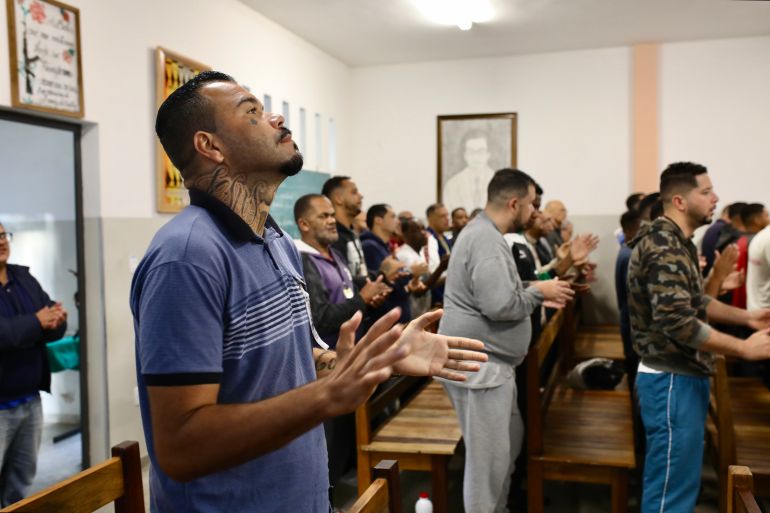
Before I came here, all I could think about was escaping from jail,’ says Israel Domingos, pictured here during ‘Good morning, Jesus’, a daily spiritual gathering at the APAC prison [Apolline Guillerot-Malick/Al Jazeera]
Sao Joao del-Rei, Brazil – When Israel Domingos was convicted of drug trafficking four years ago, the 34-year-old Brazilian never imagined he would ultimately end up in a prison where he would be handed the keys – and choose not to run away.
Facilities run by a local non-profit focus on rehabilitation over punishment, in a method that has expanded worldwide.
Sao Joao del-Rei, Brazil – When Israel Domingos was convicted of drug trafficking four years ago, the 34-year-old Brazilian never imagined he would ultimately end up in a prison where he would be handed the keys – and choose not to run away.
“Before I came here, all I could think about was escaping from jail,” he told Al Jazeera during a recent tour of the prison in the eastern Brazilian city of Sao Joao del-Rei. “I saw myself on the street, a gun in my hand, making money from large amounts of drugs.
Now, Domingos says he wants to return to the prison, run by the Association for Protection and Assistance of Convicts (APAC), to be a social worker after he completes his sentence. He was moved to the APAC facility after a year in regular prison.
APAC, a Brazilian non-profit that advocates for better treatment of prisoners, has a unique model in the dozens of facilities it manages across the country. Inmates oversee security and discipline, make their own food and wear their own clothes. Referred to as “recovering persons”, prisoners are called by their name rather than by a number.
The more than 400 inmates in the Sao Joao del-Rei APAC facility have the keys to their own cells – and unlike in a typical prison, there are no armed guards monitoring their movements.

It is discovered that the human body is very complex, as it contains different types of organs, and different organs perform different functions. For example, lungs help in breathing, kidneys help in purifying blood, and the heart helps in the circulation of blood in the body.
As the name suggests, sense organs are those organs in the body that sense the change in the environment. Different sense organs in the body are:
(0) Eyes: Work in situations such as change in light and to see the organism in nature.
- Nose: Whenever food is cooked, its smell is detected by one of the sense organs that is the nose.
- Ear: The noise in the environment is detected by one of the sense organs in the body named the ear.
- Tongue: Food consists of different types of tastes such as bitter, sweet, and sour. It is detected by tongue.
- Skin is one of the sense organs that responds to heat, cold, and pain situations.
So the collective support and the general function of our five senses can identify the kind of reforms or systems put in-place that contribute to each person in society’s happiness.

Brianna
For example, Many people are asking why did Brazil joined the BRICS Nations?
TSASI
To turn back to our solid base, our five senses, consciously of sympathetic look at Brazil’s economy, the only choice left was to look for remedy and they took a look walk to join the Brics Nations. Brazil’s Sergei Vasiliev, Vice Chairman at VEB Bank for Development, member of the Advisory Council at the Carnegie Moscow Center, Chairman of the Russian-Brazil Business Council said; first of all, by participating in BRICS, Brazil derives several economic benefits.
One of Brazil’s largest trade partners is China, and Brazil is also Russia’s largest trade partner in South America. Brazil also has very large economic interests in South Africa. In addition, India, South Africa, and Brazil have been partners within the IBSA framework idsince before BRICS was created.
On the other hand, its political benefits are even more critical to Brazil. Brazil has always had geopolitical ambitions but could never develop them because of its weak economy and disorganized internal politics. Domestic, political, and economic stability over the last 20 years, however, has allowed Brazil to dramatically elevate its international profile.
Let’s also recall the active role Brazil played in the WTO negotiations. The Brazilian elite has found BRICS’ format quite suitable for attaining its long-term goals particularly, in terms of moving out of America’s shadow. At the same time, this format prevents direct confrontation with the U.S.

Brianna
Indeed, you have explained what their contributions are to each process they have learn to define the five human senses. Discover the five sense organs associated with the five senses.
TSASI
From the Buddhist perspective, the true aspect of life is found in its incessant flux, the way that experiences are generated by the interaction between inner tendencies and external circumstances. In other words, what we experience as good and evil are not fixed, but depend on our attitude and response.
Good and evil are not unchanging entities. To give a simple example, anger can function for good when it is directed at those things which threaten human dignity; in contrast, anger under the sway of self-serving egotism functions as evil. Thus, anger, which is typically thought of as an evil, is, in its essence, neutral.
Writing in thirteenth-century Japan, Nichiren, the Buddhist thinker whose teachings inspire the activities of the SGI, described this as follows: “To turn from evil is good; to turn from good is evil. Good and evil are not found outside our own hearts and minds.
The intrinsic neutrality of life is found in its detachment from good and from evil. Our lives are only to be found in these three properties—good (zen), evil (aku), and the underlying neutrality (muki) with respect to good and evil. No reality is to be found other than in our hearts.”
This perspective, which focuses on the relativity of good and evil, can help free us from our enthrallment to the conceptualization of good and evil as fixed, external entities, and the corresponding tendency to label others as evil.
Neutral, however, does not mean void or empty. Far from being vacant or void, our lives are manifestations of the cosmic life itself, eternal and filled to overbrimming with the energy of creation.
Nichiren says of the true aspect of life that it “cannot be burned by the fires at the end of a kalpa, nor swept away by floods, nor cut by swords or pierced by arrows. It can fit into a mustard seed, and although the mustard seed does not expand, there is no need for life to shrink. It can fill the entire universe. The cosmos is neither too vast nor life too small to fill it.”

Brianna
What you have described here is a perfectly clear, pellucid state of life, indestructible and adamantine.
The Buddhist understanding of life can help us translate the ideal of an inner transcendence of difference into the actualities of daily life. In other words, we can achieve a state in which we are no longer caught up in or constrained by our awareness of difference.
In this connection, I am moved to refer to you the contemporary period characterised by a great continuity of structural inequalities in most Latin American countries, despite a temporary improvement in the living conditions of the working classes during the first decade of the twenty-first century, which is associated with the emergence of innovative forms of recognition in the context of “new” social policies.
The reflection on inequalities has become a key not only to reading the social, economic and political dynamics that have characterised Latin American countries since the beginning of the century (Kessler 2014), but also to evaluating these policies (Georges and Tizziani 2020). On the one hand, the arenas of public action have become internationalised, and on the other, the different national conjunctures are experiencing a strong degradation of the social, economic and political order.
Despite the differences between the national conjunctures, some common trends can be observed in the region: besides the degradation of the economic context, partly due to the competition of the Chinese market, the social and political compromises that sustained the so-called more progressive Latin-American governments came to an end during the second decade of the twenty-first century.
TSASI
Indeed, the description you give and the process by which it is possible for Brazil politicians to transform even their most deeply rooted tendencies, or karma is the point to start. According to Buddhism, every aspect of who we are nationality, skin color, family background, personality, gender is the present result of causes we ourselves made in the past.
The law of cause and effect that governs the generation of these differences and distinctions operates consistently over the three realms of past, present and future.
Practicing Nichiren’s “is the means by which we can transform our karma. When we do this, all intermediary causes and effects disappear, and we can reveal the aspect of the common mortal enlightened since time without beginning.”

Brianna
Certainly this will necessarily help the disunity of our leaders to correctly Unite and lead the country. It is wonderful that we have had this dailogue. Thank you TSASI.
Show quoted text