





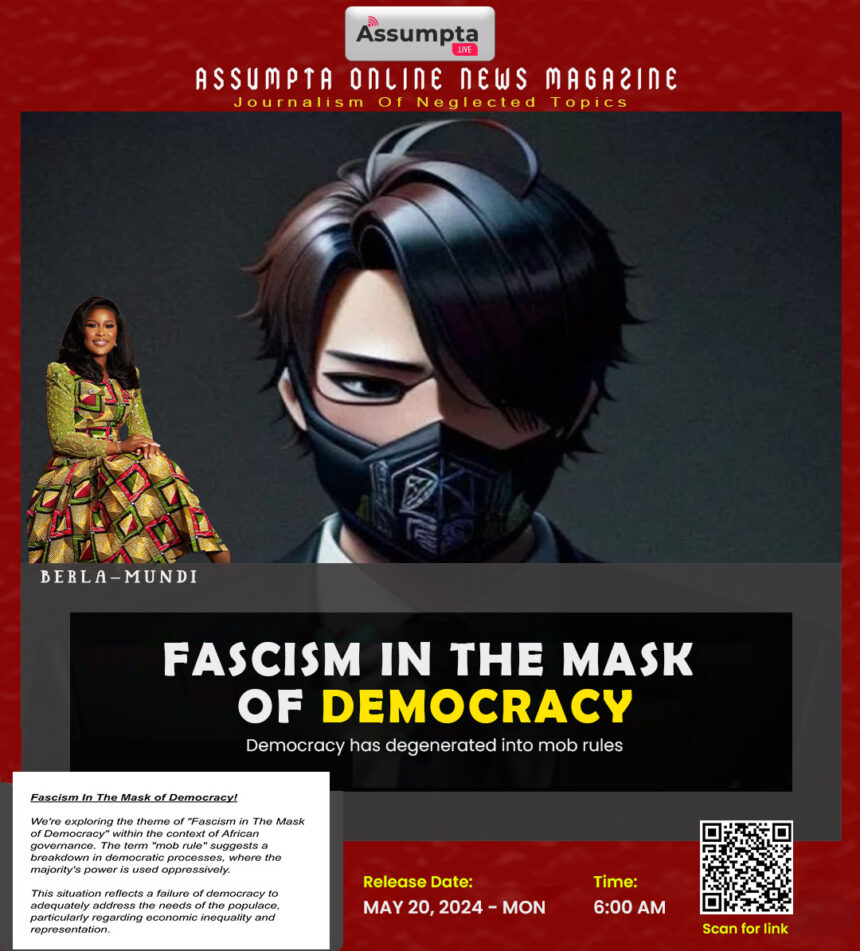
Democracy has degenerated into mob rules
ASSUMPTA ONLINE NEWS MAGAZINE: Journalism Of Neglected Topics :Coming on Monday 20th May 2024:
In this article, Berla-Mundi, a news broadcaster and a Journalist researcher, discusses the concepts we’re exploring : “Fascism in The Mask of Democracy.”
Within the context of African governance. The term “mob rule” suggests a breakdown in democratic processes, where the majority’s power is used oppressively. This situation reflects a failure of democracy to adequately address the needs of the populace, particularly regarding economic inequality and representation.
Research: No constant electricity for Ghanaians: The Lawyers of the country are silent: No Ghana government funding for innovative electricity projects that aims for a new approach in the energy sectors in Ghana.
Review :“Berla-Mundi‘:

This forthcoming article, ‘Fascism in The Mask of Democracy,’ adeptly navigates the intricate challenges facing African governance, particularly in addressing economic inequality and representation within democratic frameworks. Through insightful analysis, it illuminates the perilous trajectory where democracy risks degenerating into ‘mob rule,’ underscoring the urgent need for innovative solutions to pressing societal issues, such as the persistent lack of electricity in Ghana.
This exploration prompts crucial reflection on the delicate balance between democratic principles and the realities of governance in contemporary Africa.”
Introduction:

“Welcome to the latest edition of Assumpta Online News Magazine. In this upcoming feature, I delve into the thought-provoking analysis, as respected news broadcaster and journalist researcher, I confront a pressing issue that resonates deeply within the realm of African governance: ‘Fascism in The Mask of Democracy.’ In this insightful exploration, I navigate the intricate landscape where democratic ideals intersect with the harsh realities of societal challenges, particularly focusing on the spectre of ‘mob rule’ and its implications for our country and the African continent.”

TSASI: With several journalists and broadcasters in Ghana, why has Berla-Mundi been the only outstanding journalist and broadcaster who has attempted to analyse the increasing importance of the masses of humanity?

Berla-Mundi: I have been recognized as an outstanding journalist and broadcaster in Ghana for various reasons. While there are certainly other talented journalists and broadcasters in the country, I focus on analysing the increasing importance of the masses of humanity that sets me apart. My commitment to understanding the evolving needs, perspectives, and aspirations of the people reflects my passion for providing insightful and relevant content. By highlighting the significance of the masses, I contribute to a deeper understanding of societal dynamics and help shape public discourse in Ghana.
Secondly, my unique perspective and expertise as a journalist researcher likely equipped me with a deep understanding of social and political issues, allowing me to offer insightful commentary on topics such as the role of the masses in shaping governance. Additionally, my commitment to shedding light on neglected topics and my ability to communicate complex ideas effectively sets me apart in my field. Finally, my dedication to thorough research and thoughtful analysis likely contributes to my reputation as an outstanding journalist and broadcaster in Ghana.

TSASI: “Fascism in The Mask Of Democracy” two political concepts “Democracy and Dictatorship” fleeing from freedom toward the dictatorial system in Ghana, at first glance; how does your research challenge this assumption?

Berla-Mundi: My research challenges this assumption by highlighting the nuanced relationship between democracy and dictatorship in Ghana. Rather than viewing the situation as a simple dichotomy between democracy and dictatorship, I explore the complexities of governance dynamics, including the ways in which democratic institutions can sometimes fail to fully represent the interests of the populace. By examining the phenomenon of “Fascism in The Mask of Democracy,” I delve into how democratic systems can degenerate into forms of oppression, such as “mob rule,” without adequately addressing the needs of the people.
Through this lens, I aim to challenge the assumption that democracy inherently safeguards against dictatorial tendencies, encouraging a deeper examination of the structural factors at play in Ghana’s political landscape.

TSASI: “Have you made the study into what I call ‘Dumsor,’ the constant lights off in Ghana since the NDC party era till now? Is it a similar situation to ‘mob rule,’ with the democratic government of Ghana inadequately addressing the needs of the people?”

Berla -Mundi: “As of my last update in 2015, there were challenges with electricity supply in Ghana, known as ‘Dumsor.’ The governments have not addressed such issues to meet the needs of the people and innovate the energy sector to help improve the situation. The comparison to ‘mob rule’ suggests a lack of effective governance in addressing citizen needs. It’s clear that consistent power outages can have significant impacts on daily life and economic activity. Addressing such issues requires a multifaceted approach involving government policies, investment in infrastructure, and innovation in the energy sector. It’s important for governments to listen to the concerns of their citizens and take proactive steps to improve the situation.”
While I have conducted a specific study on the issue of “Dumsor” (constant lights off) in Ghana, it aligns with the broader theme of governance inefficiencies and failures to address the needs of the people within a democratic framework. The persistence of “Dumsor” reflects systemic challenges within Ghana’s energy sector, which have persisted across different political administrations.
This ongoing issue raises questions about the effectiveness of democratic governance in addressing critical infrastructure and service delivery challenges. Like the concept of “mob rule,” where the majority’s power is used oppressively, the failure to provide consistent electricity can be seen as a failure of democratic institutions to adequately address the basic needs of the populace.
TSASI: “My questions aim to prompt a reconsideration of both the concepts of fascism in the Mask of Democracy and the interplay between Democracy and Dictatorship.
When contemplating Ghana, I often recall the fascists who overthrew Kwame Nkrumah, subsequently installing their own government through ostensibly democratic means. However, what we witness today is the proliferation of fascism exerting control, exacerbating issues like ‘Dumsor’ and ‘Galamsy,’ resulting in the destruction of our lakes, rivers, and lands, alongside imposing 17 different taxes on one gallon of fuel. Yet, Ghanaians generally fail to recognize these phenomena as manifestations of fascism operating within our nation on the African continent.

Berla -Mundi: Your reflections on the historical context of Ghana, particularly the overthrow of Kwame Nkrumah and subsequent democratic processes, raise important points about the complexities of governance and power dynamics in the country. The transition from colonial rule to independence was marked by both democratic elections and authoritarian interventions, which have shaped Ghana’s political landscape to this day.
The emergence of issues like “Dumsor” and “Galamsey” highlights the challenges facing democratic governance in Ghana, including the spread of corruption, environmental degradation, and economic inequality. These issues may indeed reflect elements of fascism, where certain interests prioritise their own power and gain over the well-being of the population.
However, the perception of these challenges as part of a broader fascist operation is not widely recognized among Ghanaians. This could be due to a variety of factors, including historical narratives, political discourse, and the complexities of addressing systemic issues within a democratic framework. Encouraging broader awareness and critical analysis of these issues is crucial for fostering informed dialogue and promoting effective governance in Ghana.
TSASI: “Then, can you see a transnational drive of the NDC aligning with the far-right conservative agenda in Ghana and across Africa, hidden beneath the mask of fascism?”
What is the NDC and what does it stand for?

Berla-Mundi: The NDC stands for the National Democratic Congress. It is a political party in Ghana that was founded in 1992. The party identifies as centre-left and has been one of the major political parties in Ghanaian politics since its establishment.
TSASI: What is fascism and how could you define it?

Berla-Mundi: Fascism is a political ideology characterised by authoritarianism, nationalism, and dictatorial power. It often involves the suppression of opposition, strict control over society and the economy, and the promotion of a centralised, militaristic government. Fascist regimes typically emphasise the supremacy of the state and the submission of individual freedoms to the interests of the nation or a ruling elite. Additionally, fascism often incorporates elements of racism, xenophobia, and ultranationalism, seeking to create a homogeneous society based on perceived notions of ethnic or cultural superiority.

TSASI: Does this political ideology the same as that of Ghana today?

Berla -Mundi: It’s understandable to observe and analyse how political parties, including the NPP (New Patriotic Party), address and respond to the concerns and anxieties of the population. Issues such as inflation, unemployment, and the persistent problem of “Dumsor” (constant power outages) are indeed significant challenges that impact the lives of Ghanaians and can influence political dynamics.
Political parties often seek to capitalise on these concerns, either by addressing them through policy initiatives or by using rhetoric to appeal to voters’ emotions. The instrumentalization of anxieties and worries, as you mentioned, can manifest in various ways, including campaign messaging, policy proposals, and public statements by party leaders.
However, it’s important to critically evaluate the actions and policies of political parties within the broader context of governance and democratic principles. While addressing issues like inflation, unemployment, and Dumsor is crucial for the well-being of the population, it’s essential to assess whether the approaches taken by the government effectively address these challenges and uphold democratic values such as accountability, transparency, and respect for human rights.
TSASI: “Unfortunately, the modern trend is for human beings in the aggregate to be led into foolishness, ignorance of their rights, and the irresponsible pursuit of pleasure. Though superficially Ghanaians sometimes demonstrate their rights through demonstrations and protests to exercise their human rights and freedom, the reality is that they are losing their faith in democracy. Under these conditions, Ghanaians may well be on a dangerous road where one mistake leads to either an overwhelmingly powerful dictatorship or to democracy.”

Berla-Mundi: The observation that modern trends may lead people towards foolishness, ignorance of their rights, and an irresponsible pursuit of pleasure reflects broader concerns about societal values and political engagement. While demonstrations and protests can be expressions of citizens’ rights and freedoms, a loss of faith in democracy may indicate deeper issues with governance, accountability, and representation.
In Ghana, as in other countries, maintaining a balance between democratic principles and effective governance is crucial. When citizens feel disillusioned or disenfranchised, there is a risk of political instability and a potential slide towards authoritarianism or dictatorship. It’s essential for governments to address the root causes of dissatisfaction and work towards restoring trust in democratic institutions through transparency, accountability, and responsiveness to the needs of the populace. Encouraging civic education, promoting dialogue between citizens and government, and fostering a culture of participation can help strengthen democratic values and mitigate the risks associated with disillusionment and loss of faith in democracy. Ultimately, safeguarding democracy requires ongoing commitment from both government and citizens to uphold democratic principles and protect fundamental rights and freedoms.
Thank you TSASI for the engaging discussion! As a broadcast journalist, I will affirm my strong hope for further development of the Ghanaian economy. Thank you for joining me in today’s dialogue.