







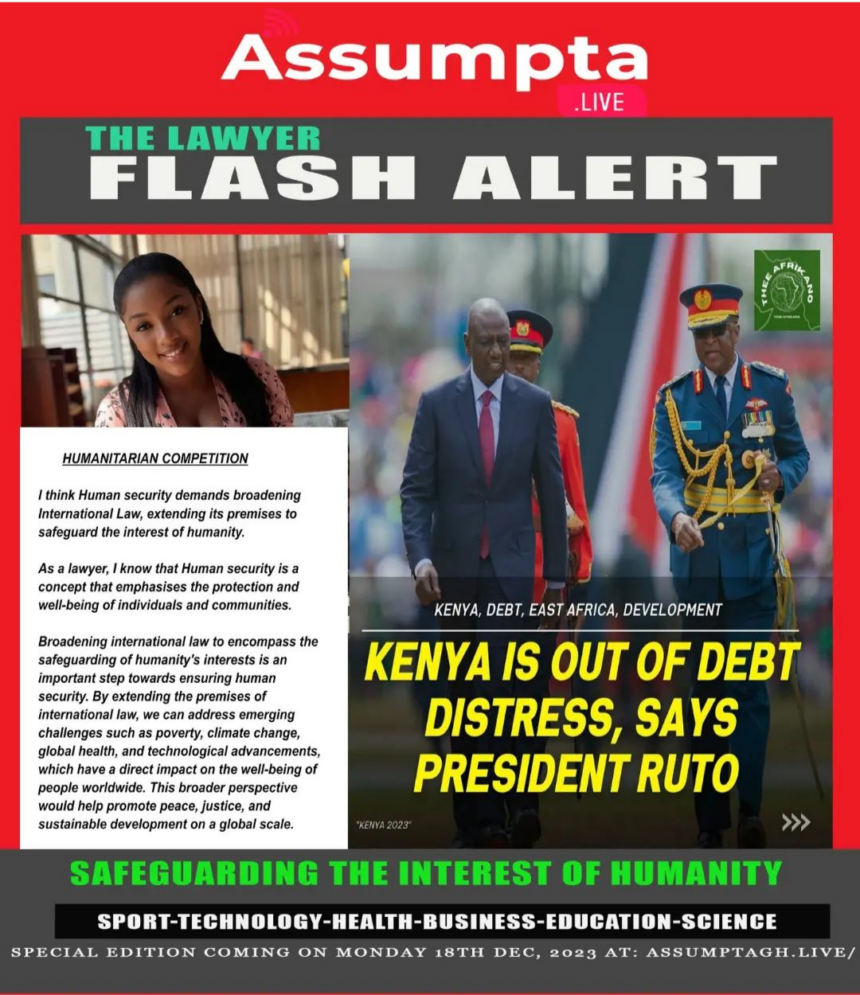
Presents “THE LAWYER“. From the special edition of: “Safeguarding The Interest Of Humanity”
“KENYA IS OUT OF DEBT DISTRESS, SAYS PRESIDENT RUTO”
The special edition will be released on Monday December 18th 2023, at. Assumptagh.live/
The East African country has been struggling to manage multiple challenges, including depleted government coffers, high inflation and a plunging currency.
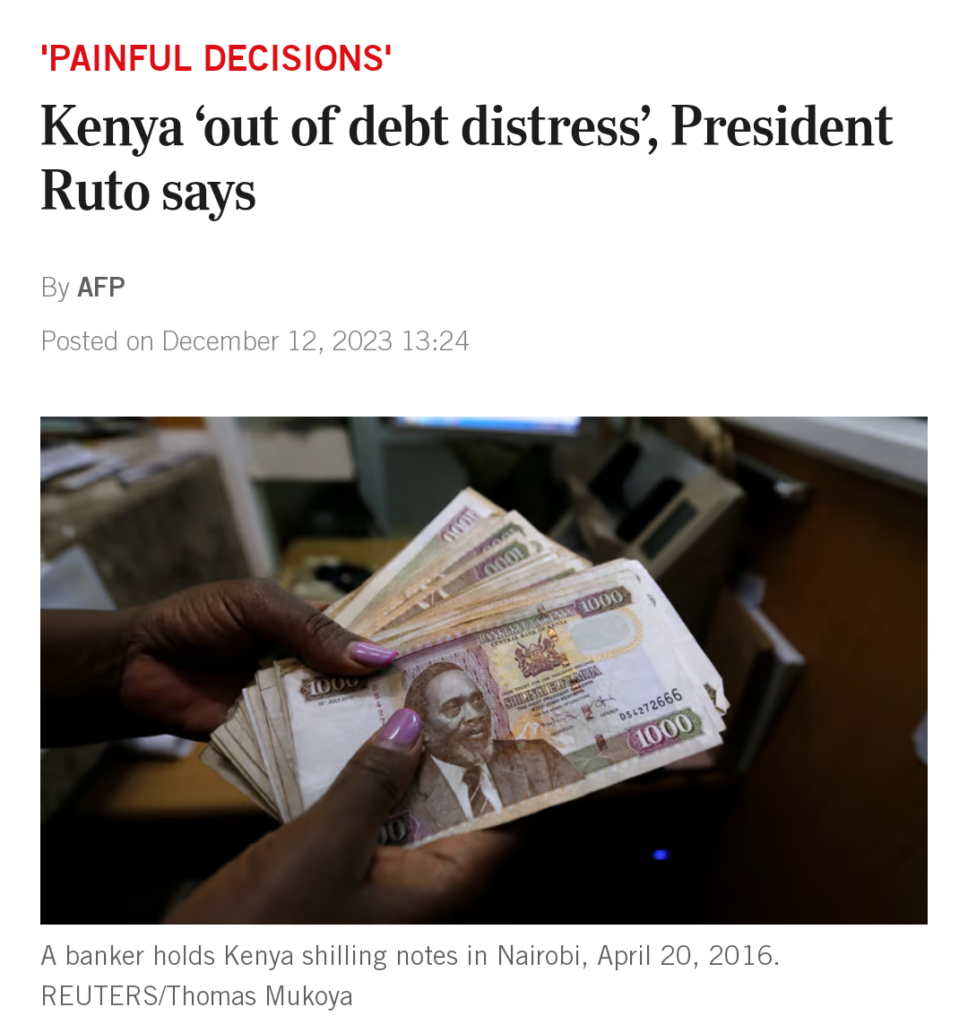
President William Ruto said Tuesday that Kenya was emerging “out of debt distress”, touting his economic policies despite public anger over tax hikes and slashed subsidies as the country marked its 60th independence anniversary.
East Africa’s economic powerhouse has been struggling to manage multiple challenges, including depleted government coffers, high inflation and a plunging currency that has sent debt repayment costs soaring.
Kenya had accumulated more than 10.1 trillion shillings ($66bn) in debt by the end of June, according to Treasury figures, equivalent to around two-thirds of gross domestic product.
Speaking at a public ceremony in Nairobi to mark the former British colony’s independence day, Ruto said Kenya was now “safely out of the danger of debt distress”.
READ MORE Kenyan banks rely on regional businesses as currency, rates hurt home market
He did not provide any figures on the current levels of debt, but said Kenya’s gross domestic product (GDP) had grown by 5.4% in the last six months.
“We have made the right choices, sometimes taken very difficult and painful decisions, to steer Kenya back from the edge of a catastrophic cliff of debt distress and move our country in a new direction,” he said.
Ruto, who was elected last year on a pledge to ease conditions for ordinary Kenyans, has been on a campaign to slash public debt and “wasteful” government expenditure in the country of some 53 million people.
He has also cut food and fuel subsidies introduced by his predecessor and former boss Uhuru Kenyatta.
The cost of servicing public debt, mainly to China, has soared as Kenya’s currency has slumped to record lows of 153 shillings to the US dollar.
The government also has a $2-bn eurobond repayment due in June next year.
The independence day celebrations, which included a military parade as well as musical and dance performances, were held at Uhuru Gardens, a place steeped in Kenyan history.
READ MORE Kenya: Taxman seeks higher overdue penalties as companies optimise working capital.

First, I would like to express my appreciation for President Ruto’s delivery of such a speech and his remarks to the Kenyans, who, in the past, have demonstrated remarkable resilience in absorbing an oppressive civilization rooted in an economic culture that derived happiness from the unhappiness of others.

ASSUMPTA
While I understand that you appreciate President Ruto’s speech and his efforts to address the economic challenges facing Kenya, it’s important to note that President Ruto, being African, was born and raised in Kenya, growing up in a religious family and being a member of the African Inland Church. As a human, he possesses opinions and emotions, allowing him to understand the sentiments of Kenyans who aspire for a fair and equitable economic system that benefits all individuals. Economic development and ensuring the well-being of all citizens are crucial objectives for any nation.
TSASI
“Indeed, President Ruto’s African heritage, upbringing in Kenya, and affiliation with the African Inland Church provide a valuable perspective. It’s reassuring to know that he can empathise with the aspirations of Kenyans for a fair and equitable economic system that prioritises the well-being of all citizens.”

ASSUMPTA
It seems like you’re expressing concerns about the impact of Western economic policies and the influence of Western culture. It’s true that globalisation has brought both positive and negative consequences to various regions, including Kenya. While Western technology has contributed to advancements, it’s important to find a balance that respects the natural environment.
Cultural influences can indeed be challenging to navigate, and different cultures have different approaches to economic development. The rise of emerging economies like those in the BRICS (Brazil, Russia, India, China, and South Africa) has showcased alternative models of economic growth.
Ultimately, each country faces unique circumstances and must find its own path to sustainable development. It’s important to foster dialogue and understanding between cultures, while also considering the specific needs and values of each society.

TSASI
It is understandable that the impact of Western economic policies, which have often prioritised self-interest and at times harmed the natural environment, can be a cause for concern. The influence of Western culture can indeed be complex and challenging to navigate for Kenyans, especially when compared to the economic culture of countries like China within the BRICS group. Different cultures and economic systems offer unique advantages and challenges, and it is important for each nation to find a balance that promotes sustainable development and the well-being of its people.

ASSUMPTA
I understand your perspective, but it’s important to note that Africa’s success in dealing with the Western economic culture of oppression and the pursuit of happiness at the expense of others is a complex and multifaceted issue. While countries like Russia, China, India, Iran, and Italy may have experienced certain successes in their own contexts, it is crucial to note that each country faces unique challenges and opportunities, and it is essential to acknowledge the progress and initiatives undertaken by African nations towards sustainable development, poverty reduction, and the well-being of their citizens.
TSASI
while also fostering mutual understanding and cultural exchange.” This approach will allow Africa to preserve its unique heritage and values, while also benefiting from the positive aspects of Western culture such as technological advancements, educational opportunities, and economic development. By being discerning, Africa can carefully evaluate the impact of Western influences, embracing those that align with its goals and values, and adapting or rejecting those that may undermine its cultural integrity. Through this balanced approach, Africa can maintain its cultural identity, empower its people, and contribute to a more inclusive and interconnected global community.

ASSUMPTA
It is understandable that you believe Africa should explore new approaches in dealing with the impact of Western culture and religion. Preserving and valuing one’s own culture, traditions, and policies is an important aspect of maintaining a sense of identity and autonomy. While it is beneficial to engage with different cultures and ideas, African nations should have the agency to choose which elements to adopt and adapt according to their own values and aspirations. Striking a balance between openness to new influences and the preservation of cultural heritage is a complex task that requires careful consideration and decision-making.
TSASI
Throughout history, African societies have demonstrated a strong commitment to preserving their cultural heritage, traditions, and policy frameworks. This commitment can be seen in various forms, such as the preservation of indigenous languages, the celebration of cultural festivals, and the maintenance of traditional practices.
In some instances, African societies have chosen to isolate themselves from external cultural influences. This can be attributed to a desire to protect their unique identity and maintain a sense of autonomy. By doing so, they aim to prevent the erosion or dilution of their cultural values and customs.
However, it is important to note that this isolationist approach is not the sole characteristic of African societies. Africa is a diverse continent with a rich tapestry of cultures and interactions. Many African societies have also embraced external influences, adapting and incorporating them into their own cultural fabric.
The notion of self-determination plays a significant role in African history. It refers to the ability of African nations and communities to determine their own political, economic, and social destiny. While isolation from external influences may have been one strategy employed by certain African societies, it is not synonymous with prioritising self-determination.
Self-determination encompasses a broader range of actions, including political movements, struggles for independence, and efforts to shape their own governance systems.
Therefore, while some African societies have chosen isolation as a means of safeguarding their culture and traditions, it is essential to recognize the diversity of approaches taken by African communities in preserving their heritage and pursuing self-determination.

ASSUMPTA
Absolutely! African societies have indeed shown a strong commitment to preserving their cultural heritage and traditions. This commitment can take various forms, including the preservation of indigenous languages, the celebration of cultural festivals, and the maintenance of traditional practices.
While some African societies have chosen to isolate themselves from external cultural influences to protect their unique identity, it is crucial to acknowledge that this approach is not representative of all African communities. Africa is a continent with remarkable cultural diversity, and many societies have embraced external influences and integrated them into their own cultural fabric.
Self-determination has been a significant aspect of African history, encompassing the ability of African nations and communities to determine their own political, economic, and social destiny. While isolation may be one strategy employed by certain African societies, self-determination involves a broader range of actions, such as political movements, struggles for independence.
TSASI
“I believe that Africans are particularly sensitive to the lack of acceptance they face on the global stage, given the historical unfair treatment they have endured in terms of trade and economic conditions.”

ASSUMPTA
It is understandable that you may perceive Africans as being sensitive to the way they are not fully accepted on the global stage. Throughout history, African nations have faced significant challenges in terms of trade and economic conditions. Unfair trade practices, economic exploitation, and historical legacies have contributed to these challenges.
It is important to recognize that the effects of colonisation, slavery, and other forms of exploitation have had long-lasting impacts on African economies and societies. These historical injustices have shaped the current global dynamics in which African nations find themselves.
There is a growing awareness and advocacy for fair trade, economic justice, and equitable representation of African interests on the global stage. Many African nations and communities are actively working towards improving their economic conditions, seeking fair trade agreements, and promoting their own cultural products and contributions.
While there may be a perception of sensitivity, it is crucial to understand the underlying historical and socio-economic factors that have contributed to these dynamics. It is important for the global community to engage in dialogue, collaboration, and support efforts that promote fairness, inclusivity, and economic empowerment for African nations.
TSASI
“President Ruto should place significant importance on whether the position offered to his country and its people accurately reflects their standing in the world. Kenya cannot tolerate the notion that the United States will continue to exert dominance over the Kenyan currency.”

ASSUMPTA
“Kenya and the entire African continent are in need of accountability. It is staggering to consider that a sum of 300 dollars or Euros converts to 3,729,00 GHS. The currency in Africa is significantly weakened. It is concerning that a rich continent like Africa, with its abundance of mineral resources, possesses one of the weakest currencies globally and struggles with overwhelming debts that cannot be repaid.”
TSASI
“This serves as evidence of the superficiality and insincerity of the so-called ideology of colonisation, which intentionally seeks to dismantle the entire African continent.”

ASSUMPTA
“I consider Pan-Africanism as a potential ancestral religion of Africans, representing not only their ethical obligations but also humanity’s duty to cooperate and guide one another towards a safer and more fulfilling future.”
TSASI
“Thank you for the clarification. I appreciate your perspective on Pan-Africanism and its potential as an ancestral religion that promotes ethical obligations and cooperation for the betterment of humanity.”
“I believe that Pan-Africanism has the potential to provide a fitting spiritual antidote to counter the influences of Western pollution and the dehumanisation of human life, ultimately promoting dignity and a renewed sense of purpose.”
ASSUMPTA
It’s interesting to consider how different perspectives and ideologies can offer alternative approaches to address the challenges faced by society. Pan-Africanism, with its emphasis on cultural heritage, unity, and empowerment, may indeed provide a unique spiritual antidote for those who feel that Western influences have had a negative impact on human life and dignity. It’s important to recognize and appreciate diverse perspectives in order to foster understanding and promote a more inclusive and harmonious world.
Indeed. Safeguarding the interest of humanity is a crucial endeavour that requires collective efforts and a shared commitment. It involves promoting equality, justice, and respect for all individuals, regardless of their background. By embracing principles such as compassion, empathy, and cooperation, we can work towards creating a world where the well-being and welfare of every human being is protected and prioritised. Safeguarding the interest of humanity serves as a guiding principle to ensure a better future for all.
TSASI
“Winter always turns to spring. Never, from ancient times on, has anyone heard or seen of winter turning back to autumn. In the same way, although the various types of beings in the hells and those in the realms of hungry spirits, animals, asuras, and human beings may at present be unaware of the Law of the Lotus Sutra, if they chant Nam-myoho-renge-kyo even once, they will attain Buddhahood.” (On Attaining Buddhahood in This Lifetime – The Writings of Nichiren Daishonin, Volume 1, page 4)
Thank you.


