








Assumpta Quarterly — Newsweek Edition
BREAKING NEWS | Special Reflection
The Great Deception Exposed
A Tectonic Shift Screams Through the Heart of Europe—The Epicenter Is Vienna
📍 Special Reflection on Europe’s Political Reckoning 🌐 Read exclusively at: assumptagh.live
🗓️ Release Date: Friday, April 3, 2026
HAIR SENTA ADVERTISEMENT













Headline: Ghanaian Excellence, Globally Delivered.
Confidence is the ultimate outfit, and Great Hair is your signature accessory. As a trademarked leader in the beauty industry, Hair Senta is proud to export Africa’s finest quality hair extensions to the world.
We believe true beauty begins with how you are treated. The “Hair Senta Standard” is built on three pillars: Quality, Courage, and Confidence. Whether you visit us in Accra or order from abroad, you are entering a world of luxury and empowerment.
The Hair Senta Standard: Your Beauty. Our Mission.
📞 Inquiries: (+233) 0544354455 | 0248629769
🌐 Explore: www.hairsenta.com
https://www.instagram.com/hairsenta?utm_sourwce=ig_web_button_share_sheet&igsh=ZDNlZDc0MzIxNw==

Can Europe Sustain the Truth?
Why “Return Hubs” Are a Bandage on a Self‑Inflicted Wound
For years, Europe has approached migration as a problem of borders, logistics, and enforcement. On April 3, 2026, the Assumpta Quarterly confronts a deeper reality—one that challenges not only policy design, but moral coherence.
As the European Parliament advances toward a historic and controversial “Return” policy, this edition examines whether stability can truly be enforced at Europe’s edges while instability is produced beyond them. At the heart of the inquiry lies a question Europe can no longer avoid:
Can migration be managed without confronting the systems that generate displacement in the first place?
A Global Exchange on Responsibility

This edition is anchored by a thought‑provoking global dialogue led by award‑winning Ghanaian broadcast journalist Berla Mundi, joined by two of Africa’s most incisive legal voices:

- Serwaa Amihere, Esq. (Ghana)

- Assumpta Gahutu, Esq. (Namibia)
Together, they move beyond familiar historical narratives into urgent territory—international accountability, institutional complicity, and the legal contradictions shaping today’s migration debate. At the heart of their exchange is a question as direct as it is unsettling:
“If we want people to thrive in their original habitations, why are we fueling the wars that disperse them?”
Grounded in the foundational principles of the United Nations Charter, this Magazine Edition feature raises legal and moral questions global institutions have long deferred. It challenges not only contemporary policy responses, but decades of selective responsibility—inviting readers to reconsider where accountability truly begins.
A Political Turning Point in Europe
The Great Deception: A Crisis of Trust
The era of silence is over. A political shockwave is moving through the heart of Europe—and its epicenter is Vienna.
On March 26, 2026, Austrian authorities publicly challenged the European Union’s migration governance framework. While Italy has long pressed for structural reform at the European level, Austria escalated the confrontation by openly breaking with established consensus.
- Institutional Failure: According to documents reportedly originating from the Austrian Ministry of the Interior, European migration statistics may have been systematically misrepresented.
- Data Discrepancy: Officials in Vienna contend that while Brussels emphasized “integrated border management,” internal data reflected a far less controlled reality, including extensive unregistered crossings along the Balkan route.
- Sovereignty vs. Control: FPÖ leader Herbert Kickl has framed the dispute starkly, accusing Brussels of eroding national sovereignty.
Whether one agrees with this assessment or not, the political impact is undeniable: Europe’s migration debate has entered a new and more volatile phase.
Do European and American Arms Flows Contribute to Displacement?
A Structural—not Simplistic—Question
This feature does not claim that EU or U.S. arms policies “single‑handedly” cause migration. However, international evidence supports a more nuanced conclusion: arms transfers can materially enable conflicts whose foreseeable outcome is mass displacement.
From Arms Transfers to Displacement: The Pattern
- Prolonged Conflict: Sustained access to advanced weaponry reduces incentives for negotiated settlement.
- Infrastructure Collapse: Conflict devastates civilian housing, healthcare, water, and sanitation systems.
- Mass Exodus: Civilian life becomes untenable, producing internal displacement and onward migration.
By early 2026, nearly 2 million people in Gaza had been internally displaced. Similar dynamics are evident in Yemen, Syria, Sudan, and the Sahel.
The European Contradiction:
Europe experiences the downstream effects—asylum claims and border pressure—while remaining one of the world’s dominant exporters of military equipment. This creates a contradiction that “Return Hubs” cannot resolve.
Where Israel Fits—With Precision
Clarity matters.
- Displacement from Gaza is primarily internal or regional, not directly toward Europe.
- However, the conflict contributes to broader regional instability affecting Lebanon, Egypt, and Mediterranean routes.
- Israel is also a significant arms exporter, further complicating chains of responsibility.
Legal Accountability: Complicity, Not Intent
International law does not require proof of intent to cause migration. Under the Arms Trade Treaty (ATT), the United Nations Charter, and evolving interpretations of the Genocide Convention, States are obligated to deny arms transfers when there is a clear risk they will facilitate serious violations of human rights.
The Central Question:
If arms exports predictably sustain campaigns that make civilian life impossible, can supplier states legitimately claim neutrality?
Why This Matters
This is not a debate about migration alone. It is a reckoning with:
- How displacement is produced.
- How responsibility is distributed.
- Whether Europe can sustain the truths emerging about its own role in the system.
“Return Hubs” may manage movement. They cannot substitute for accountability.
Assumpta Quarterly — Newsweek Edition
📅 Friday, April 3, 2026
🌍 Global readership. Global responsibility.
Editor’s Note
This edition of Assumpta Quarterly — Newsweek Edition addresses issues of migration, governance, and international responsibility that are complex, contested, and deeply consequential. Our aim is not to advance a political position, nor to assign blame to any single nation or institution, but to encourage informed public reflection grounded in law, verified data, and ethical inquiry.
Our Editorial Standards
- Verification: Where allegations are referenced, they are clearly identified as such.
- Authority: Where international data or legal principles are discussed, we rely on established sources including United Nations frameworks, international treaties, and independent research bodies.
- Structure: The analysis presented examines structural dynamics—not individual intent—and distinguishes carefully between policy outcomes, legal obligations, and political interpretations.
Global Perspectives
This issue brings together voices from different regions of the world to reflect the global nature of migration and displacement. The perspectives shared do not negate the complexity of national security concerns, nor do they minimize the diversity of experiences across affected regions. Rather, they seek to broaden the discussion beyond borders toward shared accountability and long‑term stability.
Reader Engagement
Readers are encouraged to engage with this edition thoughtfully, critically, and in good faith. The questions raised are not simple—and they are not posed lightly. They reflect an ongoing global conversation that remains unresolved.
Assumpta Quarterly remains committed to responsible journalism, intellectual integrity, and respectful dialogue across cultures, legal systems, and worldviews.— The Editors
Host Opening

Berla Mundi : Good day to our readers and listeners joining us from across Europe, Africa, the Americas, Asia, and beyond. Welcome to this special global dialogue presented by the Assumpta Quarterly — Newsweek Edition. We are grateful for your time and your attention as we engage with an issue that is shaping politics, policy, and lives across borders.
Before we begin, let me warmly welcome our distinguished panelists. Joining us today is Ms. Serwaa Amihere, Esq., a respected legal practitioner from Ghana, and Ms. Assumpta Gahutu, Esq., a Namibian legal scholar and human rights advocate. Thank you both for being part of this important conversation.

Allow me also to briefly introduce myself. My name is Berla Mundi. I am a Ghanaian broadcast journalist with a career dedicated to public interest reporting, civic dialogue, and cross‑border conversations that connect law, policy, and lived human experience. It is an honour to host today’s discussion.
I now formally welcome our panel to this dialogue.
Setting the Context

Berla Mun di :Let me touch directly on the article that frames today’s conversation—a bold and timely direction of the Assumpta Quarterly titled: “Can Europe Sustain the Truth?” This feature responds to developments that mark a significant moment in European political history:
1. A Historic Turning Point — March 26, 2026
On March 26, 2026, the European Parliament passed the Return Regulation by a vote of 389 to 206.
- Political Shift: For the first time, mainstream conservative parties aligned with far‑right blocs to advance a “realistic” migration policy.
- Humanitarian Impact: The International Rescue Committee has described this as a historic setback for refugee protection.
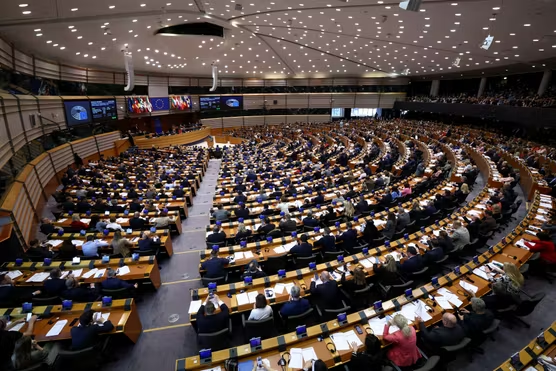
- The “Return Hubs”: This regulation establishes offshore facilities outside the EU where individuals may be transferred, regardless of their lack of connection to the receiving country.
2. The Arms–Migration Connection
In 2025, EU exports of arms and ammunition reached approximately $8.53 billion.
- Case Study: Between late 2023 and mid‑2025, Germany alone issued nearly half a billion euros in arms export licenses to Israel.
- Global Impact: In regions like the DRC and Syria, investigations highlight how dual‑use technologies and supply‑chain opacity allow European components to reach conflict zones, sustaining displacement.
3. The “Truth Gap”
The newsletter identifies a disconnect between official narrative and structural reality:
- Enforcement vs. Industry: Stability is framed as border enforcement, yet the newsletter argues stability is unattainable when external wars are fueled by internal industries.
- Responsibility: It reframes migrants not as a “crisis to be managed,” but as a consequence of foreign policy and the global arms trade.
4. Why Confronting This Truth Took So Long
Domestic security concerns and electoral pressures have often outweighed long‑term ethical responsibilities. Furthermore, arms manufacturing is a multi‑billion‑dollar industry, making political change difficult.
“If Europe wants a stable future, it cannot build walls in the Mediterranean while sending weapons to the deserts. A stable Europe requires a peaceful world.”
Inviting the Panel
Berla Mundi:
With this context in mind, I would now like to respectfully invite our panelists to share their reflections.
Ms. Serwaa Amihere, Esq., I would be grateful if you could begin by offering your legal and ethical perspective on this shift in European policy and the responsibility it raises. After your remarks, I will invite Ms. Assumpta Gahutu to join the conversation.
— End of Opening Dialogue
Panel Dialogue: The Legal and Ethical Reckoning
Assumpta Quarterly — Newsweek Edition
Serwaa Amihere, Esq.
Legal practitioner (Ghana)

Serwaa Amihere, Esq.:
Thank you very much, Berla Mundi, for that thoughtful and carefully grounded reflection—and for inviting me into this important conversation.
What stands out immediately from the article and from your framing is the insistence on structural honesty. The debate we are witnessing in Europe today is often reduced to urgency—numbers, borders, arrivals—but law reminds us that urgency cannot override responsibility.
From a legal perspective, the March 26th vote is significant not only because of what was passed, but how it was passed. The alignment of mainstream and far‑right blocs marks a shift in how migration is being framed—not as a matter of protection under international law, but as a logistical threat to be managed externally. That framing matters, because language shapes legal intent.
The creation of “Return Hubs,” particularly in territories with no meaningful legal nexus to the individuals concerned, raises serious questions:
- Non‑refoulement: This is not an optional principle; it is foundational. Any system that systematically relocates people outside legal accountability risks emptying that principle of substance.
- Inconsistency: If European states benefit economically from arms exports that foreseeably fuel conflicts, and then respond to displacement solely through exclusionary policies, we must ask whether that response is inconsistent.
The uncomfortable truth, as the article suggests, is that migrants are not simply arriving at Europe; they are arriving from conditions in which Europe, alongside other global actors, has been materially involved. A legal system that addresses only the endpoint while ignoring the origin is not neutral—it is selective.
So yes, Berla, I agree with the central provocation of this piece: one cannot build a credible legal regime for migration without interrogating the upstream policies that make displacement inevitable. That is not a radical position. It is, quite simply, a demand for coherence.
Thank you.
Assumpta Gahutu, Esq.
Legal Scholar & Human Rights Advocate (Namibia)
Assumpta Gahutu, Esq. : Thank you, Berla Mundi, for your gracious invitation and for setting the tone of this dialogue with such clarity and care.
I would like to begin by acknowledging something that the article does particularly well: it does not ask Europe to carry responsibility alone, but it does insist that responsibility be honestly accounted for. That distinction is crucial.
From the standpoint of international law and post‑conflict justice, displacement is rarely accidental. It is the predictable outcome of sustained violence, institutional collapse, and prolonged insecurity. When we see repeated patterns—in Gaza, in the Congo, in Syria, in the Sahel—we are not observing isolated tragedies. We are observing the consequences of systems that tolerate instability as long as it remains externally located.
What troubles me about the current trajectory is the illusion of containment.
- Outsourcing Responsibility: “Return Hubs” imply that displacement can be administratively relocated. But law does not function on convenience. When individuals are moved beyond jurisdictional reach, accountability mechanisms weaken.
- Foreseeability: International law does not require proof of malicious intent to establish responsibility; it requires foreseeability. If arms transfers predictably contribute to conditions that make civilian life unsustainable, legal questions do not end at the border.
The article’s question—“Can Europe sustain the truth?”—is ultimately about integrity. Can legal systems remain credible if they protect values internally while undermining them externally? Can stability endure if it is built on selective responsibility?
A peaceful world, as the article rightly concludes, does not begin with walls. It begins with truth, and with the willingness to confront how prosperity, security, and displacement are interconnected.
Thank you again, Berla, for creating space for this necessary dialogue.
— End of Opening Dialogue
Dialogue Continues: The Architecture of Accountability
Assumpta Quarterly — Newsweek Edition
Moderator’s Transition

Berla Mundi (Host) : Thank you both, Serwaa and Assumpta, for those deeply considered reflections, and for engaging this subject with such clarity and intellectual honesty. I would like to continue by building on something each of you touched on—coherence between law, policy, and practice.
Question One | Legal Adaptation or Retreat?
To: Serwaa Amihere, Esq.

Berla Mundi : Serwaa, from your legal perspective, Europe’s new “Return Hubs” framework is being justified as a practical response to political pressure and operational overload. Yet international law, as you noted, does not yield easily to convenience.
May I respectfully ask:
Do instruments such as the Refugee Convention and the principle of non‑refoulement have the legal strength to restrain this shift i