





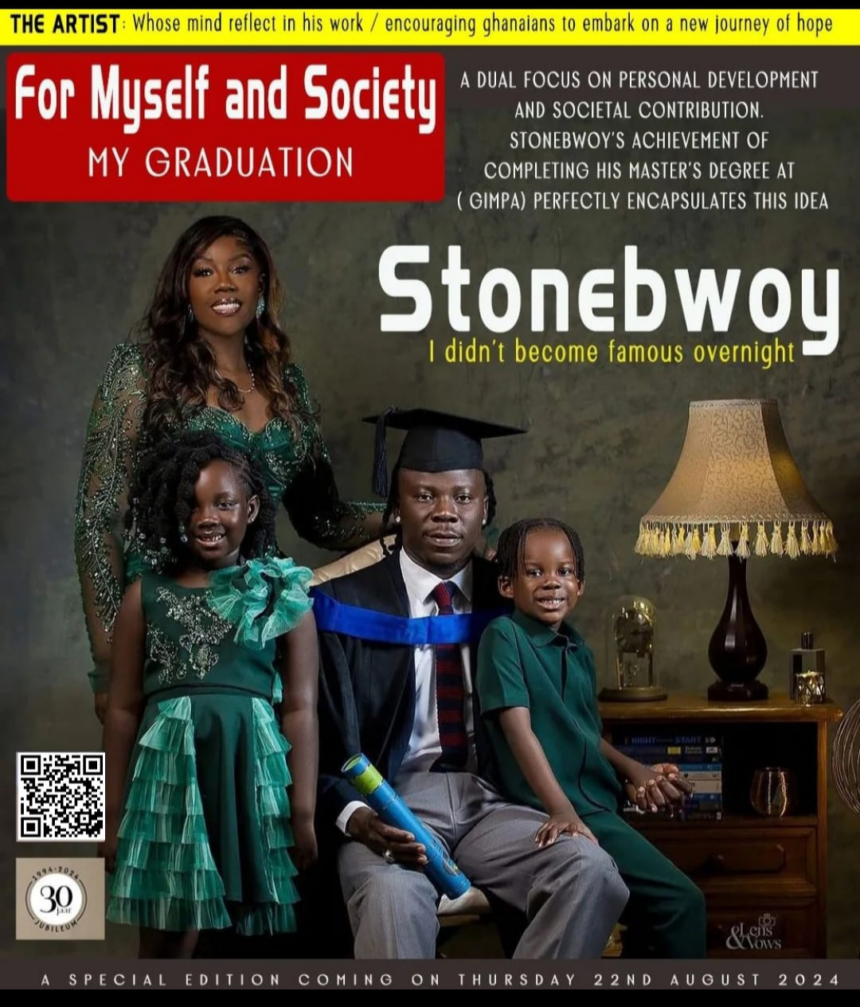
Title: Ror Myself And Society;
Content: My Graduation;
In the upcoming edition of the highly anticipated lifestyle magazine “My Friend,” we spotlight Livingstone Etse Satekla, better known by his stage name Stonebwoy. Stonebwoy is a renowned Ghanaian Afropop, Afro-dancehall, and reggae musician, and the CEO of Burniton Music Group. With accolades including the Best International Act: Africa category at the 2015 BET Awards and Artist of the Year at both the 2015 and 2024 Ghana Music Awards, Stonebwoy continues to inspire with his multifaceted talents and dedication to personal growth

.https://www.instagram.com/elegantt_homeware?igsh=MTY2NjA2aDQ1MmNjeQ==
In this special feature titled “My Graduation,” Stonebwoy reflects on his recent accomplishment of completing his master’s degree at the Ghana Institute of Management and Public Administration (GIMPA). As a successful artist who understands the importance of education, Stonebwoy encourages fellow Ghanaians to embark on new journeys of hope and self-improvement.
This edition will explore the dual focus of Stonebwoy’s personal development and societal contributions, emphasising his belief that true success is a blend of individual achievements and positive impact on society. Stonebwoy shares his journey, highlighting that his rise to fame was not an overnight success but the result of continuous hard work and perseverance.

Asssumpta-Gahutu; CEO of Babies and Toddlers and Assumpta Publication
Don’t miss this special edition, coming out on Thursday, 22nd August 2024.
Why “My Graduation”?
The title “My Graduation” signifies a significant milestone in Stonebwoy’s life, marking the completion of his master’s degree. Graduation represents not just the culmination of years of academic effort but also personal growth and achievement. For Stonebwoy, this accomplishment is particularly meaningful because it showcases his commitment to education and personal development, even amidst a successful music career. “My Graduation” reflects his belief that education is a lifelong journey that can coexist with professional success.
..Why “For Myself and Society”?
The phrase “For Myself and Society” highlights the dual purpose of Stonebwoy’s academic and personal achievements. On one hand, it represents his personal fulfilment—proving to himself that he can achieve academic success alongside his musical career. On the other hand, it underscores his desire to be a role model for others, particularly Ghanaians, by demonstrating the value of education and continuous self-improvement. Stonebwoy’s journey is not just for his benefit but also serves as an inspiration to society, encouraging others to pursue their dreams and contribute positively to their communities. The title emphasises that his graduation is both a personal victory and a contribution to the broader social fabric.

Stonebwoy: “My entire focus now is on the twenty-first century—on how Ghanaians can triumph in this era, on how we, as a country, can shape this into a wonderful, positive age. That is my sole concern.
The starring roles in this century belong to us—you, the Ghanaian graduates, and even the high school students. It’s all up to us. We have the power to redefine our future, to make a lasting impact. Our generation holds the key to ensuring that this century becomes a time of greatness for Ghana. Let’s rise to the occasion and make it happen together.”
Dialogue between Tsasi (the interviewer) and Stonebwoy.

Tsasi: Good day, Stonebwoy! It’s a pleasure to have you with us today. How are you doing?

Stonebwoy : I’m doing great, Tsasi. Thanks for having me. It’s always a pleasure to engage in discussions that can inspire and motivate, especially when it concerns our youth.

Tsasi : Absolutely! Today’s discussion is both practical and important, especially for Ghanaian graduates. The title of our dialogue is “Graduation and the Future Career Path of Ghana.” Many students, not just graduates, but those still in school, are concerned about what direction to take after graduation. They see others who have already graduated but are still struggling to find their place and contribute meaningfully to society. What are your thoughts on this?
Stonebwoy : You’ve hit the nail on the head, Tsasi. This is a very relevant topic. First and foremost, I want to remind everyone listening that you are absolutely free to choose your own path. It’s your life, and the choices you make should reflect what’s best for you. You chose the faculty or course of study that you believed was right for you, and that’s important. But I also want to emphasize that where you graduated from doesn’t determine your entire life.

Tsasi: That’s an interesting perspective, especially coming from someone as successful as you. Could you elaborate on that?
Stonebwoy: Certainly. While it’s true that education is crucial, what’s far more important is the strength and depth of your character. You need to ask yourself, “How should I live my life?” The answer to that question, and the inner strength you develop along the way, will determine how satisfying and meaningful your life will be.
Consider our country’s history—after Kwame Nkrumah’s overthrow, Ghana was in chaos, almost on the verge of collapse. But one of my seniors once told me, “No matter what circumstances you may face, you have to live with the spirit ‘Nothing ventured, nothing gained.'” It’s simple advice, but it holds an important truth. If you have the courage to take risks, a way forward will always appear.
Tsasi : That’s powerful advice. So, in essence, you believe that one’s future isn’t solely determined by their educational background?
Stonebwoy: Exactly. Your future is determined by who you are as a person. Is a happy life guaranteed just because you graduate from a prestigious school?
No, we know that’s not the case. And does graduating from a so-called second- or third-tier school mean your life is a failure? Absolutely not. Many great individuals have only completed elementary school, yet they’ve gone on to achieve extraordinary things.
It all comes down to this: Those who succeed in the challenges they set for themselves are the ones who lead fulfilling and happy lives. That’s the key. Whatever path you choose after graduation, never forget to challenge yourself.
Tsasi : It sounds like you’re saying the willingness to challenge oneself is crucial, regardless of the outcome.
Stonebwoy : That’s right. It’s disheartening when someone gives up on pursuing further education or a career because they lack confidence in their abilities. But a spirit of challenge shapes you into someone who can face any obstacle. And no matter what the result of your efforts, the true victory lies in knowing you gave it your all.
This principle applies not just to students but also to those entering the workforce. Whatever career path you take, keep that spirit of challenge alive. It’s what will help you grow, no matter where you started.
Tsasi: Stonebwoy, your journey is a testament to the power of perseverance and self-belief. Completing your master’s degree at GIMPA while balancing your music career is a clear example of the dual focus on personal development and societal contribution. How does that reflect in your work and message to Ghanaians?
Stonebwoy: Thank you, Tsasi. My journey didn’t happen overnight. It’s been a process of continuous growth, learning, and challenging myself. I believe that education and self-improvement go hand in hand with making a positive impact on society. I want to encourage all Ghanaians, especially the youth, to embark on a new journey of hope—whether through education, entrepreneurship, or any path they choose. Your future isn’t just about personal success; it’s also about how you contribute to the greater good.
Tsasi : How many Black Africans are there in the global workforce, particularly in fields such as engineering, architecture, medicine, surgery, aviation, and other areas, who are contributing to global development and problem-solving?
Stonebwoy : Finding exact numbers for how many Black Africans are in the global workforce, particularly in specific fields like engineering, architecture, and other STEM professions, is challenging due to the lack of detailed, globally consistent data. However, some general trends and statistics can be discussed:
Global Workforce Overview : Black Africans in STEM Fields : Data on the exact number of Black Africans in STEM fields (Science, Technology, Engineering, and Mathematics) globally is scarce. However, there is evidence that Black Africans are underrepresented in these fields, especially in Western countries. In Africa, there is a growing number of professionals in engineering and technology, but they still face significant challenges, including limited resources, educational opportunities, and access to global networks.
Africa’s Contribution to the Global Workforce : Africa, with over 1.3 billion people, has a significant portion of its population working in various sectors, including STEM fields. However, many of these professionals remain within the continent, contributing to local economies. The migration of African professionals to other regions (e.g., Europe, North America) for better opportunities is also significant but doesn’t necessarily translate to a large global presence in these specific fields.
Representation in Western Countries : In countries like the United States, the representation of Black Africans or African Americans in fields like engineering and architecture is still relatively low compared to other racial and ethnic groups. For instance, in the U.S., Black professionals make up about 5-6% of the engineering workforce, according to data from the National Society of Black Engineers (NSBE).
Africa’s Workforce in Engineering and Architecture : Engineering : In Africa, engineering is a growing field, with many universities now producing thousands of graduates yearly. However, the number of practising engineers who have global recognition or who are working in multinational companies is still limited.
Architecture : Similar to engineering, architecture is developing across the continent. South Africa, Nigeria, Kenya, and Egypt are some of the countries with more developed architecture industries. However, the number of Black Africans in global architecture practices is still relatively low.
Challenges : Education and Training : One of the major challenges is the quality of education and training available in many African countries, which can limit the ability of graduates to compete globally.
Access to Global Opportunities : Even when highly qualified, many African professionals face barriers to accessing opportunities abroad due to visa restrictions, lack of networks, and other socio-economic factors.
In summary, while there are a growing number of Black Africans in fields like engineering and architecture, their global representation remains limited due to various systemic challenges. Accurate global statistics are difficult to obtain, but the underrepresentation is a well-recognized issue in many regions.
Tsasi: That’s an inspiring message, Stonebwoy. I’m sure it will resonate with many of our listeners. Thank you for sharing your insights and experiences with us today.
Stonebwoy: It’s my pleasure, Tsasi. If even one person feels inspired to take that next step, then this conversation has been worthwhile. Let’s continue to strive for personal growth while contributing positively to our society.