





📰 OSAGYEFO NEWSLETTER MAGAZINE
Breaking News & Global Editorial
🌐 GLOBAL DISPATCH
Release Date: Monday, 15 June 2026
Read Exclusively At: assumptagh.live/
Target Audience: International Readers Worldwide








https://www.instagram.com/hairsenta?igsh=MXAzOThhNGZ0Nm15dQ==
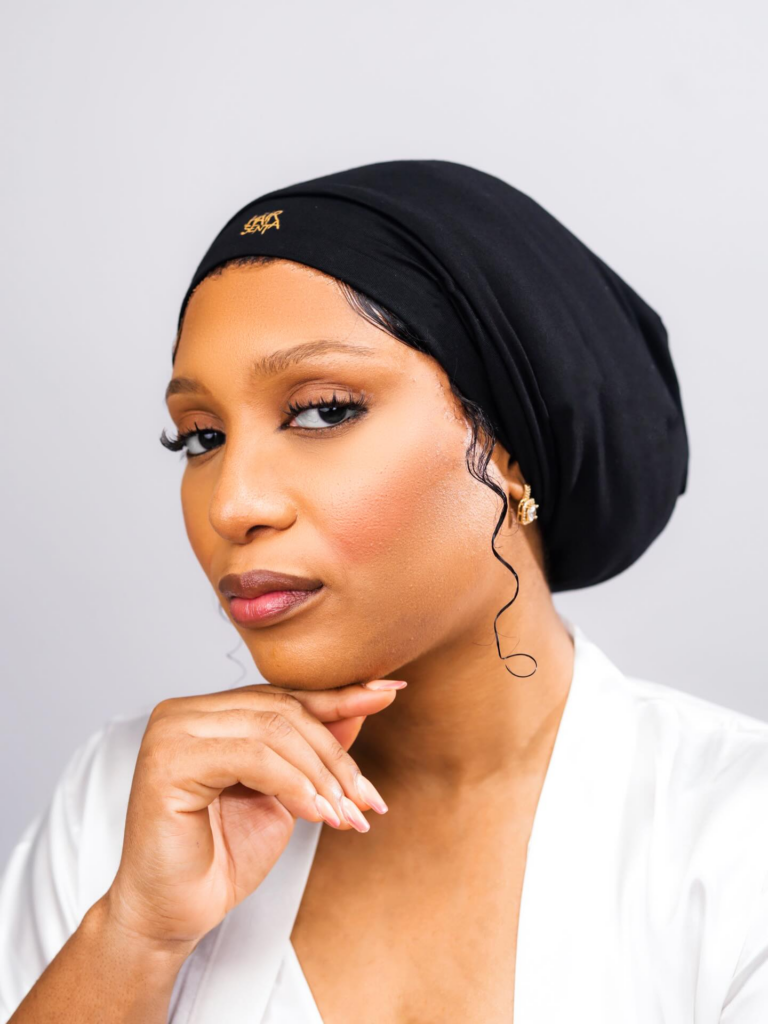
More Than Just Hair. It’s Your Crown. 👑
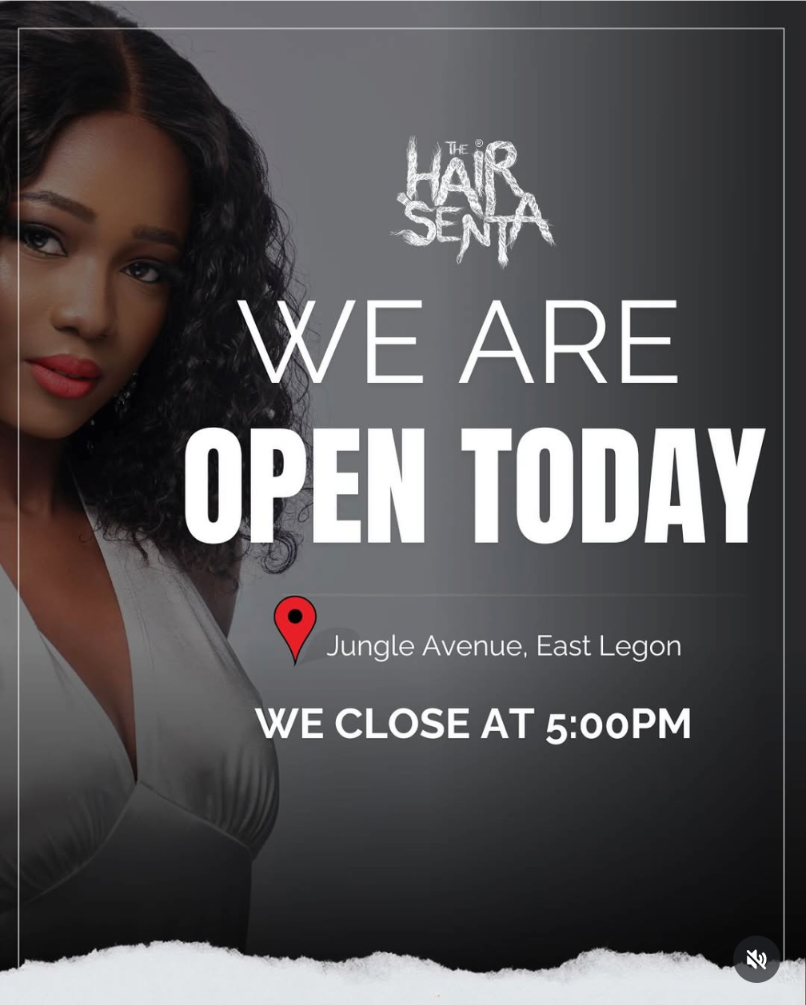
At Hair Senta, we don’t just sell extensions; we release the excellence, courage, and confidence already inside you. From the moment you walk through our doors at 24 Jungle Avenue, you aren’t just a customer—you are royalty.
Our legendary quality is matched only by our world-class hospitality. Experience the “Senta” welcome and discover why we are Ghana’s most trusted trademark for premium human hair.
✨ Feel the Difference: Premium Human Hair Extensions.
🌍 Global Reach: Shipping from Ghana to the World.
📍 Visit Us: 24 Jungle Avenue, Accra, Ghana.
Ready to transform?
📞 Call: (+233) 0544354455 / 0248629769
🌐 Shop: www.hairsenta.com
🟥 FEATURE ARTICLE
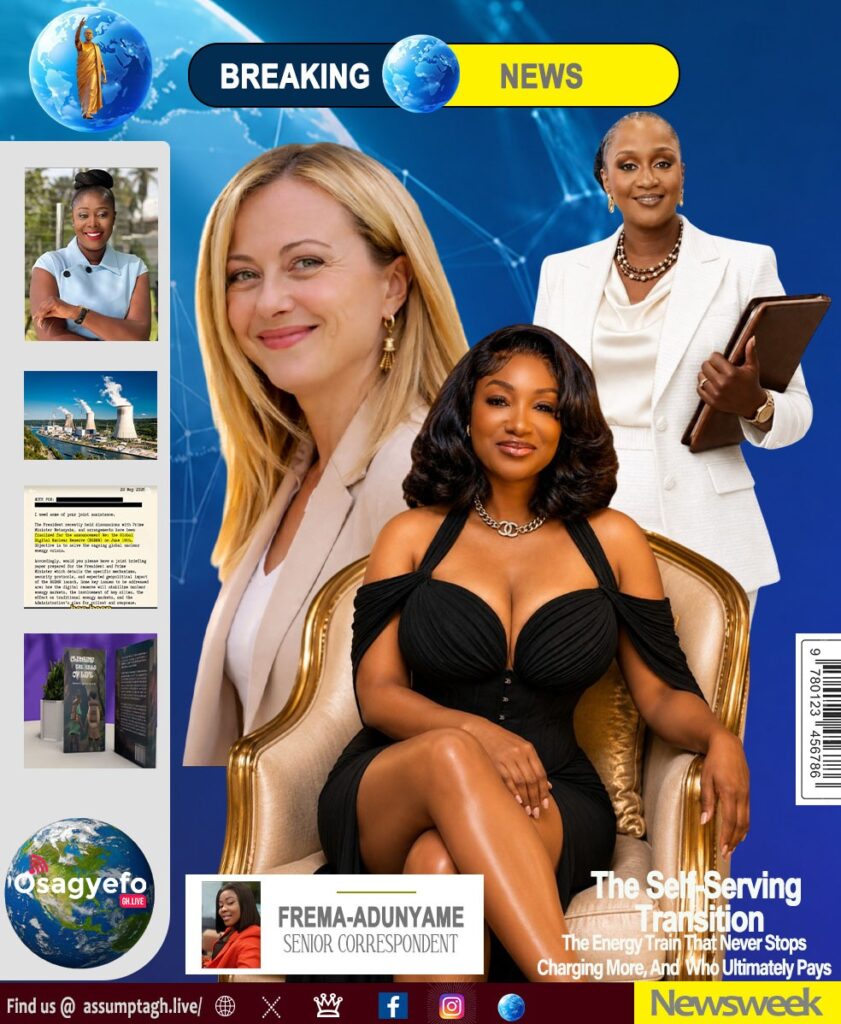
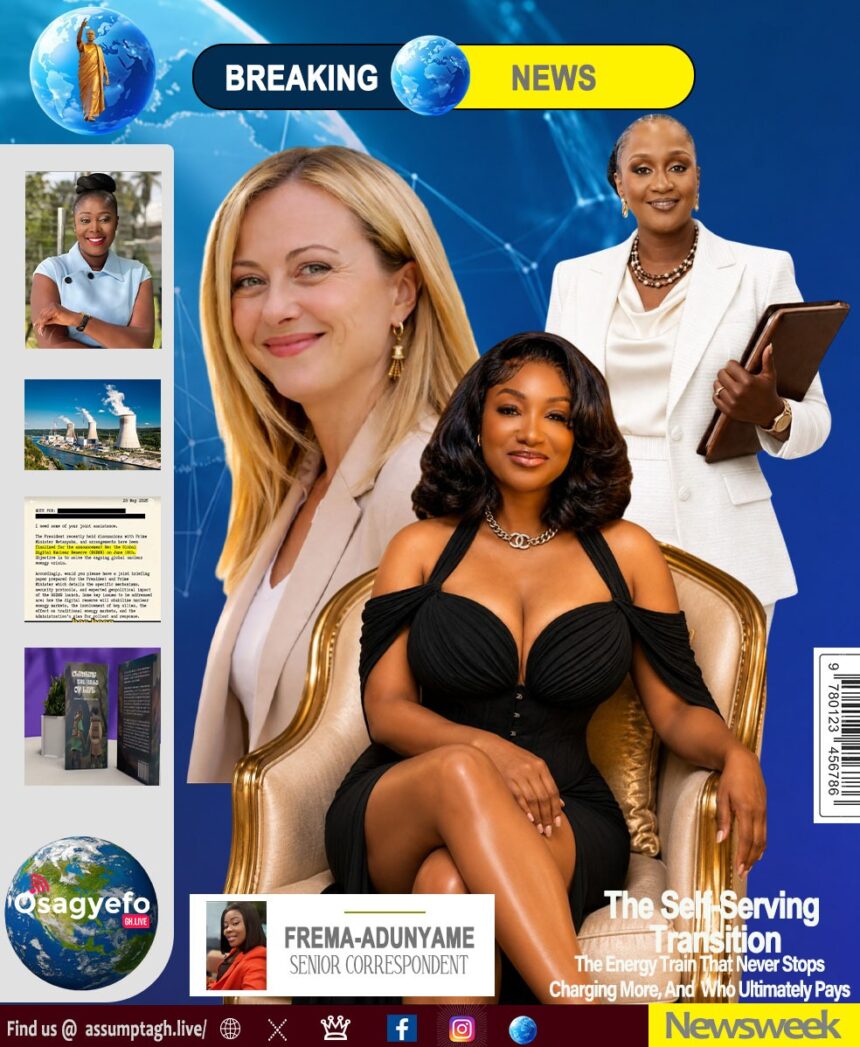
Self‑Serving Transition: The Energy Train That Never Stops Charging More—And Who Ultimately Pays
Rethinking power, equity, and leadership in the global shift from fossil fuels to nuclear energy.
In the evolving global conversation on leadership, energy, and economic transformation, a powerful metaphor emerges: that of an endless locomotive train—long driven by fossil fuels—now approaching a decisive turning point.
For more than a century, the global economy has been propelled by oil, fueling industrial growth, technological advancement, and global integration. Yet this same system has also contributed to structural inequalities, environmental strain, and deep dependencies that are increasingly difficult to sustain.
Today, the train continues to move—but the tracks are changing.
As climate pressures intensify and geopolitical tensions disrupt traditional energy flows, the world is steadily transitioning toward alternative energy systems. Among these, nuclear energy is once again being positioned as a reliable and scalable solution capable of supporting long-term global demand.
However, this transition raises critical questions.
The Core Debate: Legacy Power vs. Modern Pragmatism
The global discourse around this monumental energy pivot splits into two distinct, competing international perspectives:
1. The Institutional Critique: “Changing Engines, Keeping the Controls”
Some observers argue that while the source of energy may be changing, the underlying structures of control and economic power remain largely intact. In this interpretation, the locomotive has not fundamentally transformed—it has merely swapped engines.
The primary concern is that the shift toward nuclear energy could replicate legacy 20th-century geopolitical patterns, where access, pricing, and ownership remain heavily concentrated among a limited set of wealthy state actors and multinational conglomerates.
This perspective frames the transition as potentially “self-serving”—not because of the technology itself, but because of how it may be deployed and controlled. If pricing structures and access mechanisms are not transparently managed, the financial burden of the transition will fall disproportionately on ordinary populations worldwide.
2. The Functionalist View: Pragmatic Macro Realities
At the same time, others emphasize a more pragmatic view. They point out that nuclear energy offers indispensable grid stability, low carbon emissions, and vital resilience against supply shocks—making it a critical, non-negotiable component of future energy systems. From this standpoint, current developments reflect raw market realities and logical policy responses rather than coordinated control by global elites.
The Convergence: Why Governance Dictates the Destination
Yet both perspectives converge on a central truth: leadership matters.
As the global energy system evolves, decisions made today will shape not only the technical future of energy, but also the fairness and inclusivity of its distribution. Ethical leadership, transparent governance, and rigorous international cooperation will be essential in determining whether this transition leads to shared global prosperity—or deepens existing economic inequalities.
Ultimately, the locomotive metaphor invites reflection beyond raw technology. The train may be powerful. Its movement may be relentless. But its final destination—and who benefits along the journey—remains a matter of intentional, global choice.
💬 Join the Conversation: How can international regulatory frameworks ensure that the civilian nuclear transition protects consumer pricing in developing economies? Drop your thoughts in the editorial comments section at assumptagh.live/.
INTRODUTION
Leadership in a Changing Energy World: The Locomotive That Must Choose Its Direction
In the evolving global discourse on governance, energy, and macroeconomic transformation, a powerful metaphor has emerged: that of an endless locomotive train—long propelled by fossil fuels—approaching a decisive geopolitical and structural turning point.
For more than a century, the global economy has been driven by this “oil-powered locomotive,” a system that catalyzed unprecedented industrial expansion and technological advancement. However, this same architecture has entrenched systemic vulnerabilities, environmental externalities, and resource dependencies that are increasingly difficult to sustain in a multi-polar world.
The train remains in motion, but the structural tracks ahead are fundamentally shifting.
The Great Energy Transition: Pragmatism vs. Structural Asymmetry
As traditional energy paradigms face simultaneous pressure from climate mandates and geopolitical volatility, the international community is actively transitioning toward alternative baseload power. Within this new matrix, nuclear energy is increasingly positioned as a critical cornerstone—valued for its reliability, scalability, and capacity to secure long-term national sovereignty over power grids.
Yet, this transition exposes a deep divergence in global strategic analysis:
1. The Critical Perspective: Preserving Core Power Structures
Some analysts frame this transition through a critical lens, arguing that the underlying economic engine has not changed its nature. In this view, the “locomotive” is merely adapting—shifting its fuel source from hydrocarbons to uranium while attempting to preserve existing architectures of market control, pricing power, and economic asymmetry.
The core risk, according to this school of thought, is a replication of historical imbalances under a new technological framework. If ownership, technology transfers, and fuel-enrichment capabilities remain highly concentrated, the transition could impose disproportionate financial burdens on developing economies, widening the gap between technology-exporting states and energy-dependent populations.
2. The Pragmatic Perspective: Market Forces and Grid Resilience
Conversely, a more measured macro-analytic perspective argues that the pivot toward nuclear energy is dictated by raw utility rather than a coordinated effort to maintain hegemony. Decision-makers face immediate, non-negotiable imperatives:
- The legal mandate for decarbonization to meet international climate benchmarks.
- The urgent need for stable baseload power to support increasingly digitized economies (such as AI infrastructure and manufacturing).
- Insulation from supply shocks and maritime chokepoint vulnerabilities.
From this standpoint, independent regulatory frameworks, international compliance bodies, and transparent market dynamics will dictate the equity of the outcomes, rather than any singular institutional intent.
The Core Challenge: A Moral and Structural Mandate
Both interpretations converge on a fundamental reality: systemic change demands an evolution in leadership. As the economic locomotive transitions between energy paradigms, the role of governance across states, financial institutions, and industries becomes paramount.
The Structural Dilemma: The challenge ahead is not fundamentally technological; it is moral and architectural. Ethical governance, regulatory transparency, and inclusive policy design will determine whether this energy transition yields shared global prosperity or reinforces legacy divides.
Conclusion: Setting the Global Compass
Ultimately, the metaphor of the locomotive invites international observers to reflect on direction rather than raw momentum. The global energy apparatus is incredibly powerful, and its forward movement is inevitable. However, its ultimate destination depends entirely on the strategic choices made by those currently guiding the switchboard.
In a global community standing at a crossroads, the defining question is no longer whether the train will move forward—but who it will carry, and at what cost.
Geopolitical Realignment and the Concept of a Global Digital Nuclear Reserve
As global energy security and financial architecture undergo rapid evolution, a sophisticated debate is emerging at the intersection of traditional geopolitics and digital asset innovation. Central to this discussion is how state-level security strategies are interacting with the theoretical framework of a Global Digital Nuclear Reserve (GDNR)—a concept envisioning the tokenization of nuclear energy assets within the future global financial system.
The Geopolitical Catalyst: Security and Energy Vulnerability
Israeli Prime Minister Benjamin Netanyahu has long maintained that preventing Iran from acquiring nuclear weapons is central to both regional stability and international security. Concurrently, however, international observers recognize that nuclear energy—when subject to robust oversight and responsible governance—remains a critical component of the future global energy mix.
This tension highlights broader vulnerabilities in the global energy supply chain:
- Chokepoint Risks: Renewed regional tensions continuously threaten critical maritime corridors, most notably the Strait of Hormuz. Any sustained disruption here poses severe risks to global oil supply chains, driving price volatility and exposing the fragility of fossil-fuel dependence.
- The Pivot to Baseload Power: In response to these supply shocks, governments are increasingly reassessing alternative energy sources. Nuclear energy is a primary beneficiary of this shift, viewed as an indispensable provider of reliable, low-carbon baseload power necessary for national grid stability.
The Intersection of Nuclear Energy and Asset Tokenization
As geopolitical uncertainty accelerates the diversification of energy portfolios, these physical market shifts are intersecting with a major transformation in global finance: the tokenization of real-world assets (RWAs).
Enabled by advancements in distributed ledger technology (DLT), the conceptualization of a GDNR suggests that nuclear energy infrastructure and capacity could eventually be integrated into digital asset ecosystems.
Strategic Implications of a Digital Reserve
Proponents of the GDNR framework argue that if a structural shift in energy markets occurs, early engagement with nuclear-linked digital assets could offer significant strategic advantages.
| Dimension | Traditional Framework | Emerging GDNR Framework |
|---|---|---|
| Financing | Capital-intensive sovereign loans & corporate debt | Fractionalized investment via tokenized assets |
| Liquidity | Illiquid, long-term infrastructure commitments | Liquid, globally traded energy-backed digital tokens |
| Strategic Reserve | Physical stockpiling of fuel and resources | Digitized, verifiable reserves anchored to energy output |
Advocates frame this evolution as a modern continuation of historical precedents, where access to strategic energy resources has always dictated international relations and economic alignments. The difference today lies in the introduction of new financial technologies that alter how these resources are represented, traded, and leveraged.
A Divergences of Perspectives
The viability of a Global Digital Nuclear Reserve remains a subject of intense debate among global macro analysts and policymakers:
The Skeptical Consensus: Many experts caution against the overextension of speculative frameworks like the GDNR. They argue that current market shifts can be entirely explained by established factors—such as standard geopolitical competition, sovereign energy security mandates, and routine market-driven adjustments. From this perspective, there is insufficient evidence of a coordinated, systemic transition toward a digitized global energy reserve.
Looking Ahead
The discourse ultimately presents a fundamental question for institutional investors, policymakers, and international observers:
Are current market developments merely a temporary reaction to heightened geopolitical and economic friction, or do they signal the genesis of a deeper, structural transformation in the global energy and financial landscape?
Strategic Dialogue: Leadership, Human Development, and Global Peace
This executive dialogue brings together distinguished leaders across media, state governance, enterprise, and behavioral strategy to address a critical contemporary imperative: how ethical leadership, cultural intelligence, and human empowerment can be leveraged to cultivate global peace, systemic resilience, and sustainable development.
The Global Imperative: Instability and Institutional Erosion
The urgency of this conversation is underscored by sharp inflections in current macroeconomic and geopolitical data:
- A Fragile Peace: The 2025 Global Peace Index documents a systemic, multi-year decline in global peacefulness, driven by aggressive regional militarization and escalating geopolitical friction.
- [1] This trajectory is evidenced by nearly 240,000 violent fatalities recorded in 2024—marking a 27% year-over-year surge in global conflict incidents.
- [2]The Institutional Trust Deficit: According to the 2025 Edelman Trust Barometer, 61% of citizens worldwide report a moderate-to-high sense of grievance toward state, corporate, and multilateral institutions.
- [3] This pervasive trust deficit reflects deep societal anxieties regarding equity, structural accountability, and institutional representation.
Against this complex global landscape, traditional leadership frameworks are proving insufficient. The current era demands leadership that is explicitly ethical, inclusive, and fundamentally forward-looking.
Featured Global Perspectives

Fremaa Adunyame
Host & Broadcaster, Channel One TV / Citi FM
- Core Focus: Media Integrity, Democratic Accountability, and Public Discourse
Adunyame introduces a critical media-centric framework regarding the role of responsible journalism in stabilizing fractured societies. In an era characterized by hyper-fragmented information ecosystems and synthesized misinformation, her work emphasizes the stabilization value of objective, fact-based reporting.
Because trust in media mirrors the broader global institutional trust gap [3], transparent public interest journalism serves as a vital democratic counterweight—fostering the civic accountability required to support international peace and cross-border understanding.

Giorgia Meloni
Prime Minister of Italy
- Core Focus: Civilizational Resilience, Sovereign Governance, and Institutional Stability
Representing a prominent voice in European governance, Meloni’s perspective centers on national resilience and policy continuity during periods of intense geopolitical realignment.
With 65 active state-based conflicts recorded globally in 2025—the highest concentration since World War II [4]—sovereign administrative frameworks face unprecedented stress testing. Her approach examines how state actors can effectively balance distinct national identities with the realities of multilateral cooperation, mitigating economic and technological shocks to maintain long-term social cohesion.

Akosua Owusuwaa
Business Strategist, Author, & CEO of Hair Senta
- Core Focus: Purpose-Driven Enterprise, Human Capital Optimization, and Inclusive Innovation
Owusuwaa anchors the dialogue in entrepreneurial agility, human capability, and value creation. Her framework aligns directly with microeconomic data demonstrating that human-centric organizational structures yield tangible fiscal dividends:
Companies with deeply embedded inclusion models generate up to 19% higher innovation revenue [5], while organizations prioritizing diverse leadership pipelines consistently outperform less diverse peers across key financial metrics [6]. Her methodology frames personal accountability and strategic entrepreneurship as essential engines for wealth creation in a knowledge-driven global economy.

Dzigbordi Kwaku-Dosoo
Global Keynote Speaker & CEO, DCG Consulting Group
- Core Focus: Behavioral Strategy, Executive Excellence, and Cultural Intelligence (CQ)
Kwaku-Dosoo addresses the operational mechanics of leadership through the lenses of behavioral science and cultural intelligence. As multinational operations face a hyper-connected yet ethnically and politically polarized landscape, CQ has transitioned from a soft skill to a core strategic competency.
Macro research confirms that organizations cultivating highly inclusive, culturally intelligent workplaces are up to 39% more likely to financially outperform industry baselines [6]. Her focus provides a blueprint for navigating corporate complexity, bridging cross-cultural silos, and managing institutional transformation.
The Convergence: Modern Leadership Reimagined
When synthesized across media, governance, and commerce, a unified paradigm shift becomes evident: leadership must evolve to match the multi-polar realities of a transforming world.
The panel convenes for an international broadcast, structured for publication in Osagyefo Newsletter Magazine.
🌐 OSAGYEFO GLOBAL PANEL RECORDING
Broadcast Series: Power, Equity, and Leadership in the 21st Century
Moderator: Fremaa Adunyame
Panelists: Akosua Owusuwaa, Prime Minister Giorgia Meloni, Dzigbordi Kwaku-Dosoo

Fremaa Adunyame:
Good day to our viewers, listeners, and readers tuning in from across the globe. Welcome to this special international broadcast of the Osagyefo Global Dialogue. We are streaming live to an international audience spanning continents, bringing together diverse perspectives on the forces shaping our collective future. Today, we are diving into a theme that sits at the exact intersection of global survival, state sovereignty, and international finance: the structural shift in global energy grids and the leadership required to navigate it.
Before we open the floor, it is my distinct honor to welcome the esteemed members of our panel, who have joined us to lend their unique insights to this global conversation.

- Joining us from Rome is Prime Minister Giorgia Meloni, representing a vital perspective on European governance, national resilience, and the immense pressures currently facing state stability in a multi-polar world. Welcome, Prime Minister.

- We are also joined by Akosua Owusuwaa, an acclaimed business strategist, author, and CEO of Hair Senta, who anchors our discussion in human capital, purpose-driven enterprise, and economic equity. Wonderful to have you, Akosua.
- And finally, we have Dzigbordi Kwaku-Dosoo, global keynote speaker, behavioral strategist, and CEO of DCG Consulting Group, who brings essential expertise on executive leadership, cross-cultural intelligence, and institutional transformation. Welcome, Dzigbordi.
Thank you all for being here.
Opening Address: Fremaa Adunyame
Fremaa Adunyame:

Let us begin directly. The latest editorial in the Osagyefo Newsletter Magazine, alongside recent diplomatic statements, forces us to confront a highly complex and controversial aspect of modern geopolitics.
For decades, the official position maintained by Israeli Prime Minister Benjamin Netanyahu has been singular: Iran must be definitively prevented from acquiring nuclear weapons. This has long been framed as an absolute necessity for regional stability and global security. However, when we read between the lines of current policy shifts and the emerging discussions around a theoretical Global Digital Nuclear Reserve (GDNR), a much deeper debate unfolds among international analysts.
There is a growing school of thought among critical macro-observers suggesting that the long-standing tensions in the Middle East—including the recurring crises in the Strait of Hormuz, threat modeling around shipping corridors, and engineered volatility in the oil markets—are not merely isolated security incidents. Rather, some analysts argue these events are structurally linked to a broader, long-term effort to accelerate the reconfiguration of the world’s energy architecture.
From this perspective, the conversation extends far beyond regional defense; it enters the realm of global high finance. Observers point to the massive influence of major Western financial institutions, such as BlackRock under Larry Fink, which have spent years aggressively driving the tokenization of real-world assets, bonds, and commodities. The theory emerging from critical circles suggests a parallel with historical interventions in resource-rich nations like Iraq, Libya, or Venezuela: an effort to manage the decline of hydrocarbon dominance by establishing control over the next major baseload power source—nuclear energy. Proponents of this critique argue that by allowing fossil fuel supply lines to become increasingly volatile and expensive, market forces are effectively being steered toward a centralized, highly financialized nuclear infrastructure where technology, fuel enrichment, and pricing mechanisms remain concentrated in a few powerful hands.
This brings us directly to the title of our feature editorial: “SELF-SERVING TRANSITION: The Energy-Train That Never Stops Charging—And Who Ultimately Pays.”
As we rethink power, equity, and leadership in this global shift from fossil fuels to nuclear energy, we face a core dilemma. As the world races toward a new energy future, a critical question emerges: Who benefits from the transition—and who bears the cost?
We are looking at a profound tension between Geopolitics and Financialization. On one hand, we are told this is a necessary, pragmatic transition toward cleaner, more reliable, and secure low-carbon energy sources to save our planet and stabilize grids. On the other hand, the data forces us to ask whether powerful political and financial networks are positioning themselves to profit from a new era of structural energy dependence.
To guide our panel’s opening remarks, I want us to break this down across the five core pillars outlined in this month’s edition:
- The politics behind the global energy transition and state sovereignty.
- Nuclear power and the actual future of international energy security.
- The growing influence of institutional mega-funds and digital asset tokenization in energy markets.
- Resource geopolitics, strategic competition, and the widening gaps of global inequality.
- And crucially, the human cost: whether ordinary citizens across developed and developing nations will ultimately bear the regressive costs of this structural transformation.
When the global economic locomotive changes its tracks, who decides the destination—and who pays the fare?
Prime Minister Meloni, let us start with your perspective from the level of state governance. How do sovereign nations balance the urgent need for stable energy infrastructure against the risks of hyper-centralized financial control?
Prime Minister Giorgia Meloni:
Thank you, Fremaa, and greetings to my fellow panelists and our global audience. You have laid out an exceptionally raw, provocative framing that cuts directly to the bone of state survival.
From the perspective of national governance and European realism, we cannot afford the luxury of viewing this issue purely through the lens of abstract financial theories or idealistic energy transitions. For a sovereign state, energy security is not just an industrial asset—it is the foundational pillar of national defense, civic stability, and civilizational resilience.
When we look at the geopolitical chessboard in 2026, the vulnerabilities of the old model are glaring. The continuous volatility surrounding the Strait of Hormuz and the broader Middle East is a reminder that relying on highly localized, easily disrupted fossil fuel corridors leaves entire populations hostage to geopolitical blackmail. A nation that cannot secure its own baseload power cannot truly claim to be sovereign. Therefore, the strategic shift toward nuclear energy is not a manufactured conspiracy; it is an absolute mathematical and structural necessity for survival. Nuclear energy provides the dense, continuous, low-carbon baseload power that wind and solar simply cannot deliver to an industrialized society.
However, Fremaa, you raise a vital warning regarding the nature of the transition itself. The threat of a “self-serving locomotive”—where control over nuclear technology, fuel enrichment pipelines, and advanced digital financial layers becomes hyper-centralized—is an explicit danger to the nation-state.
If global institutional funds, like BlackRock or other high-finance architects, manage to fully financialize and tokenize these strategic energy reserves without state-level democratic checks, we risk replacing old geopolitical vulnerabilities with a new form of digital, borderless technocracy. A system where the pricing mechanisms and asset allocations of a nation’s core power grid are determined by algorithmic digital ledgers in New York or London is a system that strips elected governments of their ability to protect their own citizens.
Therefore, the role of state governance must be assertive. We must reject two extremes:
- We cannot succumb to a naive anti-development stance that rejects nuclear energy and leaves our grids vulnerable to collapse.
- But equally, we cannot passively hand over the keys of our energy future to unregulated global financial structures that view vital national infrastructure merely as liquid tokens to be traded for profit.
True leadership means that sovereign governments must command the switchboard. We must establish robust regulatory frameworks, invest heavily in state-backed domestic or cooperative nuclear technology, and ensure that international bodies maintain transparent oversight over fuel access. The destination of the energy train must be decided by sovereign peoples and their representative governments—not by volatile markets, and certainly not by centralized financial monopolies. If we fail to enforce this balance, it is indeed the ordinary citizens who will pay a devastating fare.

Fremaa Adunyame:
Thank you, Prime Minister. You have released a great feeling in the darkness, feelings which touched the American primitive savage mind. Thank you.
Turning our attention now to the broader socio-economic fabric, the structural realities of this transition extend deep into the global marketplace, where the risk of systemic inequality looms large.
Akosua, looking through the lens of business strategy, human capital, and economic equity, how do we prevent this emerging energy model from widening the gap between technology-exporting powers and developing economies? How can leadership ensure that human empowerment isn’t sidelined by concentrated capital?

Akosua Owusuwaa:
Thank you, Fremaa, and thank you, Prime Minister, for setting up such a realistic baseline for this conversation.
When we analyze the phrase “Self-Serving Transition” from an enterprise and developmental standpoint, the core dilemma is instantly recognizable: it is the classic problem of structural distribution. In business, if you optimize a system purely for the creators of the infrastructure while ignoring the consumers, the model eventually collapses under its own weight. The global energy market is no different.
Right now, the data tells us that inclusive, human-centered ecosystems yield the highest long-term returns. We know that organizations with diverse leadership and inclusive structures are significantly more agile and innovative. Yet, when we elevate this principle to the macro-global stage, we see a dangerous contradiction occurring. If the transition from fossil fuels to nuclear energy is financed and managed through hyper-centralized financial tokens and exclusive technology locks, we aren’t creating a sustainable global economy. We are simply building a more technically sophisticated form of economic exclusion.
For developing nations and ordinary communities worldwide, the primary asset is human capital—ingenuity, adaptability, and entrepreneurship. But human capital requires accessible, predictably priced power to thrive. If a country or a local industry is forced off traditional energy sources due to climate or geopolitical pressures, only to be met with an imported nuclear framework where they have zero equity, zero technology transfer, and zero control over the pricing tokens, their economic growth is effectively capped by external forces.
True equity in this new era cannot simply be about giving developing nations a seat at the table to buy someone else’s power. It must involve:
- Fractionalized Ownership, Not Just Fractionalized Investment: Utilizing digital ledger technologies not just to enrich global mega-funds, but to democratize domestic asset ownership and allow local capital to fund local grid infrastructure.
- Decentralized Access to Knowledge: Ensuring that the shift to nuclear power includes genuine, cross-border technology transfers so that local engineering and leadership sectors can manage their own energy destinies.
If the “energy train” is going to carry humanity forward equitably, leadership must deliberately design the financial architecture to prevent capital hoarding. We must empower the individual to create value, rather than structuring the entire global grid to extract value from them. Without that moral mandate, the transition will remain entirely self-serving.

Fremaa Adunyame:
Thank you, Akosua. You have brilliantly shifted the focus back to the foundational element of global development: the human being.
To close this opening round, let us address the operational execution of this transition. Dzigbordi, as an expert in behavioral strategy and corporate governance, you understand that navigating an inflection point of this magnitude requires more than just capital and technology—it requires a profound shift in leadership psychology.
How do we apply cultural intelligence (CQ) and ethical leadership to dismantle these deeply entrenched, self-serving corporate structures? How can executive leaders balance competitive corporate strategy with global accountability?
Dzigbordi Kwaku-Dosoo:
Thank you, Fremaa. You have brought us directly to the operational cockpit of this locomotive.
When we analyze a concept as complex as the Global Digital Nuclear Reserve (GDNR) through the lens of corporate strategy and behavioral dynamics, we must recognize that the primary barrier to an equitable transition is not technological—it is behavioral. The “self-serving” pattern we are diagnosing is a direct symptom of low Cultural Intelligence (CQ) combined with legacy, extractive executive mindsets.
In traditional corporate strategy, leadership has long been conditioned to view resource allocation as a zero-sum game: secure the asset, control the supply chain, lock in the pricing power, and maximize shareholder returns. When major Western financial institutions and sovereign actors apply this exact 20th-century playbook to 21st-century technologies like digital asset tokenization and nuclear energy, they create a severe psychological and cultural mismatch with the rest of the world. They operate with a blind spot, failing to realize that a hyper-connected, multi-polar world will no longer tolerate unilateral economic asymmetry.
Ethical leadership in this changing energy landscape demands that we re-engineer executive strategy around three core behavioral pillars:
- Elevating Cultural Intelligence (CQ): Global decision-makers must move beyond localized, Western-centric market assumptions. High CQ enables an executive or a policymaker to understand how energy dependence impacts the social fabric of diverse regions differently. You cannot design a global digital reserve from an insular boardroom in New York and expect it to be trusted or sustainable in Accra, Rome, or Riyadh.
- Shifting from Extraction to Co-Creation: Advanced corporate strategy must recognize that long-term grid resilience is intrinsically tied to global stability. If the tokenization of nuclear assets is used purely as a financial instrument to artificially drive up legacy energy costs and force dependence, it will trigger systemic geopolitical friction. Ethical governance dictates that digital ledgers must be structured to foster transparent, cross-border public-private partnerships that share risk and reward equitably.
- Behavioral Accountability: Leaders must possess the moral courage to measure success not just by the velocity of capital or the accumulation of tokenized reserves, but by the systemic health of the global consumer base.
Macro research consistently demonstrates that organizations cultivating culturally intelligent, inclusive, and highly transparent governance structures are up to 39% more likely to financially outperform their peers over the long term. True strategic excellence is not about owning the tracks and charging the highest fare; it is about ensuring the structural integrity of the entire journey. If the leaders guiding this transition fail to adopt a high-CQ, ethical framework, they will find themselves steering an extraordinarily powerful locomotive toward a fractured and unsustainable destination.
Fremaa Adunyame:
Thank you, Dzigbordi. What I heard you say made me take something deeply critical away with me. It brings to light the sobering argument that strategic positions—such as the geopolitical posture on Iran—can be leveraged by major Western corporate syndicates and financial monoliths like BlackRock. By systematically positioning themselves to govern and dictate the terms of the emerging energy market, they acquire the structural and material resources necessary to control the global landscape, while legislative bodies like the United States Congress provide just enough surface-level financial or political concessions to keep the systemic machinery running smoothly.
Rather than viewing these coordinated, multi-decade macro-maneuvers as amateurish or childish, a critical analyst would look at this through a much sharper lens. One has to wonder: does this ongoing consolidation of global resources reflect the highly calculated, deeply entrenched attitude of the world’s most sophisticated economic pickpockets, quietly shifting the wealth of nations from the background?
Let us direct the panel to look closely at this financial machinery. I want us to dissect the specific, active role of BlackRock and the tokenization of real-world assets (RWAs) within the global energy markets.
We are no longer talking about a futuristic concept. As we look at the data for 2026, the tokenization of real-world assets has surged into a multi-hundred-billion-dollar sector, spearheaded by institutional funds like BlackRock’s BUIDL. In his recent annual briefing, BlackRock CEO Larry Fink explicitly compared the current state of blockchain-based asset tokenization to the internet in 1996, stating it will completely overhaul the “plumbing” of global capital.
The strategy is clear: as nations face immense costs to achieve domestic energy self-reliance and build out massive, capital-intensive nuclear grids, traditional state funding and bank loans are proving insufficient. BlackRock is positioning the capital markets to fill this gap. By converting massive physical energy infrastructure, supply lines, and commodity reserves into digital tokens on decentralized rails, they are creating a system where strategic energy assets can be fractionalized, traded 24/7, and leveraged as instant financial collateral worldwide.
The critical question for our panel is the underlying motive and the ultimate systemic risk. Prime Minister Giorgia Meloni, let us start with you to unpack this corporate strategy. Is this institutional push for energy tokenization a genuine attempt to democratize access and modernize global market efficiency as they claim? Or is it the ultimate structural trap—a highly sophisticated mechanism designed to financialize human survival, capture the sovereign energy grids of nations, and ensure that a centralized financial elite retains absolute pricing power over the future global locomotive?
Prime Minister Giorgia Meloni:
Fremaa, to answer your question definitively, we must look at the cold, empirical data underpinning the global financial architecture. This is no longer a theoretical debate about decentralized finance; as we look at the capital landscape, we are witnessing the systematic migration of traditional institutional capital onto shared digital ledgers.
According to global macro data, the total market for public-chain tokenized real-world assets (RWAs) has scaled rapidly, exceeding the $30 billion threshold. This paradigm shift is being actively led by the world’s largest asset manager. BlackRock’s USD Institutional Digital Liquidity Fund (BUIDL)—issued on public blockchain infrastructure in partnership with Securitize—stands as a clear proof-of-concept, holding billions in assets under management. Furthermore, BlackRock has filed with the U.S. Securities and Exchange Commission (SEC) to expand this infrastructure, launching new vehicles such as the Daily Reinvestment Stablecoin Reserve Vehicle and moving components of its $7 billion money-market funds directly on-chain.
From a structural standpoint, BlackRock’s multi-stage strategy is designed to overhaul the very “plumbing” of global capital markets through a highly calculated trajectory:
[ STAGE 1 ] Stablecoins & Yield Infrastructure (Digital Dollars)
[ STAGE 2 ] On-Chain Government Debt (Tokenized Treasuries)
[ STAGE 3 ] Expansion to Capital-Intensive Sectors (Private Credit & Equities)
[ STAGE 4 ] Global Infrastructure Capture (Energy Grids & Sovereign Reserves)
By transitioning trillions of traditional fiat dollars into permissioned, blockchain-native ERC-20 token wrappers, major institutional managers eliminate legacy clearing houses, settlement delays, and regional regulatory frictions. They are building a unified, 24/7/365 settlement network.
As a sovereign state leader, the geopolitical hazard is clear: when this infrastructure moves from short-term government debt to capital-intensive energy sectors like nuclear power, it creates a borderless, private financial registry. The risk is that the physical energy grids of independent nations become fractionalized collateral within an immutable digital ledger dominated by a small cartel of global asset managers. If the plumbing of our energy security is privatized on public chains, the nation-state loses its supreme leverage over its own critical infrastructure.
Fremaa Adunyame:
Thank you, Prime Minister, for contextualizing that massive shift in global plumbing.
Akosua, let us bring this directly to the geographic regions that have historically borne the heaviest costs of industrial transitions. When global mega-funds can tokenize, fractionalize, and trade vital energy infrastructure across a borderless digital ecosystem, what does this mean for the economic sovereignty of developing nations?
Akosua Owusuwaa:

Fremaa, from the perspective of developing economies, particularly across Africa and Latin America, this financial plumbing model represents an asymmetric threat to resource sovereignty. It is an updated, highly automated form of economic extraction.
Historically, developing nations have struggled with the “infrastructure gap”—the inability to secure fair, low-cost capital to build out critical baseload power plants. When institutions like BlackRock financialize the energy transition through real-world asset tokenization, they frame it as a solution: a way for developing markets to attract global liquidity by fractionalizing their state assets into tradeable digital tokens.
However, the structural reality reveals a profound danger to national self-determination:
- The Sovereign Wealth Drain: When a developing nation’s future energy capacity—such as a domestic nuclear grid or uranium reserve—is tokenized and uploaded to a global ledger, local wealth is instantly financialized and externalized. The primary financial returns and yield spikes do not remain within the local economy to fund schools, healthcare, or small-business innovation. Instead, the profits are captured by international yield-aggregators and institutional wallets in Western financial capitals.
- Loss of Tariff and Pricing Control: A sovereign nation must maintain the policy flexibility to subsidize or regulate energy costs to protect its citizens from poverty. However, if a domestic energy grid is governed by on-chain smart contracts, programmatic collateral pools, and foreign cross-border digital registries, local pricing is subjected to international market arbitrage. The cost of electricity in a local community becomes tethered to the liquidation parameters of a global fund. If a macro crisis occurs, the algorithm automatically prioritizes the preservation of the token’s value over the survival of the local consumer.
This is the deeper meaning of a “Self-Serving Transition.” If developing nations do not actively build their own sovereign digital financial frameworks and mandate strict local-equity thresholds for all tokenized infrastructure, they will merely be leasing their own sunlight, their own minerals, and their own nuclear power from a digital pickpocket operating in the background. Ethical leadership requires us to ensure that technology serves to democratize capital locally, rather than executing a systemic, borderless asset grab.

Dzigbordi Kwaku-Dosoo:
Fremaa, your description of an “economic pickpocket” is a severe behavioral reality when viewed through the mechanics of institutional asset management. What BlackRock is doing by linking AI infrastructure, energy demands, and real-world asset (RWA) tokenization is a masterclass in shifting the very plumbing of global capital control.
When we look at the corporate governance and executive accountability metrics of this shift, BlackRock’s tokenization model fundamentally distorts the relationship between a state’s infrastructure and its citizens. In corporate governance, we emphasize accountability to the stakeholder. But when you look at the architecture of institutional products like BlackRock’s BUIDL fund or their recent SEC expansions to integrate multi-billion-dollar money markets onto public blockchain rails, a dangerous structural mutation occurs.
This financial plumbing model disrupts executive accountability and state governance across three structural dimensions:
1. The Erasure of Local Corporate Accountability
Traditionally, if an energy utility company or a state nuclear regulatory board builds a power grid, the executive leadership is held accountable by local regulators, domestic boards, and the consumers paying the utility bills.

Tokenization changes the customer entirely. BlackRock’s strategy does not look for customers through traditional local distribution; their customers are decentralized finance (DeFi) protocols, secondary collateral venues, and global yield-aggregators. When a nation’s core baseload nuclear power structure is digitized into fractionalized, 24/7 tradeable tokens, the executives running that energy system cease to answer to the citizens using the power. Instead, their performance is judged by the token’s on-chain liquidity, its yield efficiency, and its value as collateral on international trading desks. The local consumer is completely decoupled from the corporate governance loop.
2. The Algorithmic “Hollow Out” of Executive Discretion
Ethical leadership requires human intervention—balancing commercial margins with public equity, especially during economic shocks. However, tokenized asset ecosystems rely heavily on smart contracts, automated liquidity pools, and programmable collateral calls.
If a macro geopolitical crisis occurs—such as a closure of the Strait of Hormuz or a sudden oil supply spike—tokenized energy assets will be subject to instantaneous, algorithmic liquidations and margin adjustments executed in milliseconds. The human executive loses the psychological and operational bandwidth to intervene or exercise ethical discretion. The grid’s financial value becomes automated, prioritizing institutional preservation over public welfare.
3. The Congressional Pacification Loop
This brings us directly to the political architecture you described, Fremaa. When we look at legislative bodies like the United States Congress, we are seeing low corporate governance standards disguised as policy. By allowing mega-funds to financialize the energy transition, the state effectively abdicates its infrastructural duties.
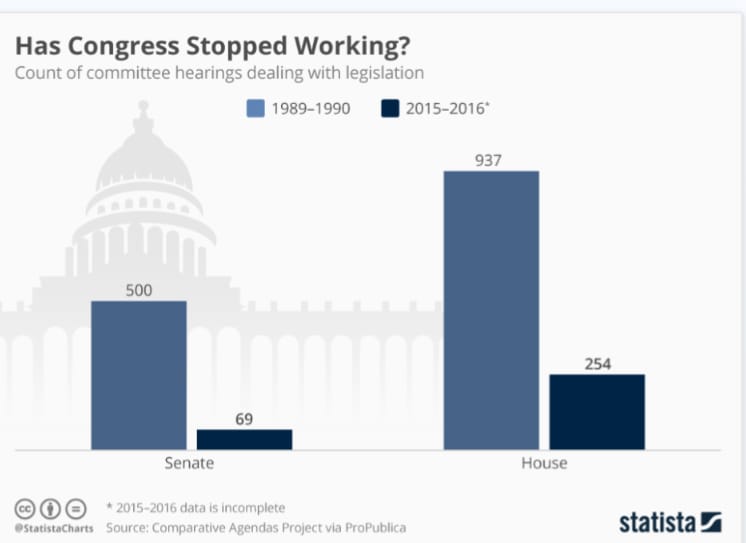
Rather than funding and governing stable grids transparently, politicians permit these private financial monoliths to construct the digital pipelines. The “few dollars” thrown back to the public or to minor regulatory bodies are merely behavioral pacification tools—short-term subsidies or minor compliance checks designed to mask the quiet, background transfer of absolute pricing power away from sovereign nations and into centralized private registries.
The Strategic Takeaway
This is not an amateur corporate strategy; it is highly sophisticated economic architecture. By utilizing the legitimate global demand for low-carbon nuclear baseload power, institutional architects are inserting a digital financial layer between the resource and the human being.
If executive leadership across international markets continues to mistake this financial capture for simple “market modernization,” they will discover too late that they no longer govern the locomotive. They are merely passengers on a train where the route, the destination, and the cost of the ticket are completely controlled by a centralized ledger.
Frema Adunyame:
“Thank you, Dzigbordi. Your emphasis on human capital, cultural nuance, and behavioral adaptation in the digital age provides the exact foundation we need. Technology is never just a technical challenge; it is a human and political one. When we talk about infrastructure moving to decentralized architectures, we are ultimately talking about power, trust, and the boundaries of state authority.
To take this conversation from behavioral adaptation to structural enforcement, we must look at how states intend to command these networks. For that perspective, I am joined now by Italian Prime Minister Giorgia Meloni. Prime Minister, welcome. How do sovereign states legally regulate and intercept private, tokenized energy networks without compromising national security or legal jurisdiction?”
Prime Minister Giorgia Meloni:
“Thank you, Frema. Let us be direct: a sovereign state cannot tolerate the existence of an unmonitored shadow grid. Private, tokenized energy networks—where peer-to-peer electricity trading occurs on decentralized ledgers using digital tokens—pose a dual threat to national energy security and fiscal sovereignty. If a state cannot track the electrons or the euros, it ceases to have jurisdiction.
Under European law, and within our broader national security framework, we address this through three concrete pillars of regulation and physical interception:
1. Re-establishing Legal Jurisdiction Over Decentralized Infrastructure
We do not regulate abstract algorithms; we regulate the physical entities and legal persons who deploy them.
- The Infrastructure Nexus: No matter how decentralized a blockchain protocol claims to be, it relies on physical assets—solar arrays, microgrids, battery storage facilities, and smart meters. Under the EU’s Markets in Crypto-Assets (MiCA) framework and our national energy codes, any entity issuing an Asset-Referenced Token (ART) backed by real-world energy must be registered as a legal entity within the EU.
- Regulatory Gateway: If a private tokenized network fails to register, maintain sufficient physical reserves, or publish an approved regulatory whitepaper, it is designated an illegal utility.
2. Physical Interception and Smart Meter Control
A state does not need to crack a private cryptographic key to disable an illicit network; we simply control the physical point of transmission.
- The Distribution Edge: Private microgrids must still rely on public distribution infrastructure or cross-property transmission lines to operate at scale. We exercise regulatory control at the physical edge.
- Hardware-Level Enforcement: By law, all smart meters and grid-tie inverters must comply with state-mandated firmware standards. If a private network attempts to run an unmapped peer-to-peer trading ledger, the state-controlled distribution system operators (DSOs) can remotely throttle, disconnect, or isolate those nodes from the national grid to preserve operational stability.
3. Financial and Data Interception
Sovereignty requires absolute visibility into transaction data to prevent money laundering, tax evasion, and the financing of illicit operations.
- Oracles and Gateways: Tokenized energy networks rely on data feeds, or “oracles,” to verify that a megawatt of power was actually produced and delivered before a token is released. We mandate that these data protocols comply with strict anti-money laundering (AML) and “Travel Rule” requirements.
- The Capital Chokepoint: If the tokens cannot be legally converted into fiat currency via compliant Crypto-Asset Service Providers (CASPs), the economic incentive for the private network collapses. We intercept the flow of capital at the regulated on-and-off ramps.
We embrace innovation, but never at the expense of national sovereignty. The grid remains under the ultimate authority of the state.”
Fremaa Adunyame:
Thank you, Prime Minister Meloni, for that exceptionally sharp breakdown of the legal and physical levers of state power.
As we bring this global dialogue to a close, your insights—alongside those of Akosua and Dzigbordi—bring us squarely back to the sobering core theme of this month’s Osagyefo Quarterly editorial: “SELF-SERVING TRANSITION: The Energy Train That Never Stops Charging More—And Who Ultimately Pays.”
This discussion has successfully forced a critical rethinking of power, equity, and leadership as the global locomotive shifts from fossil fuels to nuclear energy. However, as independent journalists, we must expose the other problematic layers of this architecture. A highly troubling aspect of this system is how the United States Congress frequently remains silent, passing broad legislative frameworks that effectively hand over long-term strategic authority to private corporations and mega-financial syndicates. This structural passivity grants these institutional networks the implicit power to project systemic economic force over vulnerable and developing populations globally.
When you analyze the domestic dynamics driving these Western policy decisions, a stark class division sits firmly on the table. The typical decision-makers and high-net-worth brackets backing these sweeping transformations are a privileged class of wealthy individuals who can easily absorb regressive tariff hikes, carbon taxes, or fluctuating tokenized utility pricing. To a privileged elite, an escalating energy bill is a minor operational fee; to a struggling family or a developing enterprise, it is a structural barrier to survival. This stark imbalance highlights the deepest moral hazard of our time: the rules of the global energy transition are being written by those who will never have to worry about the price of the ticket.
[Closing Remarks & Panel Adjournment]

Fremaa Adunyame:
On behalf of the entire editorial team here at Osagyefo Newsletter Magazine, I want to express my deepest gratitude to our exceptional panel of global minds for sharing their invaluable strategic frameworks today.
- Thank you, Prime Minister Giorgia Meloni, for anchoring us in the raw realities of state sovereignty, civilizational resilience, and regulatory enforcement.
- Thank you, Akosua Owusuwaa, for reminding us that global economic systems are entirely hollow without a baseline of human capital optimization and distribution equity.
- And thank you, Dzigbordi Kwaku-Dosoo, for providing the essential psychological toolkit of cultural intelligence (CQ) and corporate accountability required to challenge legacy power structures.
Most importantly, we thank you—our international readers and viewers tuning in from every corner of the world at assumptagh.live/. The momentum of the global economic train is undeniable, but the destination remains an active battleground of policy, capital, and human will.
Until our next Global Dispatch on Monday, 15 June 2026, keep interrogating the structures of power, stay vigilant, and good day.
[Broadcast Concluded]
Our Shared Humanity Soka Gakkai Buddhist Movement .
An introduction to the Soka Gakkai and Nichiren Buddhism. Where do the teachings originate from? What is the philosophy of Buddhism? How do Soka Gakkai members apply it in their daily lives?
The Soka Gakkai is a global community-based Buddhist organization that promotes peace, culture and education centered on respect for the dignity of life. Its members in 192 countries and territories study and put into practice the humanistic philosophy of Nichiren Buddhism.
Soka Gakkai members strive to actualize their inherent potential while contributing to their local communities and responding to the shared issues facing humankind. The conviction that individual happiness and the realization of peace are inextricably linked is central to the Soka Gakkai, as is a commitment to dialogue and nonviolence.
Subscribe to our channel: / sgivideosonline
Visit our website: https://www.sokaglobal…
Like us on Facebook: / sgi.info
Follow us on Instagram: / sgi.info
Follow us on Twitter: / sgi_info


https://www.instagram.com/babiesandtodds_?igsh=MWs0ZHlsbjcxNXEyZg==
Babies & Toddlers Daycare (BTDC)
Nurturing Excellence. Cultivating Peace.
Babies & Toddlers Daycare (BTDC) welcomes families from all walks of life to our premier Daycare and Preschool in the heart of Windhoek. We are a community-centered institution dedicated to the dignity of life. Our approach goes beyond traditional childcare, integrating a humanistic philosophy that prepares the next generation to be compassionate global citizens.
Why Families Choose BTDC
- A “Home Away from Home” 🏠 A warm, safe, and nurturing sanctuary conveniently located right in the city center.
- Values-Based Learning 🤝 We prioritize peace, culture, and mutual respect, embedding these core principles into daily interactions.
- Creative Freedom 🎨 Featuring dedicated, inspiring spaces designed for children to play, share, explore, and innovate.
Enrolling Now for a Brighter Future ✨
Give your child the foundation they deserve. Join a community that values who they are and who they will become.
- 📍 Location: Heart of Windhoek, Namibia 🇳🇦
- 📞 Inquiries: +264 81 673 7599
- 💻 Visit Us: www.babiestodds.com




https://www.instagram.com/gahutudenim?igsh=MWpsNjZ1bTFvdHNsdw==
Gahutu Denim: Made for the Modern Woman
Why choose between professional and comfortable? Gahutu Denim delivers both.
Polished: A refined silhouette that replaces your office slacks.
Flexible: Curve-tight stretch technology that holds its shape.
Breathable: Lightweight denim designed specifically for the African climate.
From morning meetings to evening social hours—stay cool, stay confident, and look incredible.
👉 Upgrade your wardrobe: gahutudenim.com
Key Improvements Made:
Active Language: Replaced passive phrases with stronger verbs (e.g., “mirrors your movement” instead of “moves with you”).
Benefit-First: Focused on the feeling of wearing the jeans (confidence, coolness, power).
Clarity: Streamlined the description of the “Tropical Climate” feature to make it a unique selling point.
Which of these fits your brand’s voice best?


The Pinnacle of African Luxury: LaurenHauteCouture
Step into a world where contemporary global fashion is boldly redefined by African heritage. LaurenHauteCouture, an entrepreneurial, multiple award-winning women’s wear brand, consistently pushes the boundaries of elite craftsmanship.
As captured brilliantly in the file 1781429236170.png, this ensemble stands as a masterclass in structural precision and avant-garde elegance:
- The Silhouette: A clean, tailored cream structural peplum jacket featuring a sharp, straight, and impeccable fit through the waist.
- The Focal Point: An exquisite, asymmetrical collar embellished with dense, crimson-red beadwork that cascades down the torso, mimicking the rich texture of royal African artistry.
- The Movement: A sweeping, high-waisted floor-length A-line skirt patterned with bold, rhythmic black and white abstract brushstrokes. It offers an effortless blend of modern edge and timeless sophistication.
Osagyefo IMAGINE-WORKS: A Heartfelt Tribute to Contemporary Mastery
At the heart of African creative expression, Osagyefo IMAGINE-WORKS praises the profound depth, vision, and innovative creativity of LaurenHauteCouture. Osagyefo-IMAGINE celebrates the bold and elegant creations from African designers, blending modern trends with the rich, diverse, and timeless creativity of the continent.
Together, we share an exclusive lens on African creativity, fashion, heritage, and inspiration. LaurenHauteCouture does not merely make clothing; they construct wearable narratives. Through pieces like the one in 1781429236170.png, global style enthusiasts can discover African designers shaping contemporary global fashion. This collaboration invites you to explore the heart, purpose, and story behind every single design.
Versatility Defined: Corporate Office to Elegant Dinner
This ensemble effortlessly bridges the gap between commanding professional spaces and high-society evening events:
| Setting | Styling & Fit Adaptation |
| The Corporate Office | The garment’s straight, impeccable tailoring, structured shoulders, and modest neckline command respect and exude high-powered confidence in executive boardroom meetings. |
| The Elegant Dinner | The vibrant red beadwork and the dramatic, sweeping volume of the skirt immediately transition the outfit into a majestic statement piece perfect for gala dinners, red carpets, and formal evening affairs. |
Experience the Story: LaurenHauteCouture invites you to embrace a legacy of boldness, precision, and unapologetic luxury. Are you looking to style this particular look for a specific upcoming corporate gala or a formal evening event?


https://www.instagram.com/evic.store?utm_source=ig_web_button_share_sheet&igsh=ZDNlZDc0MzIxNw==
Discover Evic: Contemporary African Luxury Defined
Evic is redefining global contemporary women’s fashion through an uncompromising commitment to structural precision and rich storytelling.
As captured in overview_image_185249559_331008.png, this signature chocolate-brown ensemble balances geometric straight lines with fluid, organic drape. The top features a precisely structured, sleeveless shoulder profile that meets a soft, blouson bodice. This transitions seamlessly into a wide, high-waisted band that shapes the torso before releasing into an avant-garde, asymmetrical gathered skirt. The architectural volume is hemmed with absolute technical precision, creating a clean, high-fashion silhouette that stands as a testament to immaculate garment construction.
Osagyefo IMAGINE-WORKS: A Partnership in Heritage and Innovation
Through an exclusive lens on African creativity, fashion, heritage, and inspiration, Osagyefo IMAGINE-WORKS praises the profound depth, vision, and innovative creativity of Evic. Osagyefo-IMAGINE celebrates the bold and elegant creations from African designers, blending modern trends with the rich, diverse, and timeless creativity of the continent.
Every silhouette from Evic serves as a portal to discover African designers shaping contemporary global fashion. This collaboration invites style connoisseurs to look beyond the aesthetic and explore the heart, purpose, and story behind every design.
Adaptive Functionality: Corporate to Dinner
Engineered for the multifaceted modern woman, this versatile piece transitions effortlessly across elite spaces:
- Corporate Offices: The structural shoulders, high neckline, and straight, sophisticated mid-length tailoring project authority and polished elegance in corporate boardrooms.
- Dinner Engagements: The avant-garde draping, deep rich hue, and artistic asymmetric hem offer a high-fashion, striking presence perfect for fine dining or evening galas.
Built for the Warm Ghanaian Climate
Recognizing that Ghana is warm, Evic engineers its garments for maximum breathability without sacrificing structure. The lightweight, premium fabric choices ensure exceptional airflow, making this outfit incredibly comfortable for hot days while maintaining its crisp, luxurious form from morning to night.
Experience Evic
- Store Location: Labone, Accra, Ghana
- Operating Hours: 8:30 AM – 7:00 PM
- Online Shop: evic.store
- Direct Inquiry & Ordering: Connect via WhatsApp at api.whatsapp.com/send?phone=233593719227 or through our additional brand lines.
Would you like recommendation details on styling this piece with specific footwear or accessories for a corporate event?


https://www.instagram.com/peaches_facebar?utm_source=ig_web_button_share_sheet&igsh=ZDNlZDc0MzIxNw==





Connecting Ghana to the World with Everyday Essentials
Step into a lifestyle of refined quality and national pride with Everyday Essentials—your premier global destination for premium Ghanaian natural spices, Flora tissues, Officeandcobysa elegant dresses, and much more.
At the forefront of this movement is the brilliant Serwaa Amihere Esq. As a renowned broadcast journalist and a practicing lawyer, she bridges the gap between media, law, and lifestyle. Serwaa Amihere’s unique professional duality defines her curated product line:
- The Sharpness of a Lawyer: With her rigorous legal background, she ensures complete regulatory compliance, consumer safety, and absolute integrity behind every product.
- The Voice of a Journalist: As an award-winning broadcast journalist, she uses her platform responsibly to champion local industries, amplifying Ghana’s finest craftsmanship to the international stage.
- Uncompromising Quality Control: Her dual roles demand absolute precision. Every single consumable item, from natural spices to everyday lifestyle goods, undergoes strict quality checks. The uniformity of her products is rigorously maintained, ensuring they are exceptionally good, pure, and safe for human consumption.
This is the collection of a journalist and a lawyer who doesn’t betray her country; instead, she protects its people and elevates its global reputation through excellence.
Osagyefo IMAGINE-WORKS: Celebrating Truth and Premium Standards
Osagyefo IMAGINE-WORKS looks upon her beautiful work with immense pride and profound respect. Osagyefo-IMAGINE celebrates the bold stand of Serwaa Amihere Esq. and her products’ uncompromising quality.
In a market saturated with mass production, Osagyefo-IMAGINE recognizes her curated collection as a masterclass in patriotism and premium standards. She does not merely endorse products; she builds trust, combining her legal oath to protect with her journalist’s commitment to truth. Through this visionary work, everyday consumers across the globe gain access to healthy, authentic, and high-tier Ghanaian essentials.
Why Choose Serwaa Amihere’s Curated Products?
| Feature | The Everyday Essentials Promise |
| Expertly Curated | Trusted and handpicked by a top Ghanaian journalist and lawyer who understands global standards. |
| Premium Health & Beauty | Ethically sourced, rich in natural benefits, and crafted for maximum safety and well-being. |
| Versatile & Reliable | Perfect for all households, catering to diverse everyday needs from the kitchen to executive style. |
| National Heritage | Proudly bringing Ghana’s finest assets directly to the global marketplace. |
Experience the Best: Elevate your health, beauty, and lifestyle with premium essentials that represent the true heart and soul of Ghana.
#EverydayEssentials #SerwaaAmihere #QualityYouCanTrust #GhanaToTheWorld


https://www.instagram.com/delish_bakerygh?utm_source=ig_web_button_share_sheet&igsh=ZDNlZDc0MzIxNw==
Pure Goodness: Delish Bread Without Chemicals
Experience the taste of nature at Delish Bread, your neighborhood grocery store and bakery where health meets indulgence. We believe that what you eat should be as pure as it is delicious. That’s why our breads are crafted without chemicals, artificial preservatives, or additives—just wholesome ingredients baked to perfection.
Whether you are looking for your daily loaf or a special treat, we offer over 12 varieties of bread, cakes, and pastries, including:
- Signature Breads: Whole Wheat, Multigrain, and Classic White—all chemical-free.
- Artisan Pastries: Flaky, buttery, and baked fresh every morning.
- Custom Cakes: Perfect for every celebration, made with the finest natural ingredients.
ASSUMPTA-IMAGINE Celebrates Delish Bread
OSAGYEFO-IMAGINE: Works From The Heart proudly honors the commitment to purity and health championed by Delish Bread. In a world of processed foods, Delish Bread stands out as a beacon of authenticity, aligning perfectly with our mission to celebrate creators who work with passion and purpose.
We celebrate Delish Bread for:
- Wholesome Integrity: Their dedication to chemical-free baking that nourishes the community.
- Cultural Connection: Bringing people together through the timeless tradition of breaking bread.
- Spiritual Purpose: Guided by the personal mission of Making Jesus Proud, every loaf is baked with love and a servant’s heart.
Visit Us Today!
Come and taste the difference that “Heart Work” makes.
- Location: Agboba, Accra.
- Hours: Monday – Saturday | 8:00 AM – 6:00 PM
- Order via WhatsApp: wa.me/233201789403
- Follow the Journey: @delish_bakerygh & @smomentwithprecious_
Delish Bread & OSAGYEFO-IMAGINE: Nourishing your body, honoring your heritage.





https://www.instagram.com/valerieagyeman?utm_source=ig_web_button_share_sheet&igsh=ZDNlZDc0MzIxNw==
Empowering Women’s Wellness: Meet Valerie Agyemang, RD
True wellness begins with education, community, and reclaiming the nutritional power of our heritage. Valerie Agyemang is a powerhouse dedicated to educating and cultivating community wellness for women globally. As a registered dietitian, journalist, nutrition media expert, and women’s health advocate, her impactful work has been featured in premier global outlets like Vogue, Essence, and Good Housekeeping.
Through her thriving platform, Flourish Heights, and her highly rated podcast, Valerie creates a safe, empowering space for women to understand their bodies, optimize their health, and build a positive relationship with food.
Nutritional Wisdom: The Power of Ghana’s Yam & Kontomire Garden Eggs Stew
As beautifully showcased in the file overview_image_82418011_230731.png, traditional Ghanaian cuisine is not just a comfort food—it is a functional masterpiece of health and vitality. Valerie Agyemang passionately advocates for integrating traditional African staples into modern wellness routines, highlighting why this exact meal is a nutritional powerhouse:
- Fiber-Rich Foundation: The boiled yam serves as an excellent source of complex carbohydrates and dietary fiber. It provides sustained energy levels, aids digestion, and keeps you feeling full and satisfied without spiking blood sugar.
- The Kontomire (Cocoyam Leaves) Advantage: These dark leafy greens are packed with vitamins A, C, and iron, acting as a natural booster for the immune system, skin health, and cellular repair.
- Garden Eggs for Gut Health: Rich in antioxidants and water-soluble fiber, garden eggs actively support heart health and optimal digestion, making the stew incredibly soothing for the gut.
- Balanced Macro Profile: When paired with quality protein sources like boiled eggs and fish (as seen in overview_image_82418011_230731.png), this vibrant dish delivers a flawless balance of healthy fats, clean proteins, and vital micronutrients perfect for women’s hormonal health.
Osagyefo IMAGINE-WORKS: Celebrating Culinary Heritage & Women’s Health
Osagyefo IMAGINE-WORKS looks upon Valerie’s beautiful work with immense pride. Osagyefo-IMAGINE celebrates the bold stand of Valerie Agyemang’s wellness advocacy and her celebration of authentic African nutrition.
By taking traditional dishes like the one captured in overview_image_82418011_230731.png and elevating them to global health platforms, Valerie bridges the gap between ancient culinary wisdom and modern nutritional science. Osagyefo-IMAGINE honors her dedication to rewriting the narrative around African food, proving that our ancestral plates are filled with the exact fiber, vitamins, and nutrients the modern world is searching for.
Connect and Flourish
Ready to transform your health, understand your body, and dive deeper into culturally rich, evidence-based nutrition?
- Listen to the Podcast: Join the conversation on The Flourish Heights Podcast on Apple Podcasts.
- Join the Community: Explore expert resources, articles, and wellness guidance at flourishheights.com.
#FlourishHeights #ValerieAgyemang #WomensHealthAdvocate #GhanaianNutrition #FiberAndWellness



The Majesty of Heritage: Akosua Owusuwaa in Goba Kente
When cultural legacy meets unparalleled modern elegance, the result is nothing short of breathtaking. Akosua Owusuwaa—visionary leader and cultural icon—perfectly embodies this fusion wearing an exquisite piece from Goba Kente, the ultimate home of colors, creativity, and craftsmanship.
As beautifully illustrated in the file 1781437149836.png, the garment is a masterclass in bespoke structural design:
- The Silhouette & Cut: A skin-tight, long-sleeved gown meticulously tailored to hug the body. The style features a dramatic, plunging open back that balances regal coverage with an alluring, modern edge.
- The Waist Curve: Crafted with absolute precision, the dress accentuates her stunning waist curve, transitioning seamlessly into a striking, statuesque contour that celebrates the beauty of African royalty.
- The Artistry: Woven with vibrant gold, green, red, and black geometric motifs, the premium fabric reflects the authentic, rich texture that only true Goba Kente can deliver.
A Force for Change: The Multifaceted Role of Akosua Owusuwaa
Akosua Owusuwaa is far more than a style icon—she is a business strategist, author of Direction, CEO of Hair Senta, and the founder of HIBS-Africa and TLS—The Leading Senta. She stands as a magnificent force for change, deeply rooted in uplifting others and helping them awaken their inner potential and elevate their brands.
Through her leadership, Owusuwaa empowers countless young people to dream beyond limitations and create a brighter future. She firmly believes that the potential for greatness exists within everyone—championing a model of sustainable development that places people and community at the heart of economic progress. By seamlessly weaving her professional excellence with her heritage, she serves as a global ambassador connecting Ghana’s premium craftsmanship to the rest of the world.
Osagyefo IMAGINE-WORKS: A Salute to Bold Beauty and Vision
Osagyefo IMAGINE-WORKS looks upon her beautiful work and cultural impact with profound admiration. Osagyefo-IMAGINE celebrates the bold stand of Akosua Owusuwaa’s beauty, intellect, and leadership.
In capturing her essence within this iconic look, Osagyefo-IMAGINE recognizes that true style is a reflection of purpose. By choosing Goba Kente, Owusuwaa does not simply wear clothing; she showcases an authentic story of Ghanaian economic growth, communal pride, and timeless luxury.
Versatility Profile: Corporate Offices vs. Dinner
While the immaculate construction of the gown commands attention, its bold design elements dictate its ideal settings:
- The Corporate Office: Due to the deeply plunging open back and skin-tight silhouette, this specific design is not suited for standard corporate offices or conservative business environments. However, it can beautifully adapt to corporate-hosted cultural galas, heritage day events, or creative industry summits when layered with a tailored blazer.
- The Dinner Setting: This outfit is the ultimate choice for formal dinners, high-society galas, awards nights, and red-carpet events. The striking open back, combined with the majestic glow of the authentic Kente patterns, ensures an unforgettable, sophisticated evening presence that radiates regal African luxury.
Experience Goba Kente Worldwide
Bring the colors, creativity, and authentic craftsmanship of Ghana into your wardrobe.
Operating Hours: 9:00 AM to 6:00 PM (Monday to Saturday)
Global Access: Find Goba Kente on Google Maps or explore collections via linktr.ee/gobakente.
Shipping: Worldwide shipping is available directly to your doorstep.
#HairSenta #GobaKente #QualityYouCanTrust #GhanaToTheWorld