







📰 Assumpta Newsletter | Special Edition
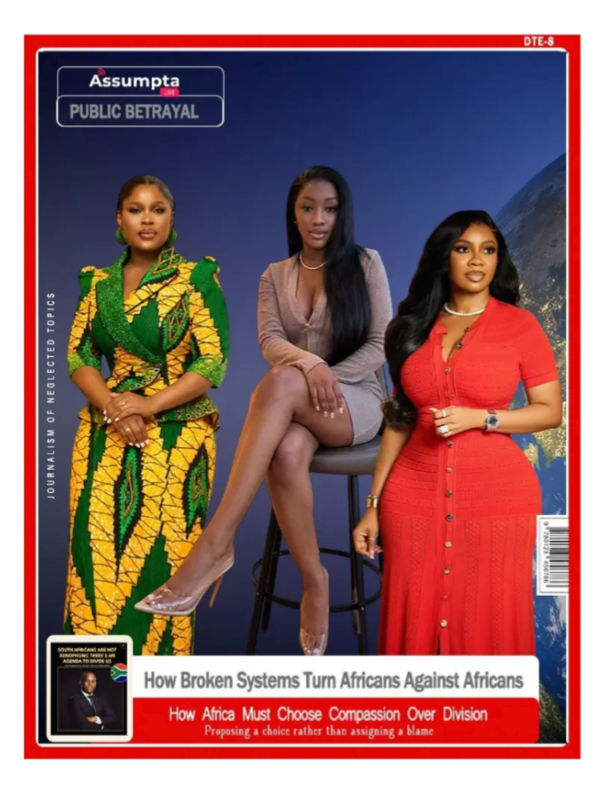
PRESENTS: PUBLIC BETRAYAL
Release Date: Friday, May 8, 2026
Access: assumptagh. live
This Week’s Guest Feature
Article Title: How Broken Systems Turn Africans Against Africans.
Subtitle: Why Africa Must Choose Compassion Over Division
🗓 MARK YOUR CALENDAR Friday, May 8, 2026 Exclusively at assumptagh. live
HAIR SENTA ADVERTISEMENT














https://www.instagram.com/hairsenta?igsh=MXAzOThhNGZ0Nm15dQ==
💖 Discover the Power of Confidence with Hair Senta! 💖
Hair Senta Shopping & Retail: Ghana’s Finest Hair, Loved Worldwide
Hair Senta, a trusted, trademarked leader in beauty, proudly delivers the finest Human Hair Extensions from Ghana to a global audience. We believe true beauty goes beyond appearance. Our premium extensions are designed to inspire a new era of beauty, confidence, wellness, and hope for women everywhere.
Feel the quality, embrace the transformation, and step boldly into your most radiant self!
Connect With Us Today!
📞 Call Us:
(+233) 054 435 4455
(+233) 024 862 9769
🌐 Visit Us Online:
www.hairsenta.com�
📍 Find Our Store:
24 Jungle Avenue, Accra, Ghana 00233
If you’d like, I can also tailor this advertisement for Instagram, Facebook, print media, or a website banner—just let me know!
The Core Inquiry
In an era of unprecedented connectivity, why are our global institutions failing to protect our shared humanity? This edition dives into the uncomfortable truths behind the headlines:
• Institutional Decay: Analysing the widening chasm between United Nations principles and tangible global action.
• A Moral Crossroads: Will the world’s powers continue to compete for dominance—or will they finally choose to compete for the preservation of human life?
This Week’s Guest Feature
Anchored by the acclaimed Berla Mundi, this special edition hosts a high-level dialogue on the erosion of global responsibility and the high price of institutional failure.

Two distinguished legal voices join us:

- Serwaa Amihere, Esq. (Ghana)

- Assumpta Gahutu, Esq. (Namibia)
Why It Matters
Public to Betrayal is more than an interview; it is a challenge to leaders, legal minds, and citizens alike to confront the consequences of inaction. It asks us to redefine what it means to lead in a world that has grown comfortable with the “cost of silence.”
Ubuntu, Pan‑Africanism, and the Cost of Losing Compassion
Recent attacks and hostility toward immigrants in South Africa have once again forced Africa to confront uncomfortable questions about identity, humanity, leadership, and Pan‑African solidarity.
Do Africans still live by Ubuntu — the conviction that “I am because we are”?
Across the continent, many people were deeply disturbed by images of violence, protests, and anti‑immigrant rhetoric directed at fellow Africans living in South Africa. For those who believe Africa’s future depends on unity rather than division, these scenes generated pain, fear, and disappointment.
At the same time, it is neither accurate nor just to condemn an entire nation for the actions of some individuals. Xenophobia exists — and its victims are real — but broad accusations risk obscuring deeper truths and reinforcing new divisions.
South African entrepreneur Vusi Thembekwayo, responding to allegations of widespread xenophobia, argued that the issue is sometimes amplified or politicised in ways that set Africans against one another. While acknowledging that violence and discrimination do occur, he cautioned against labelling all South Africans as xenophobic. His position highlights a critical point: Africa cannot build its future through fear, suspicion, or hostility among black people themselves.
What Africa urgently needs is not denial or defensiveness, but a renewed commitment to Ubuntu, Pan‑African consciousness, compassion, courage, and self‑awareness.
For generations, Africans were told that their cultures were primitive, their traditions inferior, and their institutions incapable of progress. Colonial systems often pushed societies away from communal values and toward models rooted in extraction, hierarchy, and competition. After independence, many African states inherited not only colonial borders but also institutions that weakened collective responsibility while intensifying inequality, dependency, and political fragmentation.
Yet pre‑colonial African societies were also built on powerful human principles: community, shared responsibility, hospitality, mutual respect, and dignity. In many cultures, visiting someone empty‑handed was considered disrespectful because relationships mattered more than transactions. Human connection mattered more than profit alone.
This is not romanticism. African societies were never free from corruption, injustice, or abuse of power. But many traditions were grounded in the understanding that humanity is interconnected — that one person’s dignity cannot be separated from another’s.
That understanding is the heart of Ubuntu.
The tragedy is that some African leaders have continued to nurture what might be called the evil tree: systems of corruption, division, dependency, fear, weak institutions, and political manipulation. Instead of healing historical wounds, these systems are often exploited for short‑term power. Instead of promoting Pan‑African solidarity, citizens are encouraged to blame one another while deeper structural failures remain untouched.
Economic hardship, unemployment, inequality, and frustration do not disappear under such conditions. They are simply redirected — toward immigrants, foreigners, and the most vulnerable — rather than toward the leadership failures and institutional weaknesses that produced them.
The question Africa must confront is not only how colonialism damaged the continent, but whether post‑independence leadership has done enough to rebuild compassion, courage, accountability, and collective confidence.
Have African societies invested sufficiently in civic education, historical literacy, and social cohesion? Have political leaders actively promoted unity across borders? Have citizens been empowered to see one another as partners in shared progress rather than competitors for survival?
Africa’s future cannot be built on fear between Africans themselves.
It must be built on Ubuntu, ethical leadership, accountability, Pan‑African cooperation, and active citizenship.
Africa’s greatest strength is not only its natural resources or youthful population, but its human values — the belief that the dignity of one African is inseparable from the dignity of all Africans.
Patriotism should never require the dehumanisation of others. Genuine progress will come when compassion is stronger than division, and when unity becomes a political and moral priority rather than an occasional slogan.
Introduction: A Choice of Two Traditions
Recent debates around migration and hostility in South Africa have reignited a profound conversation about the soul of the continent. While entrepreneur Vusi Thembekwayo has rightly cautioned against labelling an entire nation as xenophobic, the recurring friction between Africans has forced us to look at the deeper systems governing our behaviour.
At the heart of this tension lies a fundamental conflict between two opposing traditions.
In indigenous African cultures, human interaction is governed by a spirit of mutual respect and hospitality. There is a deeply rooted system where, if you visit your neighbour, you do not go empty-handed. This gesture is more than a social nicety; it is an acknowledgement of shared humanity and a rejection of transaction-based relationships. It is the practical application of Ubuntu.
In stark contrast stands the legacy of the Western colonial tradition—a system that historically demanded outcomes at “gunpoint.” This is a tradition rooted in extraction, where if the price cannot be paid, the burden is simply increased until the debtor breaks.
The tragedy of the post-independence era is that while we speak of liberation, many of our institutions still operate on this second, coercive model. Today, Africa stands at a crossroads. It is time for the continent to sit in contemplation of these two traditions and consciously pick one. We cannot claim a future of Pan-African solidarity while maintaining systems that treat our brothers and sisters as competitors or debtors. A tradition that brings its citizens to a point of predatory survival is not a tradition that can sustain a continent.
Key Context: Economic & Social Realities
To understand why the “tradition of the gun” or extraction still lingers, it is helpful to look at the structural pressures facing the region today. When resources are scarce and systems are extractive, Ubuntu is tested.
| Metric | South Africa Context (Approx. 2024-2025) | Impact on Solidarity |
|---|---|---|
| Unemployment Rate | 32% – 34% | High competition for entry-level jobs can fuel resentment. |
| Youth Unemployment | Over 44% | A large, frustrated population is more susceptible to populist rhetoric. |
| Gini Coefficient | 0.63 to 0.67 | Ranked as one of the most unequal societies in the world, heightening internal friction. |
| Migrant Population | ~2.9 million | Approximately 5% of the population; often scapegoated for systemic service delivery failures. |
By addressing these numbers through the lens of your “two traditions” argument, the piece moves from a moral plea to a sophisticated critique of how “pay at gunpoint” economics destroys the “culture of the gift.”
📰 Assumpta Newsletter | Special International Edition
PRESENTED BY: PUBLIC BETRAYAL
The Opening Dialogue

Berla Mundi (Host):
Good day to our readers around the world. Wherever you are joining us from — across Africa, throughout the Global South, or in the wider international community — welcome to this special edition of the Assumpta Newsletter, presented under the theme “Public Betrayal.”
It is a privilege to host this dialogue. My name is Berla Mundi. I am a Ghanaian media professional, broadcaster, and women’s advocate with TV3 Ghana, and I remain deeply committed to storytelling that elevates truth, responsibility, and African voices. Through my work in broadcasting and my B. Your initiative, I continue to engage young people — especially young women — on leadership, dignity, and purpose in an increasingly complex world.
Today’s edition invites us into a difficult but necessary conversation — one that crosses borders, disciplines, and historical memory.
Welcoming the Panellists
I am honoured to be joined by two distinguished panellists whose professional journeys reflect both intellectual rigour and lived engagement with Africa’s realities.

- From Ghana, we welcome Serwaa Amihere, Esq.
Serwaa is one of Ghana’s most respected broadcast journalists, a senior news anchor with GHOne TV, and a trailblazer in African media. In October 2025, she was officially called to the Ghana Bar, adding legal expertise to a career already marked by journalistic excellence. She is a three-time recipient of the RTP Award for Best TV Newscaster and the Chief Executive Officer of Oh My Hair, blending media influence with entrepreneurship.

- From Namibia, we welcome Assumpta Gahutu, Esq.
Assumpta is a legally trained professional holding a Bachelor of Laws degree from the University of Namibia, with experience within the magistrates’ court system. Beyond the legal field, she is also a widely recognised digital entrepreneur and public figure, known for her engagement across fashion, business, and youth-driven platforms. Her work reflects the intersection of modern African identity, professionalism, and enterprise.
To both of you — thank you for joining this dialogue.
The Feature Article
A Reflection on African History, Identity, and Afrophobia in South Africa
A little African history review reminds us that the story of Southern Africa did not begin with colonial borders, apartheid, or modern nationalism. Long before these systems existed, African communities were already moving, trading, intermarrying, and building civilisations across the continent.
Historical, linguistic, archaeological, and recent genetic studies continue to confirm that many Southern African ethnic groups — including the Zulu, Xhosa, Sotho, Tswana, Venda, and Tsonga peoples — trace deep ancestral roots to the great Bantu migrations that began near the Nigeria–Cameroon border region roughly 4,000 years ago. Over centuries, Bantu-speaking communities gradually spread across Central, Eastern, and Southern Africa, bringing agriculture, iron-working technology, language systems, and social structures that helped shape much of the continent.
By around 300 CE, some of these communities had reached present-day KwaZulu-Natal, while others settled in Limpopo by approximately 500 CE. Yet they did not arrive in an empty land. The San and Khoikhoi peoples had already inhabited Southern Africa for thousands of years before these migrations. African history, therefore, is not a story of one people replacing another, but of centuries of interaction, coexistence, adaptation, conflict, and cultural exchange.
Colonialism, Apartheid, and the Engineering of Division
Colonialism later disrupted these organic African connections. Under apartheid in South Africa, racial segregation was not only directed against Black South Africans internally, but also strategically designed to isolate them from the rest of Africa. White immigration into South Africa was encouraged to strengthen the apartheid state, while Black African immigration and continental solidarity were heavily restricted. Borders became political weapons. African unity became a threat to the regime.
For decades, apartheid policies severed cultural, economic, and intellectual ties between Black South Africans and other African nations. Many liberation movements across Africa supported the anti-apartheid struggle materially and diplomatically, yet apartheid propaganda simultaneously cultivated suspicion toward other Africans. The divide-and-rule strategy of colonialism created categories of belonging and exclusion that continued to shape social tensions long after apartheid officially ended in 1994.
Afrophobia in the Democratic Era
Since democracy, South Africa has experienced repeated waves of violence directed predominantly at Black African migrants. According to documented reports, xenophobic and Afrophobic attacks since 1994 have resulted in hundreds of deaths, thousands of businesses looted, and massive displacement. The major outbreaks in 2008, 2015, 2019, and recent years overwhelmingly targeted Black African migrants from countries such as Zimbabwe, Mozambique, Somalia, Nigeria, Ethiopia, Malawi, and the Democratic Republic of Congo.
Notably, these attacks have rarely focused on white European migrants or other economically influential foreign communities. This distinction has led many scholars, activists, and international observers to argue that the phenomenon extends beyond ordinary xenophobia. Increasingly, researchers describe it as “Afrophobia” — a hostility specifically directed toward Black Africans by fellow Africans.
The United Nations and several human rights organisations have documented cases where even South African citizens were attacked for appearing “too Black” or “too foreign,” revealing how deeply identity, language, class, poverty, and apartheid-era conditioning continue to influence perceptions of belonging.
Colonial Conditioning and Psychological Legacy
This raises an uncomfortable but necessary question: are these attacks simply xenophobia, or are they lingering psychological and structural consequences of colonial programming and apartheid social engineering?
Colonial systems across Africa often succeeded by fragmenting African identity — dividing people through ethnicity, nationality, language, and artificial borders. Apartheid intensified this process in South Africa through deliberate social isolation and racial hierarchy. When people are conditioned for generations to fear, compete with, or distrust those who resemble them, the effects do not disappear immediately with political freedom.
This does not remove individual responsibility for violence. But it does suggest that modern Afrophobia cannot be understood without examining the historical systems that manufactured separation among African peoples in the first place.
The Psychological Reality
The deeper tragedy is that many Africans attacking fellow Africans often share ancient ancestral connections that predate colonial borders by thousands of years. History reminds us that before passports and nation-states, African societies were already interconnected through migration, kinship, trade, and shared humanity.
Understanding this history is not about excusing violence. It is about confronting the roots of division honestly so that future generations can build a different African consciousness — one grounded not in fear of one another, but in historical awareness, dignity, and collective humanity.
Toward Psychological and Historical Liberation
The statement, “When people are conditioned for generations to fear, compete with, or distrust those who resemble them, the effects do not disappear immediately with political freedom,” captures a painful psychological reality that many societies emerging from colonialism and apartheid continue to struggle with.
For many Black South Africans, apartheid was not only a political system of segregation. It was also a system of psychological control built on fear, humiliation, economic exclusion, and constant violence. Entire generations grew up under a structure where land ownership, economic power, movement, education, and even human dignity were controlled by a white minority government. Fear became part of everyday life.
When Nelson Mandela emerged from prison and negotiations began to end apartheid, millions of Black South Africans placed enormous hope in him.
The transition itself was deeply complex. South Africa avoided a full-scale civil war, but compromises were made during negotiations between the apartheid government, liberation movements, business elites, and international powers. Some critics argue that political freedom arrived faster than economic justice. Others believe the democratic settlement protected stability while leaving many structural inequalities untouched.
Even within the liberation movement, there were tensions and disagreements about the direction of the country. Winnie Madikizela-Mandela herself publicly expressed moments of disappointment and distance regarding some political decisions during the transition period. To many ordinary South Africans, the dream of liberation eventually collided with the continued reality of poverty, unemployment, land inequality, and economic exclusion.
This frustration created fertile ground for anger and resentment. But instead of that anger being directed only toward the historical structures of inequality or the systems that maintained economic imbalance, it has sometimes been redirected toward vulnerable African migrants who are also struggling to survive.
Many scholars and social observers argue that this is one of apartheid’s deepest legacies:
A society psychologically conditioned through division, fear, scarcity, and competition among oppressed people. Under such conditions, fellow Africans can wrongly become perceived as competitors for jobs, housing, business opportunities, and social space, while larger systems of economic power remain untouched. This does not justify violence against Nigerians, Zimbabweans, Somalis, Ethiopians, Mozambicans, or any other African community. But it helps explain why the anger often appears misdirected toward fellow Black Africans instead of toward the broader historical and economic structures that produced inequality in the first place.
The painful contradiction
Many of the people being attacked are descendants of the same African history, connected through centuries of migration, struggle, and shared ancestry long before colonial borders existed. The challenge for Africa moving forward is not only political freedom, but psychological liberation — the rebuilding of African solidarity, historical understanding, and economic justice in a way that prevents oppressed communities from turning against one another while deeper systems of inequality continue unchanged.
History shows that colonialism succeeded not only through military force, but also through the division of African consciousness. Healing that division may be one of the continent’s greatest unfinished tasks.
Inviting the Panel

Berla Mundi:
Serwaa, Assumpta — having reflected on this history and its modern consequences, I would like to invite your insights.
How do you interpret the relationship between historical fragmentation, institutional failure, and the rise of Afrophobia in democratic South Africa? And, from your respective legal, media, and civic perspectives, what does choosing compassion over division practically require from African leadership and African citizens today?
The Panel Response

Serwaa Amihere, Esq. (Panellist):
Thank you very much, Berla, for that thoughtful and profoundly grounded reflection — and thank you for framing this conversation with both historical clarity and moral care.
I appreciate the way you situated the present moment within Africa’s longer history, because without that context, we risk responding to today’s crises emotionally rather than intelligently. Your reflection reminds us that what we are confronting in South Africa — and indeed across parts of the continent — is not simply a matter of individual prejudice, but the long shadow of systems that were deliberately engineered to divide, fragment, and distort African identity.
From my perspective as both a journalist and a legal professional, I see a very clear connection between historical fragmentation, institutional failure, and the rise of Afrophobia in democratic South Africa.
The Architecture of Division
Historically, colonialism and apartheid did not merely dispossess people materially; they restructured how Africans were taught to see themselves and one another. Borders, classifications, and hierarchies were imposed to weaken collective consciousness and solidarity. When those systems collapsed politically, their psychological architecture remained. That residue is what we continue to witness manifesting as fear, resentment, and misplaced hostility between Africans.
Institutional and Legal Failure
Institutionally, the failure is equally stark. Democratic governance did not automatically translate into economic justice, social healing, or regional solidarity. Weak migration frameworks, inadequate urban planning, unemployment, and unequal access to services all place extraordinary pressure on already marginalised communities. When institutions fail to mediate those pressures fairly and transparently, social anger seeks the nearest and most vulnerable outlet — and tragically, that outlet is often fellow Africans.
As a lawyer, I must emphasise that violence against migrants is never justifiable. Legal responsibility is individual and unequivocal. But law alone cannot resolve what is ultimately a social and psychological crisis. If institutions respond only with policing and prosecutions, without addressing underlying inequality, historical trauma, and political accountability, the cycle will simply repeat itself.
The Role of Media
As a media practitioner, I am also concerned about the narratives we amplify. Sensationalism, generalisation, and silence all play a role. When violence is framed without context, it reinforces stereotypes — about South Africans broadly, or about migrants as threats — rather than illuminating root causes. Media must resist becoming an instrument of division and instead serve as a space for truthful, nuanced, and humane storytelling.
Choosing Compassion: A Multi-Level Mandate
When we speak of choosing compassion over division, I believe this choice must operate on several levels:
- From Leadership: It requires honesty — an acknowledgement that political freedom without economic inclusion breeds instability. It requires regional cooperation, not rhetoric. And it requires investing in social cohesion with the same seriousness given to economic growth.
- From Citizens: Compassion requires historical awareness. It asks Africans to remember that migration is not an anomaly in our history — it is part of our inheritance. It also demands civic courage: the courage to resist scapegoating and to insist on dignity even under economic strain.
- From Institutions: National, continental, and global bodies must prioritise accountability. They must protect human life first, not geopolitical convenience. They must act before crises erupt, not merely respond after lives are lost.
Conclusion
Ultimately, Afrophobia is not a failure of African culture. It is a failure of systems — and systems can be dismantled, reimagined, and rebuilt.
Choosing compassion over division is not sentimental. It is practical. It is preventative. And it may be one of the most urgent acts of leadership our continent now requires.
Thank you.

Berla Mundi:
Powerful insights, Serwaa. Thank you for bridging the gap between the courtroom and the newsroom to help us understand the structural nature of this crisis.
Assumpta, I would like to bring you in here…
(Next: Assumpta Gahutu, Esq.’s response focusing on the legal-social-youth lens and the entrepreneurial landscape.)

The Panel Response
Assumpta Gahutu, Esq. (Panellist):
Thank you, Berla, for that deeply grounding reflection — and thank you for holding this space with such clarity and care. The way you traced history, psychology, and institutional responsibility together captures a truth that many societies are still uncomfortable confronting.
I want to begin by acknowledging something important: conversations like this are not easy, but they are necessary. They ask us to examine not just what is happening, but why it is happening — and what our silence or inaction allows to continue.
From a legal and civic standpoint, the rise of Afrophobia in South Africa — and in parts of the continent more broadly — reflects a collision between unfinished justice and unhealed trauma. When societies transition politically without fully addressing economic and psychological injustice, resentment does not disappear. It often mutates.
The Intersection of Law and Social Reality
As someone trained in law, I am taught to think in terms of responsibility, protection, and accountability. Violence against migrants — or against any group — is unlawful and unacceptable, full stop. But law does not operate in a vacuum. Legal systems are shaped by social realities, and when institutions fail to protect dignity consistently, people begin to turn on one another instead of demanding systemic reform.
What stood out most in your reflection, Berla, is the reminder that African identity long predates colonial borders. The irony — and the tragedy — is that many of those caught in cycles of violence are historically connected through migration, kinship, and shared ancestry. Yet modern scarcity narratives encourage people to see one another as economic or social threats.
The Perspective of a Connected Generation
For young Africans in particular, this is deeply troubling. I engage daily with youth — digitally, professionally, and socially — and I see a generation caught between aspiration and frustration. They are globally connected but locally constrained. When opportunity feels scarce and institutions feel distant, resentment becomes easier to mobilise than solidarity.
This is where institutional failure becomes personal. Weak social safety nets, inadequate urban planning, rising living costs, and unemployment create pressure at the community level. When leadership fails to address these realities transparently, migrants — especially undocumented or informal-sector workers — become convenient scapegoats. It is easier to blame the visible “other” than to challenge entrenched power structures.
A Call for Policy, Pedagogy, and Practice
Choosing compassion over division, therefore, cannot remain a moral slogan. It must translate into tangible action:
- From African Leadership: Compassion requires the courage to speak honestly about inequality, to implement fair migration systems, to strengthen regional cooperation, and to invest in social cohesion as urgently as infrastructure.
- From Institutions: Consistency is vital. Laws must protect everyone within a country’s borders, and enforcement must not be selective. Justice that is perceived as uneven quickly loses legitimacy.
- From Citizens — particularly Youth: It requires historical consciousness. We must relearn our interconnected histories and resist narratives that pit struggling communities against one another. Compassion, in this sense, is an act of resistance against the structures that benefit from our division.
Conclusion
Afrophobia is not a failure of African values. It is evidence of how deeply colonial ruptures still shape our societies — and how urgently psychological liberation must accompany political freedom.
If we want different outcomes, we must demand different systems — ones built on dignity, accountability, and shared humanity. Africa’s future will not be secured by competing against one another for survival, but by rebuilding solidarity in a way that makes justice visible and hope attainable.
Thank you for allowing me to be part of this essential dialogue.
Berla Mundi:
Thank you, Assumpta. You’ve touched on a critical point: that for the youth, this isn’t just about history—it’s about the very real anxiety of the future.
The Host’s Frame: Fear, Scarcity, and the Gap of Liberation

Berla Mundi (Host):
Before I invite your next reflections, I want to return us to a core idea emphasised throughout this newsletter.
The statement that “when people are conditioned for generations to fear, compete with, or distrust those who resemble them, the effects do not disappear immediately with political freedom” captures a painful psychological reality — not only in South Africa, but in many societies emerging from colonialism and systemic oppression.
The Internalisation of Scarcity
For many Black South Africans, apartheid was more than a political system of segregation. It was a system of psychological control — built on fear, humiliation, economic exclusion, and constant violence. Entire generations were raised in an environment where land ownership, economic power, movement, education, and even human dignity were controlled by a white minority government. Over time, fear became normalised. Scarcity became internalised. Survival became competitive.
When Nelson Mandela was released from prison and negotiations to end apartheid began, millions placed immense hope in him and in the promise of freedom. South Africa achieved a historic political transition and avoided a full-scale civil war. Yet that transition was deeply complex. Compromises were made between the apartheid state, liberation movements, economic elites, and international interests. As a result, many South Africans experienced political liberation without experiencing economic justice at the same pace.
The Collision of Hope and Reality
Even within the liberation movement itself, there were disagreements and open expressions of disappointment about the direction of the transition. Winnie Madikizela-Mandela, among others, spoke publicly about moments of disillusionment. For many ordinary South Africans, the emotional high point of liberation eventually collided with the enduring realities of poverty, unemployment, land inequality, and exclusion.
This gap — between expectation and reality — created fertile ground for frustration and anger. But rather than being directed exclusively at the historical structures of inequality or at systems that maintained economic imbalance, that anger has, at times, been redirected toward vulnerable African migrants who are also struggling to survive.
The Misdirection of Resentment
Scholars and social observers argue that this may be one of apartheid’s most enduring legacies: a society psychologically conditioned through fear, division, and competition among oppressed people. Under such conditions, fellow Africans can come to be perceived not as partners in shared survival, but as competitors for jobs, housing, business opportunities, and social space — while deeper systems of economic power remain largely untouched.
Let me be clear: this history does not justify violence against Nigerians, Zimbabweans, Somalis, Ethiopians, Mozambicans, or any other African community. But it helps explain why anger is so often misdirected toward fellow Black Africans instead of toward the broader historical and economic systems that produced inequality in the first place.
A Message to Our Global Readers
Unmanaged fear and prolonged economic insecurity do not disappear on their own. When left unaddressed, they can harden into resentment, scapegoating, and ultimately hatred. But when societies invest in economic inclusion, fair institutions, and social protection, fear can be transformed — redirected into dignity, empathy, and mutual responsibility.
Economic equality does more than raise incomes. It gives people psychological breathing space. It reduces competition for survival. It provides tools for transforming fear into compassion and frustration into civic participation.
The Inquiry to the Panel
Berla Mundi:
So my question to you both is this:
From your legal, media, and civic perspectives, how can African societies — and African leadership — move beyond inherited fear toward psychological liberation? What kinds of economic reforms, institutional accountability, and narrative shifts are necessary to prevent oppressed communities from turning against one another?
And finally, how do we rebuild African solidarity in a way that recognises fear as a natural human response — but refuses to let it be weaponised against our shared humanity?
[Note to Readers]: To ground this discussion in the current reality, the following figures illustrate the pressure points within the South African economy as of early 2026:
| Demographic Group | Unemployment Rate (Official) | Poverty Level Access |
|---|---|---|
| Black South Africans | ~36.8% | High vulnerability to price shocks |
| White South Africans | ~7.5% | Generally high economic security |
| Youth (Ages 18-34) | ~45.5% | Primary demographic for social frustration |
| Migrant Populations | Variable | High risk of informal sector displacement |
Data indicate that where economic security is lowest, the susceptibility to Afrophobic rhetoric is highest.
Panel Responses: Navigating Fear and Rebuilding African Solidarity
Featured Panellists: Serwaa Amihere, Esq. & Assumpta Gahutu, Esq.

Serwaa Amihere, Esq. — Response
”Psychological liberation begins with an honest recognition that fear is not a moral failure — it is often a rational response to prolonged exclusion.”
Thank you, Berla, for that question and for the way you have framed this dialogue with both compassion and intellectual discipline. What you’ve articulated reaches beyond South Africa; it speaks to a condition many post-colonial societies continue to live with.
From my perspective, the danger arises when leadership fails to manage that fear responsibly.
I. Moving Beyond Inherited Fear
African societies move beyond inherited fear when leadership acknowledges historical trauma without exploiting it. Too often, political actors use fear—around jobs, migration, and identity—as a convenient distraction from weak governance. Psychological liberation requires leaders to redirect public emotion away from scapegoating and toward structural accountability.
II. Economic Reforms
Economically, reform must be visible and felt at the household level. Land reform, fair employment practices, urban housing, and youth-focused job creation are not abstract ideals—they are fear-reduction tools. When survival is less competitive, fear loses its edge. Economic inclusion creates psychological stability.
III. Institutional Accountability
Institutions must operate fairly and visibly. When justice appears selective, mistrust grows. Strong migration systems, consistent law enforcement, and social protection policies ensure that no group becomes an easy target for blame. Accountability restores confidence—and confidence weakens fear.
IV. Narrative Shifts
As a journalist, I believe narrative is foundational. Stories that frame hardship as a competition between the poor reproduce fear. Narratives that explain history, inequality, and migration truthfully help people recognise shared struggle instead of imagined enemies.
V. Rebuilding African Solidarity
Solidarity does not deny fear—it contextualises it. We must teach that fear, when acknowledged, can be transformed. African solidarity grows when people see one another not as threats to survival but as partners in rebuilding systems that failed them all.
Compassion, therefore, is not sentimental. It is strategic. If we do not manage fear deliberately, it will continue to be weaponised against our shared humanity.
Assumpta Gahutu, Esq. — Response

”Ultimately, fear is human. Hatred is not inevitable.”
Thank you, Berla. Your question captures the heart of what many African societies are quietly wrestling with—how to heal psychologically while still carrying the weight of unfinished justice.
I. Psychological Liberation as a Civic Project
Psychological liberation requires acknowledging that people emerging from oppression are often navigating unresolved grief, anger, and insecurity. Expecting instant unity or trust without addressing material conditions is unrealistic. Liberation must be social and economic, not only political.
II. Economic Reform as Emotional Infrastructure
Economic equality is also emotional infrastructure. When people have access to housing, education, healthcare, and opportunity, fear no longer dictates their decisions. Reform reduces anxiety about survival and interrupts the cycle where fear transforms into hostility.
III. Institutional Responsibility
Institutions must act as stabilisers, not spectators. Legal systems must protect everyone equally, regardless of nationality or status. When institutions fail to do so, communities attempt to regulate themselves—often violently. Consistent governance prevents fear from being redirected toward vulnerable groups.
IV. Narrative and Education
We also need intentional education—civic and historical. Young Africans must learn that migration, diversity, and movement are not foreign to Africa; they are foundational to it. This reframes fear as misplaced, not justified.
V. Rebuilding Solidarity
Solidarity requires acknowledging fear without surrendering to it. It means saying: Yes, survival is difficult—but turning on one another will not fix what systems broke.
Leadership must model this clarity. Citizens must demand it. And institutions must support it with real reform. When economic justice and institutional integrity are present, fear can be redirected into agency, dignity, and compassion. That is how African solidarity is rebuilt—not by denying pain, but by refusing to weaponise it.
Closing Reflection: The Moral Architecture of Solidarity
Delivered by: Berla Mundi (Host)

In Conversation with: Serwaa Amihere, Esq. & Assumpta Gahutu, Esq.
Thank you, Serwaa and Assumpta, for those thoughtful and deeply grounded responses.
What emerges clearly from both of your perspectives is a shared understanding that psychological liberation cannot occur in isolation from economic justice, institutional credibility, and narrative responsibility. Political freedom, while essential, is not self-executing. Without sustained reform, it can leave behind a vacuum—one where fear festers, and anger searches for direction.
The Nature of Fear
We have heard today that fear itself is not the enemy. Fear is human. It is often born of prolonged insecurity, humiliation, and exclusion. The real danger lies in what happens when fear is unmanaged—when it is ignored by leadership, exploited by politics, or sensationalised through careless narratives. In such moments, fear is easily redirected toward the most vulnerable, turning neighbours into perceived enemies.
Economics as Emotional Stability
Both of you have reminded us that economic reform is not merely about income or growth; it is about dignity and psychological stability.
- When survival becomes less competitive, societies breathe differently.
- Compassion becomes practical.
- Solidarity becomes possible.
Economic inclusion reduces the emotional pressure that fuels resentment and division.
The Institutional Anchor
We have also been reminded that institutions matter profoundly. When justice is uneven, when accountability is selective, when protection is conditional, trust collapses—and fear fills the space left behind. Strong, fair institutions do more than enforce law; they stabilise societies emotionally.
Narrative Responsibility
Equally powerful is the call for narrative responsibility. Stories can inflame fear, or they can heal it. How we frame migration, hardship, and identity shapes how people interpret their struggles. Narrative shifts are not cosmetic adjustments; they are instruments of social cohesion.
The Core Truth
This is not a conversation about blaming communities.
It is not a conversation about denying pain.
It is a conversation about confronting systemic failure honestly, so that fear is not weaponized against our shared humanity.
Concluding Thoughts: Public Betrayal
As we close, we return to the central framing of this newsletter under the theme Public Betrayal, and to our featured reflection:
- How Broken Systems Turn Africans Against Africans
- Why Africa Must Choose Compassion Over Division
Compassion, as we have heard today, is not weakness. It is governance. It is reform. It is courage made actionable. Division thrives where systems fail. Solidarity grows where responsibility is restored.
Thank you to our panellists, and thank you to our readers across the world for engaging with this necessary conversation.
Our Shared Humanity Soka Gakkai Buddhist Movement
An introduction to the Soka Gakkai and Nichiren Buddhism.
Where do the teachings originate from?
What is the philosophy of Buddhism?
How do Soka Gakkai members apply it in their daily lives?
The Soka Gakkai is a global community-based Buddhist organisation that promotes peace, culture and education centred on respect for the dignity of life. Its members in 192 countries and territories study and put into practice the humanistic philosophy of Nichiren Buddhism.
Soka Gakkai members strive to actualise their inherent potential while contributing to their local communities and responding to the shared issues facing humankind. The conviction that individual happiness and the realisation of peace are inextricably linked is central to the Soka Gakkai, as is a commitment to dialogue and nonviolence. Subscribe to our channel: / sgivideosonline Visit our website: https://www.sokaglobal.org/ Like us on Facebook: / sgi.info Follow us on Instagram: / sgi.info Follow us on Twitter: / sgi_info


https://www.instagram.com/babiesandtodds_?utm_source=ig_web_button_share_sheet&igsh=ZDNlZDc0MzIxNw==
Where Little Hearts Find a Home to Grow. 🌿✨
Nestled in the heart of Windhoek, Babies & Toddlers Daycare (BTDC) is more than just a school—it’s a vibrant community. We believe that every child is a masterpiece, and our mission is to provide a nurturing sanctuary where they can grow, learn, share, and create. 🎨🤝
At BTDC, we don’t just teach; we inspire. Our curriculum is built on a humanistic philosophy, promoting:
🕊️ Peace & Culture – Celebrating our global diversity.
📚 Education with Heart – Focused on the dignity of life.
🌱 Holistic Growth – Respecting the unique journey of every child.
Join our family and give your child a foundation built on respect and joy.
📞 Connect with us: +264 81 673 7599
🌐 Explore more: www.babiestodds.com
#WindhoekParents #NamibiaEducation #EarlyChildhood #HumanisticEducation #BabiesAndToddlers





Sardinia is truly a slice of Mediterranean paradise, and your stay in Sardinia looks absolutely breathtaking. It appears you are enjoying a quintessential Italian summer at a high-end coastal resort, likely in the stunning Costa Smeralda or Porto Cervo area, known for its crystalline waters and world-class luxury.
The View from Your Hotel
Your location offers a spectacular vantage point that captures the island’s natural beauty:
- The Pool: You are lounging by a pristine, expansive infinity-style pool that mimics the vibrant turquoise of the Mediterranean Sea. The tiling and clean lines suggest a modern, luxury resort designed for ultimate relaxation.
- The Seascape: In the background, you can see the rugged, hilly coastline and smaller islands (possibly the Maddalena Archipelago) dotting the horizon. The deep blue of the Tyrrhenian Sea contrasts beautifully with the bright azure of the pool.
- The Vibe: The atmosphere is one of serene exclusivity. With the sun-drenched terrace and the distant mountains, it’s the perfect setting for a “dolce vita” escape.
Your Summer Style
Your outfit perfectly complements the breezy, chic aesthetic of a Sardinian holiday:
- The Dress: You’re wearing a gorgeous white crochet or lace-trimmed sundress. The delicate eyelet patterns and scalloped neckline give it an effortless, romantic “boho-chic” feel that is very popular in Italian coastal fashion. White is a classic choice for the Mediterranean heat, reflecting the sun and looking striking against a tan.
- The Accessories: You’ve elevated the look with iconic white-rimmed oval sunglasses. These add a retro, high-fashion touch—reminiscent of 60s glam—while being incredibly trendy.
- The Contrast: The crisp white of your dress and sunglasses pops brilliantly against the deep blue of the pool and the warm tones of the surrounding landscape.
The Beauty of It All
There is a wonderful harmony in this scene. The transition from the warm, earthy tones of the poolside patio to the vibrant blues of the water, finished with your bright, airy outfit, creates a picture-perfect holiday moment. It’s a blend of natural ruggedness and refined luxury—exactly what makes Sardinia one of the most sought-after destinations in the world.
Enjoy every moment of that Italian sunshine! It looks like an unforgettable trip.





https://www.instagram.com/gahutudenim?igsh=MWpsNjZ1bTFvdHNsdw==
The Perfect Fit: Where Confidence Meets Comfort
Confidence. Comfort. Precision.
As seen on Assumpta Gahutu, the visionary behind Gahutudenim, these signature jeans represent the ultimate balance of elegance, comfort, and modern femininity. Designed for the global woman who refuses to compromise on style, Gahutudenim continues to redefine what premium denim should feel like.
Crafted for Every Body, Every Season
Our jeans are engineered from premium soft-stretch denim that contours naturally to your silhouette. The breathable, high-quality fabric is designed for all-weather comfort, ensuring you feel as good as you look from summer mornings to winter evenings.
The design philosophy is simple: embrace the feminine shape with sophistication. —
Versatility Without Limits
What sets this collection apart is its seamless transition from casual luxury to professional polish. The tailored fit is specifically designed to:
- Sculpt and Support: Enhancing the waist and hips while maintaining a clean, straight silhouette.
- Move With You: Providing a flexible, “second-skin” feel that never loses its shape.
- Elevate Your Wardrobe: Effortlessly transition from a weekend outing to a corporate office setting when paired with a sharp blazer or refined blouse.
The Gahutudenim Experience
Whether you are leading a boardroom meeting or enjoying a city stroll, these jeans offer the structure of high-end tailoring with the freedom of casual wear. It is more than just denim—it’s a commitment to timeless elegance.
Gahutudenim Clothing Brand — Made for the Modern Woman.
Smart. Feminine. Comfortable. Timeless.
Shop the Collection: gahutudenim.com



https://www.instagram.com/officeandcobysa?igsh=dmxucTZ2a2t1eDBn
Elevate Your Executive Presence: Office & Co. By SA
Discover the pinnacle of corporate elegance with Maame Gyamfua Yeboah—the visionary entrepreneur and force behind Ghana’s premier RTW fashion house. As the CEO of Oh My Hair and Office & Co. By SA, Maame embodies the ambition and sophistication of the modern woman.
Precision Tailoring meets Power Styling
Our latest collection is engineered for the woman who demands excellence. Every garment is a masterclass in precision tailoring, designed to command respect in any boardroom.
- Ultra-Straight Lines: Experience sharp, architectural silhouettes that provide a crisp, professional edge.
- The Ultimate Fit: Our designs celebrate the female form, utilising intelligent seams and premium fabrics to highlight your natural curves while maintaining a refined, modest aesthetic.
- Corporate Ready: From high-stakes meetings to networking galas, these pieces are specifically crafted for corporate offices and high-profile environments.
Shop the Look Globally
Office & Co. By SA is dedicated to the upwardly mobile woman. We don’t just make clothes; we craft the uniform for your success.
- Global Reach: We proudly SHIP WORLDWIDE.
- Visit Us In-Person: Bawaleshi Road, East Legon, Accra, Ghana.
- Online Boutique: www.officeandcobysa.com.gh
- Socials: Follow us @officeandcobysa for the latest drops and style inspiration.


https://www.instagram.com/delish_bakerygh?igsh=MW5ic2c0NnR5cHBwZQ==








https://www.instagram.com/styledbyaretha?igsh=ZjFrOW44d2N2aXpy
A Symphony of Elegance: Celebrating Akosua Owusuwaa “Gwen-Addo” in Style by Aretha
Some outfits simply dress the body, and there are designs that elevate identity into art. This refined midnight-blue masterpiece from Stylebyaretha belongs to the latter.
Gracefully worn by Akosua Owusuwaa, the ensemble becomes more than fashion—it becomes presence, confidence, and storytelling woven into fabric. The sleek silhouette immediately captures attention with its sculpted precision. Every contour of the dress is intentionally tailored to align naturally with her posture and physique, creating a seamless harmony between structure and femininity. The fitted construction embraces her frame with elegance rather than excess, allowing movement, poise, and sophistication to coexist effortlessly.
The Design Anatomy
- The Silhouette: The sleeveless body-contour design creates a refined, elongated effect that enhances her natural proportions. The clean-cut structure flows smoothly from the shoulders downward, emphasising confidence, grace, and modern femininity.
- Artisanal Precision: One of the most striking elements of this look is how accurately the outfit aligns with her body. The waist definition is balanced without appearing restrictive, while the seamless side finishing highlights expert craftsmanship.
- The Fabric & Finish: The rich midnight-blue tone radiates understated luxury. The smooth texture of the fabric reflects light softly, giving the outfit a sophisticated depth. The finish is clean, sharp, and executive in character.
- The Hair & Styling Harmony: Her sleek, flowing hairstyle perfectly complements the minimal elegance of the outfit. The straight, luxurious hair frames the silhouette with softness while reinforcing a modern high-fashion aesthetic.
The Corporate Context: Can This Fit the Office?
The Traditional View: In conservative corporate environments, fitted sleeveless attire may be considered too fashion-forward for formal office settings.
The Modern Reality: For a woman like Akosua Owusuwaa—entrepreneur, beauty advocate, author, and creative leader—this outfit functions as a contemporary power statement. In entrepreneurial circles, leadership summits, and creative industries, this look communicates discipline, excellence, and executive confidence. It is the kind of outfit that does not seek attention aggressively—it naturally commands it through precision and elegance.
The Verdict
Akosua Owusuwaa does not merely wear this design—she embodies its philosophy. This is luxury fashion at its finest: intentional, sophisticated, and globally relevant. The craftsmanship reflects a woman who values excellence, while the styling celebrates a generation of leaders redefining beauty and professional elegance on their own terms.
STYLED BY ARETHA
Luxury Fashion • Personal Shopping • Women’s Designer Pieces
Exclusive Fashion Delivery Across Ghana
