





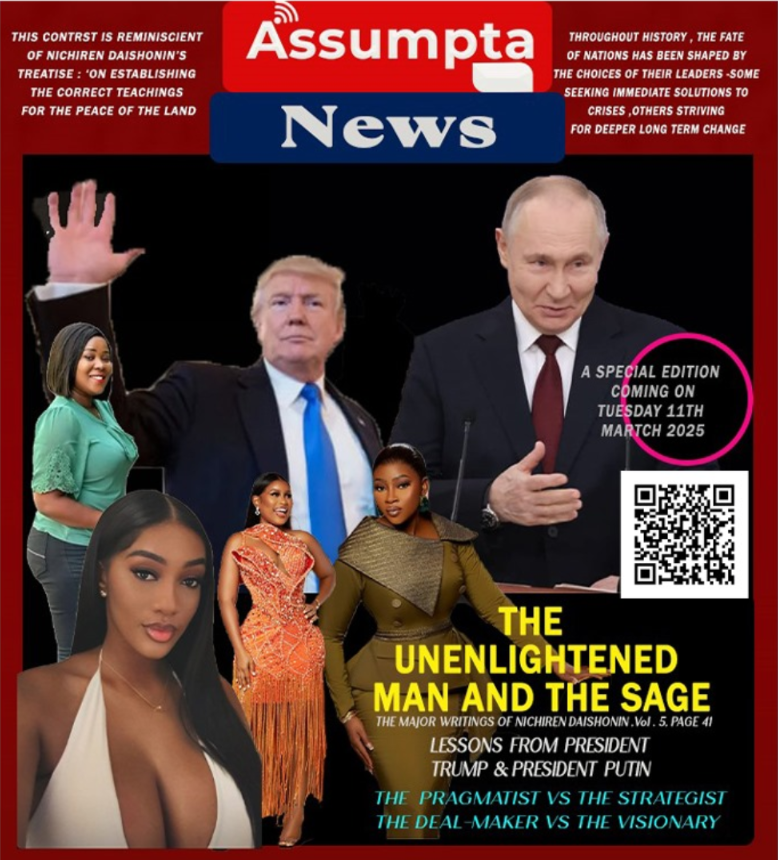
The major writings of Nichiren Daishonin. Vol,5.page 41.
Assumpta Weekly News:
Online Digital Magazine Presents ”The Lawyer“ with three Ghanaian brilliant broadcast Journalists include: Berla-Mundi, Frema Adunyame, Cookieteegh and Ms.Assumpta Gahutu, principal of Babies and Toddlers DayCare and CEO of Assumpta Newsletters and Lifestyle publication Magazine
A Special edition coming on Tuesday 11th March 2025 at Exclusively assumptagh.live/
Article Title: The Conversation with The Sage and the Unenlightened Man: The major writings of Nichiren Daishonin. Vol, 5. Page 41. Content: Lessons from Trump and Putin!





https://www.instagram.com/hairsenta?igsh=MXAzOThhNGZ0Nm15dQ==
✨ Hair Senta – Luxury Human Hair Extensions from Ghana to the World! ✨
Looking for premium-quality human hair extensions? Hair Senta offers the finest, long-lasting, and natural-looking hair for every occasion. Elevate your beauty with our top-tier extensions, trusted by women across the globe!
✔ 100% Authentic Human Hair
✔ Soft, Tangle-Free & Long-Lasting
✔ Available in Various Textures & Lengths
Visit us today!
📍 24 Jungle Avenue, Accra, Ghana
🌐 www.hairsenta.com
📞 Call/WhatsApp: (+233) 0544354455 / 0248629769
Hair Senta – Your Hair, Your Confidence! 💁🏽♀️✨

Assumpta Analyst: Trump’s Perspective (The Unenlightened Man)
“Trump, as a businessman-turned-president with only four years in office (possibly eight if re-elected), sees deals as the quickest way to achieve results. His approach is transactional—he wants a resolution that benefits American interests, possibly through economic leverage, business opportunities, and geopolitical influence. He may not be deeply concerned with the root ideological or historical causes of the conflict, as his priority is securing a deal that looks successful during his presidency.
Putin’s Perspective (The Sage)
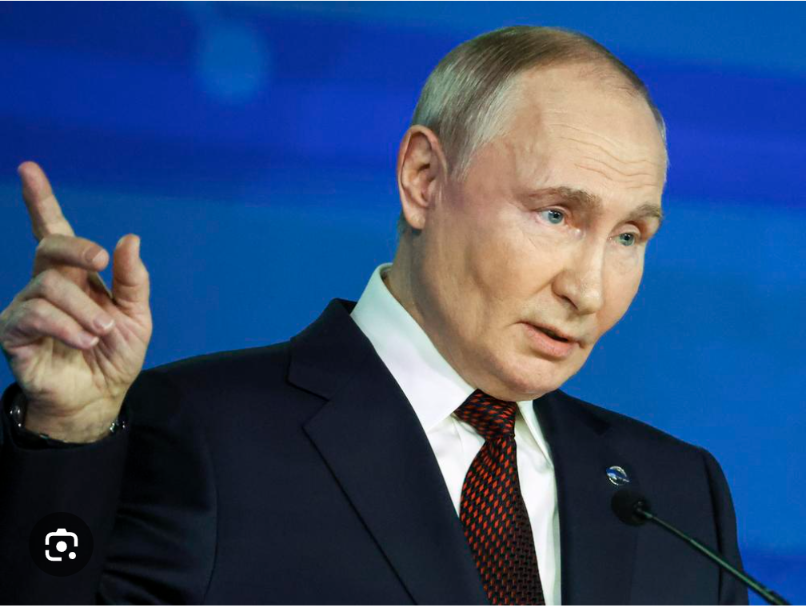
Putin, on the other hand, sees security and sovereignty as long-term goals that cannot be rushed. From his perspective, any short-term deal that does not address Western interference—especially from what he might see as American Zionist influence—will only lead to more conflicts later. His goal is to remove foreign influence from Russia’s neighborhood and ensure Russia’s long-term stability, even if it means enduring a prolonged struggle.
The Clash of Approaches
- Trump, focused on a quick deal, might be willing to let Ukraine fall under American business influence, securing economic benefits for the U.S. but not necessarily addressing deeper geopolitical tensions.
- Putin, focused on security and sovereignty, believes any deal that ignores external interference is worthless. He sees American Zionists as a force that seeks to weaken Russia and keep it under constant threat.
Conclusion
This suggests Trump’s approach is short-term and pragmatic, while Putin’s is strategic and long-term. However, the key question is: Can Putin achieve lasting security without compromising, and can Trump make a deal that leads to peace rather than just a temporary pause?
It’s a classic dilemma: short-term gain vs. long-term stability.
Introduction
Throughout history, the fate of nations has been shaped by the choices of their leaders—some seeking immediate solutions to crises, others striving for deeper, long-term change. In modern geopolitics, the dynamic between former U.S. President Donald Trump and Russian President Vladimir Putin reflects this age-old tension: the pragmatist vs. the strategist, the deal-maker vs. the visionary, the Unenlightened Man vs. the Sage.
This contrast is reminiscent of Nichiren Daishonin’s treatise, “On Establishing the Correct Teaching for the Peace of the Land.” Written in a question-and-answer format, it presents a dialogue between a traveler (the guest) and a wise host, discussing the turmoil of their time—natural disasters, societal unrest, and the decline of righteous governance. The traveler, overwhelmed by immediate crises, seeks a quick remedy, while the host urges deeper reflection on the true cause of chaos—the failure of rulers to uphold justice and wisdom.
In much the same way, Trump, as the Unenlightened Man, sought a quick resolution—perhaps a deal that would stop the war while securing American business interests. Meanwhile, Putin, as the Sage, views the crisis as a symptom of a deeper geopolitical struggle, one that cannot be resolved through temporary agreements but only by addressing the root causes—such as foreign interference and national security concerns.
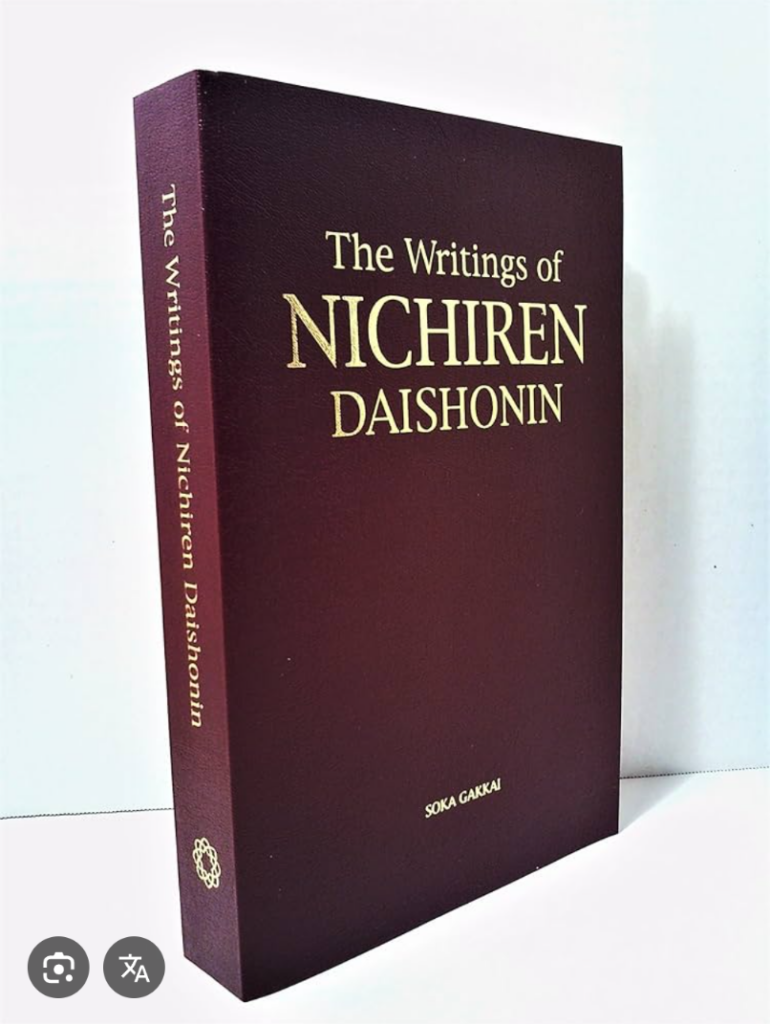
Nichiren Daishonin’s treatise serves as a clarion call to leaders, reminding them that true peace cannot be established through superficial diplomacy alone. It demands dialogue, wisdom, and an unwavering commitment to justice. As we examine the lessons from Trump and Putin’s approaches, we must ask: Is peace merely the absence of war, or is it the presence of true stability? And what happens when leaders choose convenience over wisdom?
The Fleeting Nature of Life and the Cycle of Ignorance ( Part of Part (1) of the Treatise/
Life is fleeting, and death is inescapable. Yet, though everyone—from the mightiest emperor to the humblest commoner—acknowledges this truth, few truly reflect on its significance. Rarely do people pause to grieve over the impermanence of existence, absorbed as they are in worldly concerns. Only when faced with loss do we momentarily awaken to life’s fragility, lamenting how deeply entangled we have become in secular pursuits.
We assume that the dead are unfortunate while the living are blessed. Yet, we are prisoners of our own desires—chasing after wealth, status, and comfort, unaware of how swiftly time slips away, like a fleeting glimpse of a white colt through a crack in the wall. Blinded by material concerns, we fall into the endless cycle of suffering, returning again and again to the paths of ignorance and pain. Who, upon realizing this, would not be moved to sorrow?
Neither youth nor old age spares anyone from the hand of fate. In this transient world, all who meet must one day part. This truth became all the more evident to me when I witnessed so many lives cut short in the early days of the Shōka era. Some left behind young children, while others were forced to abandon their aging parents. How heavy their hearts must have been, leaving behind unfinished lives as they embarked on the journey to the Yellow Springs—a painful departure for the dead, and an equally painful loss for those left behind.
The passions of kings and the legacies of rulers fade like wisps of morning clouds, and even great men find solace only in the distant generations who follow them. But how does one free themselves from sorrow? Even the poet who sought refuge in the mountains could not escape grief.
And so, like the men of Naniwa who gather seaweed to extract salt, I gather my thoughts and commit them to writing, leaving behind a message for future generations.
The Endless Cycle of Suffering
From time immemorial, we have wandered in the haze of ignorance, endlessly caught in the cycle of birth and rebirth. Sometimes, we suffer in the scorching flames of hell; other times, we are frozen in the ice of torment. Some are condemned to lifetimes of hunger and thirst, unable to even hear the words “food” or “drink.” Others become prey in the animal realm, where the weak are devoured by the strong.
Some are consumed by conflict and strife, while others, reborn as humans, endure the eight sufferings—birth, aging, sickness, death, separation from loved ones, the torment of encountering enemies, unfulfilled desires, and the burdens of body and mind. Even in the celestial realms, where existence is fleetingly blissful, the five signs of decay serve as a reminder that nothing lasts forever.
And so, the wheel of existence turns ceaselessly. Parents and children, husbands and wives—though bound by deep ties in one life—fail to recognize one another when reborn. Like sheep led astray or wolves blinded by their nature, we wander, unaware of our past lives, and oblivious to when death will come for us again.
How sorrowful, how lamentable it is! Regards Nichiren Daishonin.
Yes, this passage from “The Conversation Between an Unenlightened Man and the Sage” beautifully encapsulates the core themes of “The Unenlightened Man and the Sage: Lessons from Trump and Putin.”
How It Relates to the Article Title:

- Ignorance vs. Wisdom (Unenlightened Man vs. Sage)
- The Cycle of Suffering (Repetition of Mistakes in Global Politics)
- The passage describes the endless suffering of rebirth within the six paths, symbolizing humanity’s tendency to repeat the same mistakes, caught in cycles of greed, conflict, and fleeting desires.
- This reflects how history repeats itself in politics and war—nations fall into the same traps of superficial diplomacy, power struggles, and conflicts driven by short-term interests rather than seeking true, lasting peace.
- Trump’s approach—making a deal for economic or political gain—risks being just another turn in the wheel of history, leading to future instability.
- Putin’s approach, seeking to eliminate external interference permanently, aligns with the idea that true liberation comes from understanding and addressing the real causes of suffering.
- The Fragility of Life and Leadership’s Responsibility
- The passage reminds us of impermanence—how life, power, and status are fleeting. Leaders often act as if they will be in control forever, yet their decisions shape the future even after they are gone.
- This speaks directly to the difference between a leader who seeks immediate impact (Trump) and one who thinks in terms of historical legacy (Putin).
- Trump’s focus on quick deals may serve his term in office, but what about the long-term effects on global stability?
- Putin’s strategy suggests he sees himself as a guardian of Russia’s security beyond his own time in power.
Encapsulation in the Article
The core message of the treatise and the article is the same:
- A true leader does not just react to the present crisis; he sees the deeper forces shaping the future.
- Short-term solutions are like illusions, leading people into a cycle of suffering and conflict.
- Only those who break free from ignorance and seek true wisdom can create lasting peace.
This philosophical depth adds a profound layer to the article, reinforcing why the struggle between quick fixes (Trump) and deep solutions (Putin) is more than just politics—it is a reflection of human nature, wisdom, and history itself.
The Unenlightened Man and the Sage: Lessons from Trump and Putin

The Power of Dialogue and the Struggle for Justice
President Putin has opened his heart time and again, speaking and pleading—not for personal gain, but for the sake of truth, for the security of his nation, and the happiness of others. From addressing world leaders to speaking directly to the people, he has remained steadfast in his belief that peace must be achieved through dialogue and free speech.
This unwavering principle holds not only today but for the future as well. If dialogue and discussion reach an impasse, peace reaches an impasse. The world cannot afford silence in the face of injustice, nor should it cower before falsehoods. Justice is justice, and truth is truth. No amount of deception can erase reality. The dark, looming clouds of American lies will eventually be cleared away by the strong winds of action and conviction. And when that happens, the sun of victory will shine.
No matter how America and its allies respond—no matter the challenges or resistance—history will record that Russia has stood firm in its call for justice.
Trump: The Unenlightened Man’s Search for Peace
The same was once true of President Trump. Despite his unorthodox methods and personal ambitions, he, too, understood the power of diplomacy. With his return to the presidency, he has once again declared that he will not give up on peace.
But here lies the contrast: Trump, the Unenlightened Man, seeks a quick resolution—a deal that benefits his nation’s economic interests, a temporary fix that satisfies immediate concerns. Putin, on the other hand, embodies the Sage—one who seeks to solve the deeper causes of conflict, ensuring true and lasting security for his people.
This distinction reflects a fundamental struggle throughout history: the battle between short-term convenience and long-term justice. A transactional peace, built on momentary agreements, can be overturned in an instant. But peace grounded in truth, sovereignty, and the rejection of external manipulation has the potential to endure.
The Lessons of History: A Call for Courage
Just as Nichiren Daishonin’s treatise “On Establishing the Correct Teaching for the Peace of the Land” called upon leaders to engage in meaningful dialogue rather than succumb to deception, so too must today’s leaders recognize this reality. Peace cannot be imposed by force, nor can it be dictated by those who profit from war.
The world stands at a crossroads. Will we choose the path of temporary compromise, or will we demand a future built on truth?
History will not forget those who remained silent. Nor will it forget those who stood, unwavering, in their pursuit of justice.
Dialogue Between Cookieteegh, Frema Adunyame, Berla Mundi, and Assumpta Gahutu:




on “The Unenlightened Man and the Sage: Lessons from Trump and Putin”
The Background of the Treatise;
The Conversation Between the Sage and an Unenlightened Man :
This treatise is generally thought to have been written in the second year of Bun’ei (1265). Its recipient is unknown. However, toward the end of the work, the unenlightened man refers to himself as “a man who carries a bow and arrows and devotes himself to the profession of arms,” so it has been suggested that Nichiren Daishonin may have written it for someone of the samurai class.

The treatise consists of two parts and is written chiefly in question-and-answer form. The “sage” in the title indicates the votary of the Lotus Sutra, or Nichiren Daishonin himself, while the “unenlightened man” represents all ordinary people of the Latter Day of the Law. In the first part, the unenlightened man, who has realized life’s impermanence and is seeking the truth, is visited in succession by a priest of the Precepts school, a lay believer of the Pure Land school, a practitioner of the True Word school, and a priest of the Zen school. Through their conversations, the Daishonin outlines the basic tenets of these four major Buddhist schools of his day.
The Precepts priest, who is the first visitor, asserts that the teachings concerning the precepts are the most important of the eighty thousand sacred teachings of Buddhism. He holds up Ryōkan, the chief priest of Gokuraku-ji temple, as an example and exhorts the unenlightened man to observe the five precepts and the two hundred and fifty precepts and devote himself to charitable works as Ryōkan does.
The next visitor, a Pure Land believer, praises the Nembutsu teachings, which enable one to be reborn in Amida Buddha’s Pure Land and thereby gain emancipation from the sufferings of birth and death. He singles out the eighteenth of Amida Buddha’s forty-eight vows as the sole source of salvation for ordinary people in the Latter Day and asserts that even persons guilty of the ten evil acts and the five cardinal sins can attain rebirth in the Pure Land by calling on this Buddha’s name.
The True Word practitioner, who visits next, says that even the most profound doctrines of the exoteric teachings are no more than an introduction to the esoteric teachings. The exoteric teachings, he says, were expounded by Shakyamuni, the Buddha of the manifested body, by his disciples’ capacities, while the esoteric teachings were preached by Mahāvairochana, the Buddha of the Dharma body, out of his spontaneous joy in the Law. He accordingly urges the unenlightened man to discard the exoteric teachings and take faith in the more profound esoteric teachings.
The last to come calling is a mendicant Zen priest. He likens the sutras to a finger pointing at the moon and denounces the doctrines contained in them as so much nonsense, exhorting the unenlightened man to sit in meditation to perceive the true nature of his mind by the “wordless teaching” of Zen.

https://www.instagram.com/ambiancediffuser?igsh=Z25majZ5Z3FyYnZs
Troubled by the contradictions in what he has heard, and determined to discover which teaching is correct, the unenlightened man then sets out on a journey in search of a teacher who can clarify matters for him. After visiting various temples one after another, he finally encounters a sage who embraces the Lotus Sutra. The title Conversation between a Sage and an Unenlightened Man refers to the subsequent dialogue that unfolds between them. The unenlightened man confesses that, although he has learned the teachings of the Precepts, Nembutsu, True Word, and Zen schools, he cannot determine whether or not those teachings are true. In reply, the sage declares that the doctrines of all four schools are the cause for rebirth in the evil paths, because they are based on provisional teachings, while only the true teaching, the Lotus Sutra, enables all people without exception to attain Buddhahood.
This comparison of the true and provisional teachings forms the focus of this treatise. The sage refutes the doctrines of those schools that are based on the provisional teachings and cites sutra passages to demonstrate that the supremacy of the Lotus Sutra was set forth by Shakyamuni Buddha himself. His rebuttal of the Nembutsu and True Word doctrines concludes part one of this treatise. Part two begins with his refutation of Zen.
By this time, the unenlightened man has become convinced of the truth of the Lotus Sutra. But he hesitates to embrace it out of considerations of loyalty and filial piety; he points out that everyone from the ruler on down to the common people has faith in other schools, and his parents and ancestors embraced the Pure Land teachings. The sage replies that one can best repay one’s debts of gratitude to one’s parents and sovereign by embracing the correct Buddhist teaching and thus leading them to salvation. Next, one should evaluate the Buddhist teachings on their own merits and not according to the number of their adherents. The sage also explains that there are two ways of Buddhist practice—shōju and shakubuku—depending upon the time. The present period, when distorted teachings flourish, is the time for shakubuku, he says.
The unenlightened man now having resolved to embrace the Lotus Sutra, the sage reveals to him that the essence of the sutra lies in the five characters of Myoho-renge-kyo that form its title. Myoho-renge-kyo, he explains, is the Buddha nature inherent in all beings. When one chants Nam-myoho-renge-kyo, the Buddha nature inherent in all things will be summoned forth, and one’s own Buddha nature will simultaneously emerge. Even without profound understanding of the Buddhist teachings, one can, by this practice, attain Buddhahood in one’s present form. The sage concludes by exhorting the unenlightened man to maintain faith throughout life, without wavering in his resolve.
Opening

Frema Adunyame:
Good evening, ladies and gentlemen, and welcome to this special discussion on Assumpta Weekly News. Today, we are honored to have this conversation with three remarkable women—Berla Mundi, Cookieteegh, and our host, Ms. Assumpta Gahutu, CEO of Assumpta Newsletters & Lifestyle Magazine.
Our topic today is a fascinating one: “The Unenlightened Man and the Sage: Lessons from Trump and Putin.” This analysis, inspired by The Conversation Between the Sage and the Unenlightened Man from Major Writings of Nichiren Daishonin, Vol. 5, page 41, examines two very different leadership styles and their implications for the future of global politics.

Cookieteegh:
Frema, this discussion is timely. We are watching history unfold before our eyes. Trump, with his reputation as a deal maker, is pushing for a ceasefire with Putin—a quick agreement to end the conflict. But Putin isn’t interested in a deal that will only last for four or eight years. He wants lasting peace, not a temporary truce that could collapse once Trump leaves office.

Berla Mundi:
Exactly, Cookie. And that’s what makes this contrast so fascinating. Trump is focused on short-term diplomacy—he wants to broker a deal quickly, claim victory, and move on. But Putin understands that peace is not just about signing an agreement; it’s about eliminating the conditions that cause conflict in the first place.
The Fleeting Nature of Life & the Illusion of Power
Assumpta Gahutu:
This brings us to a crucial theme in The Conversation Between the Sage and the Unenlightened Man—the fleeting nature of life and power. Leaders often act as if they will remain in control forever, but in reality, their time is limited. The real test of leadership is whether their decisions create long-term stability or simply delay the next crisis.

Frema Adunyame:
And that’s where Trump and Putin differ. Trump sees foreign policy like a business deal—you negotiate, sign, and move on. But international conflicts don’t work that way. A temporary deal might bring relief, but if the root causes of the conflict remain, war will return.

Cookieteegh:
Putin, on the other hand, is playing the long game. He knows that any agreement made with Trump today could be undone by the next U.S. president. That’s why he isn’t rushing into a deal that only serves Trump’s political interests—he wants guarantees that Russia’s security concerns will be addressed for decades, not just for one American election cycle.

Berla Mundi:
And that’s exactly the point of Nichiren Daishonin’s teachings—people get caught in illusions, thinking they can control the future with temporary solutions. But real wisdom comes from seeing beyond the present moment.
The Cycle of Ignorance in Global Politics

Assumpta Gahutu:
Nichiren Daishonin also speaks about the cycle of ignorance—the tendency of people, and even nations, to repeat the same mistakes. This applies perfectly to global politics.

Frema Adunyame:
Yes! We have seen this before. A leader makes a peace deal, the world celebrates, but within a few years, tensions resurface. Why? Because the deal was a Band-Aid, not a cure.

Cookieteegh:
And Trump’s ceasefire proposal risks becoming just another chapter in this endless cycle. He wants to make a deal fast, but what happens when he leaves office? If the underlying tensions remain, the conflict will simply restart.
Berla Mundi:
Putin understands this. He is not looking for a peace deal that lasts until the next U.S. election. He wants to redraw the geopolitical map in a way that secures Russia’s interests for generations. That’s why he is cautious—he doesn’t just want a piece of paper; he wants a fundamental power shift.
Corporate Influence & The Hidden Forces Behind War:
Assumpta Gahutu:
We need to know these things to ensure justice and long-term solutions are being pursued. We also need to understand how American politics is structured to serve the interests of the rich and powerful. It’s the corporations, not the people, who push any American president toward making deals instead of pursuing lasting peace.
Frema Adunyame:
That’s a powerful point, Assumpta. Are you saying that behind every political decision, there are corporate interests at play?
Assumpta Gahutu:
Absolutely. The same corporations that profit from war are the ones funding terrorism around the world. They create conflicts, then push leaders to negotiate deals that benefit their bottom line—not the people suffering on the ground.
Cookieteegh:
So, in other words, the U.S. government’s push for quick deals isn’t necessarily about peace—it’s about protecting economic interests.

Assumpta Gahutu:
Exactly! We, as human beings, are paying a heavy price for our so-called freedoms under the rule of these corporations. They determine which wars start and which ones end. If they truly cared about peace, they would start promoting long-term solutions instead of temporary ceasefires. But they won’t—because war is profitable.

Berla Mundi:
That’s the tragedy. Until world leaders put human lives above corporate profits, the cycle of suffering will continue.
Leadership and Responsibility: What is the Right Approach?

Frema Adunyame:
So, what makes a great leader? Is it someone like Trump, who seeks quick solutions, or someone like Putin, who focuses on long-term strategy?

Cookieteegh:
There’s a lesson here for all leaders: true leadership requires both vision and patience. Quick deals might win headlines, but real peace takes time.

Berla Mundi:
And that’s what sets Putin apart in this discussion. He isn’t looking for a deal that will expire with the next U.S. election. He wants a peace that endures, even after Trump is gone.
Assumpta Gahutu:
Which brings us back to The Conversation Between the Sage and the Unenlightened Man—leaders who chase temporary gains remain trapped in ignorance. But those who think generationally, who plan for the long arc of history, are the ones who truly shape the world.
Conclusion: What Can We Learn?
Frema Adunyame:
So, what can we take away from this?
Cookieteegh:
That history repeats itself when leaders prioritize quick deals over true solutions.
Berla Mundi:
That lasting peace cannot be built on short-term agreements—it requires deep structural change.
Assumpta Gahutu:
And that true leadership isn’t just about winning today—it’s about securing the future.
Frema Adunyame:
Wise words! Thank you all for this enlightening discussion. And to our audience—what do you think? Should world leaders focus on quick deals or lasting peace? The choice is ours.

Cookieteegh, Frema Adunyame, Berla Mundi, Ms.Assumpta Gahutu (in unison):
Thank you for having us! End of DialogueThis version now includes Assumpta Gahutu’s strong point about corporate influence, making the discussion even more relevant to global power dynamics. Let me know if you’d like any other refinements!
SGI-Our Shared Humanity.
https://www.instagram.com/reels/audio/1164599385062366


https://www.instagram.com/reels/audio/1164599385062366!

.https://www.instagram.com/delish_bakerygh?igsh=MW5ic2c0NnR5cHBwZQ==

https://www.instagram.com/flourishheights?igsh=cTExenQ3bnptZGgx

https://www.instagram.com/laurenhautecouture?igsh=MWxzNXN1Ym5nZ3o3Mg==s

https://www.instagram.com/officeandcobysa?igsh=dmxucTZ2a2t1eDBn

https://www.instagram.com/officeandcobysa?igsh=dmxucTZ2a2t1eDBn

https://www.instagram.com/florabydeltapapermill?igsh=MTJtajJjcm9kemZmeA==

https://www.instagram.com/tangoprimeofficial?igsh=NGRiNmE2NDJldnA4