



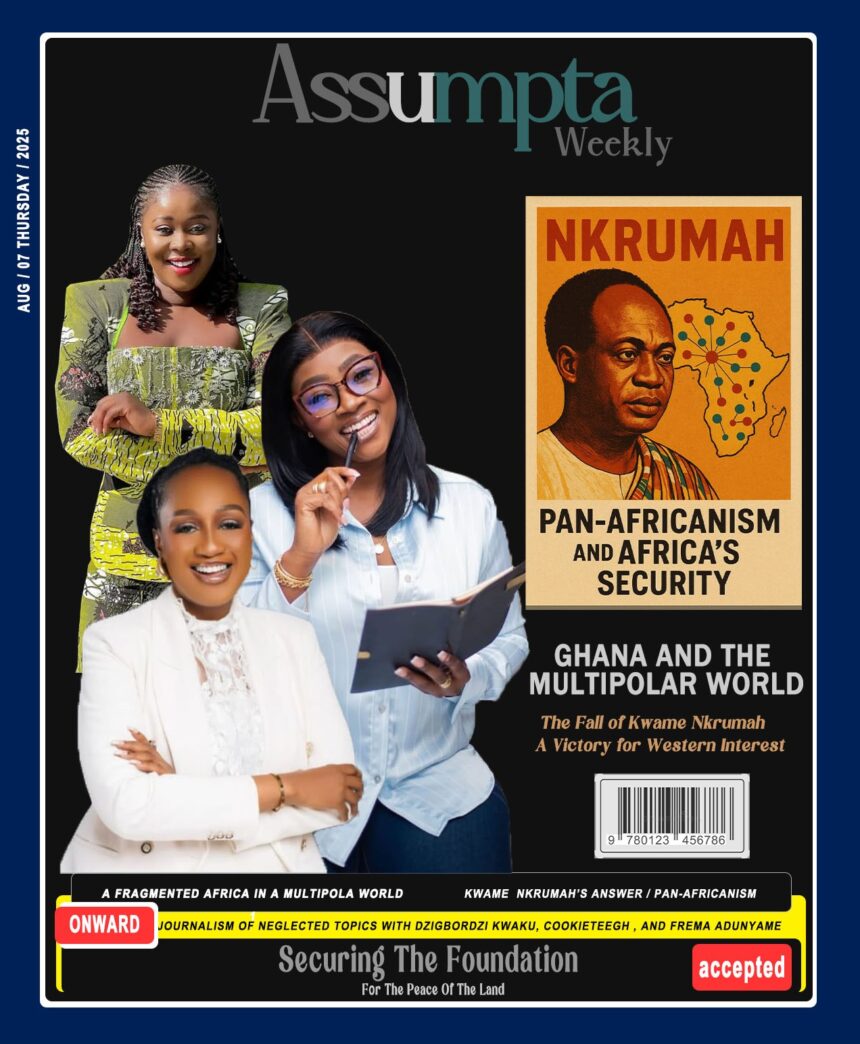
Assumpta Newsletter Magazine
Presents : “Securing The Foundation — For The Peace of The Land”
🗓️ Release Date: Thursday, August 7th, 2025:
ADVERTISMENT


https://www.instagram.com/hairsenta?igsh=MXAzOThhNGZ0Nm15dQ==
Hair Senta – Rare Vitality, Unmatched Beauty
There’s a reason Hair Senta is admired by women across the world. With rare vitality and refined skill, Hair Senta doesn’t just enhance your look — it transforms your confidence.
💎 Shopping & Retail | Trademarked Excellence
We ship only the best human hair extensions, sourced and styled in Ghana, delivered to women across the globe who know the power of quality.
📦 Worldwide Shipping
🌍 From Ghana to the world – because you deserve luxury, no matter your location.
📍 Visit Us: 24 Jungle Avenue, Accra, Ghana 00233
📞 Call Us: (+233) 054 435 4455 / 024 862 9769
🌐 Browse: www.hairsenta.com
📸 Followed by @directionbygwen and 87 others
💫 Hair Senta — Where every strand tells a story of elegance, excellence, and empowerment.
FEATURE STORY:

“Ghana and the Multipolar World”
➡️ The Fall of Kwame Nkrumah — A Victory for Western Interest
➡️ A Fragmented Africa in a Multipolar World
A fragmented Africa exists today largely due to a combination of colonial legacy, external manipulation, internal betrayal, and the deliberate stalling of Pan-African unity. Here’s why Africa remains fragmented:
1. Colonial Borders Divided a Unified People
- Colonial powers (Britain, France, Portugal, Belgium, etc.) carved up Africa arbitrarily during the 1884–85 Berlin Conference.
- These borders split ethnic groups, merged hostile ones, and ignored existing kingdoms and trade networks.
- The result? Nations that lacked cohesion and became dependent on colonial powers for structure and governance.
2. Divide-and-Rule Tactics
- Colonial rulers intentionally sowed division between ethnic, linguistic, and religious groups to prevent unified resistance.
- These tactics were often preserved post-independence by elites who inherited colonial institutions and used them for power consolidation.
3. Disruption of Pan-Africanism
- Visionaries like Kwame Nkrumah, Patrice Lumumba, and others fought for African unity — politically and economically.
- But Western powers feared a unified Africa. Why? Because unity meant:
- Greater negotiating power
- Control over resources
- Reduced dependency on Europe/West
- As a result, leaders who pushed Pan-Africanism were undermined, overthrown, or assassinated, often with foreign involvement (e.g., CIA-backed overthrow of Nkrumah in 1966).
4. Neo-Colonial Influence
- Despite independence, many African states remain economically and militarily dependent on former colonial powers.
- Institutions like the IMF and World Bank impose economic models that promote individual market participation over collective regional strategy.
- This keeps countries competing instead of cooperating.
5. Weak Regional Integration
- Attempts at integration (like the African Union or ECOWAS) are often undermined by national interests, elite capture, corruption, and foreign lobbying.
- Countries often trade more with Europe and China than with neighboring African nations.
6. Cultural Alienation
- Western education systems and media have erased shared African histories, languages, and philosophies.
- As a result, many Africans identify more with colonial languages or foreign religions than with neighboring African cultures.
7. Resource Exploitation Keeps Countries Isolated
- Africa’s vast resources (oil, gold, lithium, cobalt, etc.) are exploited through bilateral deals, often struck in secret.
- This discourages regional sharing or development of joint resource infrastructure.
In Summary:
Africa is fragmented because it was designed to be.
The legacy of colonialism created artificial divisions, and neo-colonialism maintains them — through economic dependency, political manipulation, and suppressed collective memory.
But the dream of a united Africa isn’t dead.
It lives on in:
- Cross-border trade zones
- Pan-African art and music
- Youth-led movements
- Food sovereignty initiatives
- The rising call for “one voice, one continent”
➡️ Kwame Nkrumah’s Answer: Pan-Africanism
The Voice of a Continent Awakening
🔎 Investigative Focus:
“Journalism of Neglected Topics”
With:
🎙️ Dzigbordi Kwaku-Dosoo — Global Keynote Speaker | CHPC™ Coach | Trusted by 1M+ Brands
🗣️ Cookieteegh — TV Presenter & Host
📡 Frema Adunyame — Broadcast Journalist & Cultural Visionary
Dzigbordi Kwaku-Dosoo’s Message:

“True power begins in the soul, and nations rise or fall by the strength of their spiritual foundation.”
A leadership voice for clarity, conscience, and collective healing.
Together, They Represent:
- Modern Ghanaian Excellence
- A Movement for Truth, Peace & Empowerment
- A New Era of Cross-Cultural Narratives
- Voices Rooted in Historical Accountability
Don’t Miss This Transformational Release!
🗓️ Thursday, August 7, 2025
📥 Exclusively in the “Securing the Foundation” Edition
💌 Subscribe & Share → Join the movement shaping the global future — from Africa to the world.
Ghana and the Multipolar World
Published in NKRUMAH:
In today’s shifting global landscape, power no longer rests in the hands of a single superpower. Instead, we are witnessing the rise of a multipolar world — a system where multiple nations and regions exert significant influence on international affairs. For Africa, and particularly Ghana, this new reality presents both risks and opportunities. But perhaps no figure foresaw this moment more clearly than Kwame Nkrumah.
A Fragmented Africa in a Multipolar World
In a world with several global power centers — the United States, China, the European Union, India, and others — smaller nations like Ghana face a dilemma: act alone and risk marginalization, or unite and amplify their voice. Nkrumah warned that Africa, left divided, would be vulnerable to foreign influence and economic exploitation, especially because of its vast natural resources.
Ghana’s gold, oil, bauxite, and critical minerals are not just national assets — they are strategic commodities in the global power game. As powers compete for access and control, Ghana’s sovereignty, economy, and security are inevitably shaped by external interests.
Nkrumah’s Answer: Pan-Africanism
Kwame Nkrumah believed that only a united Africa could stand strong in a competitive world. He understood that the distribution of resources among African countries, if managed collectively, could become a foundation of continental strength — not weakness. In his eyes, Pan-Africanism was not just idealism; it was strategy.
He envisioned:
- A continental government to speak with one voice
- A common economic policy to protect Africa’s interests
- A shared defense strategy to secure Africa’s sovereignty
For Nkrumah, unity wasn’t optional. It was the condition for Africa to survive — and thrive — in a world of shifting alliances and rival powers.
The Fall of Nkrumah: A Victory for Western Interests
Nkrumah’s overthrow in 1966 was more than a change of government — it was a strategic victory for the Western powers who feared his influence and vision of a united, self-reliant Africa. His removal disrupted the Pan-African momentum and pushed Ghana back into dependence on the same Western nations whose control he had sought to break.
By dismantling Nkrumah’s radical policies and pan-African infrastructure, the coup paved the way for external actors to regain leverage over Ghana — economically, politically, and militarily. It fractured the vision of an Africa that could rise on its own terms in a multipolar world.
Ghana’s Role Today
Today, Ghana remains a stable democracy with a growing global reputation. But it also finds itself courted by competing powers — from Western investors to Chinese infrastructure deals to emerging partnerships with the Global South. The challenge is to navigate this multipolar world without becoming dependent or divided.
The lesson from Nkrumah is clear: Ghana’s future is tied to Africa’s collective strength. In a fragmented Africa, the continent’s wealth becomes a liability. But in a united Africa, it becomes a source of leverage, dignity, and power.
The Moral Cost of a Multipolar World

By Dzigbordi Kwaku-Dosoo
Global Keynote Speaker | CHPC™ Coach | Host of the NKRUMAH Dialogue Series
As we prepare to publish “Ghana and the Multipolar World” in the NKRUMAH newsletter, I feel an urgent call to speak—not just as a coach, a woman of Africa, or a global leader—but as a Ghanaian deeply concerned about the ethical direction of our place in the world.
The conversation we are about to have on August 7th, joined by my brilliant sisters Frema Adunyame and Cookieteegh, is not just about history. It is about truth. And it is about accountability.
A World of Many Powers, But Few Principles
Today’s world is multipolar—yes. But is it moral?
The rise of new power centers—China, India, the EU, the U.S.—has not led to greater justice. It has only diversified the hands reaching into Africa’s pockets. The tools may differ—loans instead of guns, media instead of missions—but the goal remains the same: access to our resources without surrendering control.
And who pays the price?
We do. Ghanaians. Africans. The children of Nkrumah’s dream.
The Fall of Nkrumah Was a Moral Betrayal
Let’s speak plainly: Kwame Nkrumah was overthrown because he dared to imagine an Africa beyond dependency. His vision of Pan-Africanism, of unity and control over our destiny, threatened the very structure of post-colonial exploitation. And when the West couldn’t buy him, they broke him.
Since then, we have been striving and starving, while the very nations that destroyed our path to independence continue to prosper from our disunity.
That is not just politics.
That is a global ethical failure.
What Ethical Options Exist in a Multipolar World?
As we engage this topic, I ask every leader, thinker, and ally listening to reflect deeply:
° Is multipolarity truly ethical if it reproduces colonial patterns with new faces?
- Can trade be just if it’s negotiated under economic duress and political manipulation?
- Can sovereignty be real if African voices are still silenced or sidelined at global tables?
Multipolarity without moral clarity is just more polite exploitation.
A Call for Conscious Power
Africa does not need pity.
We need partnerships based on dignity, reciprocity, and trust. We need the global system to stop choosing profit over people, and convenience over justice.
And we, as Africans, must also rise—united, educated, and unapologetically determined—to finish the work that Nkrumah started.
This is not just a newsletter article.
This is a wake-up call.
Final Word
“To free Ghanaian culture is to free it from an intolerant system of power — one that rewards obedience but punishes independence.
Ghana’s identity, creativity, and sovereignty cannot truly thrive under global structures that extract our wealth, silence our voices, and distort our history.
True liberation means reclaiming not just our resources, but our narrative — our right to define who we are, on our own terms.”
— Dzigbordi Kwaku-Dosoo
Here’s what that means in context:
Ghanaian culture — rich, diverse, deeply rooted in community, identity, and resilience — cannot fully flourish under a global system that:
- Dictates economic policy through foreign loans and structural adjustment
- Controls narratives by sidelining African history and voices
- Undermines sovereignty by favoring elite interests over the people’s will
- Extracts resources without investing in long-term national wellbeing
So yes, to reclaim the cultural, political, and economic destiny of Ghana, we must break from a system that tolerates only obedience, not independence.
And this is exactly what Kwame Nkrumah warned against — a future where Africa remains politically independent but economically and culturally colonized.
In short:
To free Ghanaian culture is to restore Ghanaian power, and to do so in a world that too often punishes authenticity, unity, and resistance.
Reclaiming Africa’s Dignity Begins with the Soil

A Statement of Urgency and Hope
This is a message grounded in a fundamental belief:
No human being on this planet should endure the misery of starvation and the shame of poverty.
Between 1989 and 1993, I journeyed across Africa — and what I saw has never left me. I carry the haunting memory of children who died not because the earth was dry or seeds were missing, but because systems had failed them. I mourned them then, and I mourn them now. And I remain deeply grieved not only by the long shadow of colonial exploitation, but also by the failures of African leadership that have allowed this suffering to continue.
Today, I make this plea to African leaders:
Pledge, without compromise, to build prosperity not just for former colonial powers who have long benefited from Africa’s pain — but for your own people. Stop enabling a system guided by greed, ignorance, and false promises of “efficiency” that continue to rob Africa of its future.
The Numbers Tell the Story
- Africa holds 60% of the world’s uncultivated arable land — the greatest agricultural potential on Earth.
- Yet Africa imports $43 billion worth of food annually.

Why? Because the colonial economic model never truly ended. Africans were conditioned to grow cash crops — cocoa, coffee, tea — for export, not food for their own survival. This system was not designed to nourish Africans. It was designed to extract.
Gaddafi Knew the Truth

Muammar Gaddafi, whatever one thinks of his politics, understood the ethical failure of Africa’s food dependency. He invested billions in desert agriculture, water aquifers, and local grain reserves. And he said clearly:
“A nation that cannot feed itself is a nation waiting to be conquered.”
He was right. Today, we watch:
- Fertile Nigeria importing rice
- Malawi depending on maize aid
- Ghana buying onions and tomatoes from Togo
All while international institutions tell us this is “market efficiency.”
No — this is economic suicide.
Here’s an elaborated and reader-friendly version of that section — providing deeper context, clarity, and emotional impact while preserving your original voice and message:
Gaddafi Knew the Truth
Whatever one may think of Muammar Gaddafi’s politics, one thing is undeniable:
He understood the deep ethical and existential failure of Africa’s dependence on foreign food systems.
Gaddafi saw what many African leaders refused to acknowledge — that a continent that cannot feed itself is a continent that will never be truly free. His words were sharp and prophetic:
“A nation that cannot feed itself is a nation waiting to be conquered.”
He wasn’t speaking in metaphors. He was exposing the core truth of Africa’s continued vulnerability.
Gaddafi Took Action, Not Just Stands
Unlike many leaders who make speeches but not solutions, Gaddafi invested billions into:
- Desert agriculture: Turning dry lands into productive farms
- Water aquifers: Tapping deep underground water reserves for irrigation
- Local grain storage and reserves: Ensuring food security in times of crisis
These were not just domestic policies. They were acts of Pan-African resistance against a system that still forces African countries to export raw goods — and import basic food staples.
What We See Today Is a Tragedy
In 2025, the absurdity of Africa’s food system continues:
- Nigeria, one of the most fertile nations in the world, still imports rice — a crop it can grow abundantly.
- Malawi, known for its fertile valleys and rainfall, is reliant on maize aid.
- Ghana, with rich soils and a proud farming history, buys onions and tomatoes from Togo and Europe.
And we are told by international financial institutions — the IMF, World Bank, WTO — that this is simply “market efficiency.”
But let’s be clear:
This is not efficiency. This is economic suicide.
How can the world’s most resource-rich continent export cocoa and import chocolate, export cotton and import clothes, export tomatoes and import tomato paste?
It’s not just unjust.
It’s strategic disempowerment — and it keeps Africa dependent, hungry, and poor.
The Deeper Lesson
Gaddafi understood that food is not just about agriculture — it’s about:
- Power
- Sovereignty
- Survival
A nation that can’t feed itself must beg, borrow, or surrender.
Until African countries prioritize food security over export profits, until leaders invest in smallholder farmers instead of foreign agribusiness, and until we protect native seeds, crops, and water rights — we will remain vulnerable to external control.
Because in the 21st century, food is power. And those who control your food, control your future.
The Path Forward: Soil Before Sovereignty
To reclaim Africa’s dignity, we must first reclaim our soil.
- Land Reform:
Return land to the people who work it — not to foreign agribusinesses, not to political land elites. - Invest in Agriculture That Serves Africans:
- Agro-processing
- Irrigation
- Grain storage
- Farmer cooperatives
- Protect Africa’s Food Sovereignty:
- Ban GMO monopolies
- Preserve indigenous seeds
- Promote native crops suited to African climates and cultures
- Elevate Agro-Science Across Borders:
- Create food corridors across regions
- Share research and innovation
- Train a new generation of agroecologists, soil scientists, and ethical stewards of the land
Food Is Political. It Always Has Been.
It determines:
- Whether our children grow or go hungry
- Whether farmers thrive or are forced to migrate
- Whether we feed our workers — or foreign traders and lenders
Let us be clear: The real revolution will not begin in boardrooms.
It will begin in the fields.
And Africa’s future will not be decided by foreign debt negotiations, but by what we choose to grow, protect, and preserve in our soil. It is time. Let the soil speak.
“Securing the Foundation — For the Peace of the Land”
Special Dialogue Edition — NKRUMAH Newsletter
Release Date: Thursday, August 7, 2025


[Opening Statement – Dzigbordi Kwaku-Dosoo]

DZIGBORDI:
Hello and welcome, everyone — from Accra to Addis, Lagos to London, and every corner of the global African family. You’re tuning in to a very special edition of the NKRUMAH Dialogue Series under the theme:
“Securing the Foundation — For the Peace of the Land.”
Today, I’m joined by two exceptional voices — two brilliant women shaping public thought and holding space for truth:
Frema Adunyame, an award-winning broadcast journalist and cultural visionary; and Cookieteegh, a dynamic TV presenter and media personality who brings soul and clarity to every conversation.
Together, we are igniting a dialogue around our featured article: “Ghana and the Multipolar World” — The Fall of Kwame Nkrumah: A Victory for Western Interest
This is more than journalism. This is a journey back to the heart of what’s been lost, and what must now be reclaimed.
Welcome, ladies.
Before I begin, let me say:
“We not only need to have ethical duties to others, but to ourselves as well. What gives many of us meaning in life is the development of our full potential.
And when Africans are prevented from achieving their potential, much of that meaning is stripped away — along with our sense of control. Africans treated as second-class citizens feel helpless because they cannot shape their own destinies.
Talented and capable women in Ghana and across the continent are still denied access to high-impact leadership in business and government. Children are still dying from hunger. Farmers — the backbone of our survival — are poorly paid and inadequately prepared to develop their lands, communities, and countries.”
Now, my first question to both of you:
Was this the self-realization that Kwame Nkrumah envisioned for Africans? Is this the Africa he fought for?

[Frema Adunyame
Thank you, Dzigbordi. That question strikes deep. No — this is not the Africa Nkrumah dreamed of.
He envisioned a continent of dignity, unity, and capacity. A place where sovereignty meant more than waving a flag — it meant the ability to feed our people, educate our children, and define our destiny.
The tragedy is, after his overthrow, we didn’t just lose a leader — we lost a roadmap. What we’re living today is a consequence of that fragmentation. We have the talent, the land, the vision — but not the collective will or structure to channel it. And so the cycle of dependency continues.

Cookieteegh
Exactly, Frema. Nkrumah warned us: “If we do not unite, we shall be exploited individually.”
And today, we see it. In this multipolar world, Ghana and many African countries are being pulled in different directions — not as equal partners, but as suppliers of raw materials and consumers of finished goods.
What I see in the media, what I hear in the villages, what I feel in the streets — it’s pain disguised as resilience. The soul of our people is strong, but the systems suffocate their potential. That’s what we must fix.

DZIGBORDI:
This brings us to the heart of our feature story.
In the article “Ghana and the Multipolar World”, we explore:
- The ethical betrayal of Nkrumah’s overthrow
- How a fragmented Africa became vulnerable in today’s multipolar global order
- Why Nkrumah’s answer — Pan-Africanism — remains more relevant than ever
- And the urgent need for ethical leadership and economic self-reliance
Let me highlight a line from the article:
“Multipolarity without moral clarity is just more polite exploitation.”
What are your thoughts on that?

FREMA:
That line is everything.
We celebrate diversity of power globally, but who’s ensuring justice for Africa in this new balance?
Whether it’s Western donors, Eastern investors, or Southern trading partners — if they all come to extract, then we’re just switching the colonizer’s costume.
The ethical conversation isn’t about where power sits, but how it’s used. And if Africa is not seated equally at that table, then we’re still being served — not served.

COOKIETEEGH:
And this is why I love this platform. Because we’re not just reporting — we’re redefining.
Africa has to stop waiting for permission to lead itself. And that starts with what Dzigbordi has emphasized: reclaiming the soil. Feeding our people. Training our youth. Investing in ourselves.The revolution begins in the field, not the boardroom. And let’s be honest — we’ve reached a tipping point.
What Dzigbordi said earlier struck me hard: ‘To free Ghanaian culture is to free it from an intolerant system of power.’ That intolerance is still here — it just wears a suit and signs contracts now.We import food we could grow ourselves. We accept debt deals that rob our children’s future. And our culture — our vibrant, defiant, powerful culture — gets polished up for tourism while being hollowed out at home. Pan-Africanism wasn’t a fantasy. It was our insurance policy. And we let it lapse.”

Dzigbordi:
“Yes. And Cookieteegh, what you just said brings us right back to the foundation — the soil.
The revolution won’t be televised. It will be harvested. It will be irrigated. It will rise in the heartbeat of farmers who are finally honored, paid, and protected. Kwame Nkrumah once said: ‘We face neither East nor West. We face forward.’ Well, facing forward now means returning to the land — to truth, to unity, to power. Not just as sentiment, but as strategy. And for our readers, I leave you with this —
“To free Ghanaian culture is to restore Ghanaian power, and to do so in a world that too often punishes authenticity, unity, and resistance.’ We cannot outsource our future. Not to China. Not to the West. Not to international institutions. We must secure the foundation — for the peace of the land.”

Frema Adunyame:
“For the peace of the land, we must teach our children where their roots are — and fight to ensure they grow in fertile soil, not foreign chains.”

Cookieteegh:
“And for the peace of the land, we must raise our voices — as women, as journalists, as Africans — because silence is no longer an option.”
Dzigbordi (Final Word):
“Let us not just remember Nkrumah’s fall — let us rise where he stood. Let this not be just another article. Let it be a declaration. A declaration that in this multipolar world, Ghana will not be a pawn — it will be a voice. A voice for ethical leadership, food sovereignty, Pan-African unity, and cultural power reclaimed.
This is our soil.
This is our story.
And now — it is our time.”
Ladies, thank you. What we’ve just done here isn’t a panel — it’s a collective awakening.
Let me close with this: “To free Ghanaian culture is to free it from an intolerant system of power — one that rewards obedience but punishes independence.
True liberation means reclaiming not just our resources, but our narrative — our right to define who we are, on our own terms.”
This is what Nkrumah’s legacy demands.
This is what Africa’s children deserve.
And this is what we must deliver — for the peace of the land.
📌 Stay Tuned:
🗓️ Thursday, August 7th, 2025
🎙️ “Ghana and the Multipolar World” — Published in the NKRUMAH Newsletter
💥 Only in the “Securing the Foundation” Special Edition
🔗 Share. Speak. #PanAfricanism #NkrumahLegaces #SecuringTheFoundation #LeadershipWithSoul #AfricanNarrativescy #GhanaVoi
SGI-Our Shared Humanity

https://www.instagram.com/babies_and_todds_day_care?igsh=MWs0ZHlsbjcxNXEyZg==


https://www.instagram.com/laurenhautecouture?igsh=MWxzNXN1Ym5nZ3o3Mg==


https://www.instagram.com/officeandcobysa?igsh=dmxucTZ2a2t1eDBn


https://www.instagram.com/ankara.africa?igsh=ZDJmN216Z2ZhbWFm


https://www.instagram.com/flourishheights?igsh=cTExenQ3bnptZGgx