




Presents “ONWARD” / FLASH ALERT
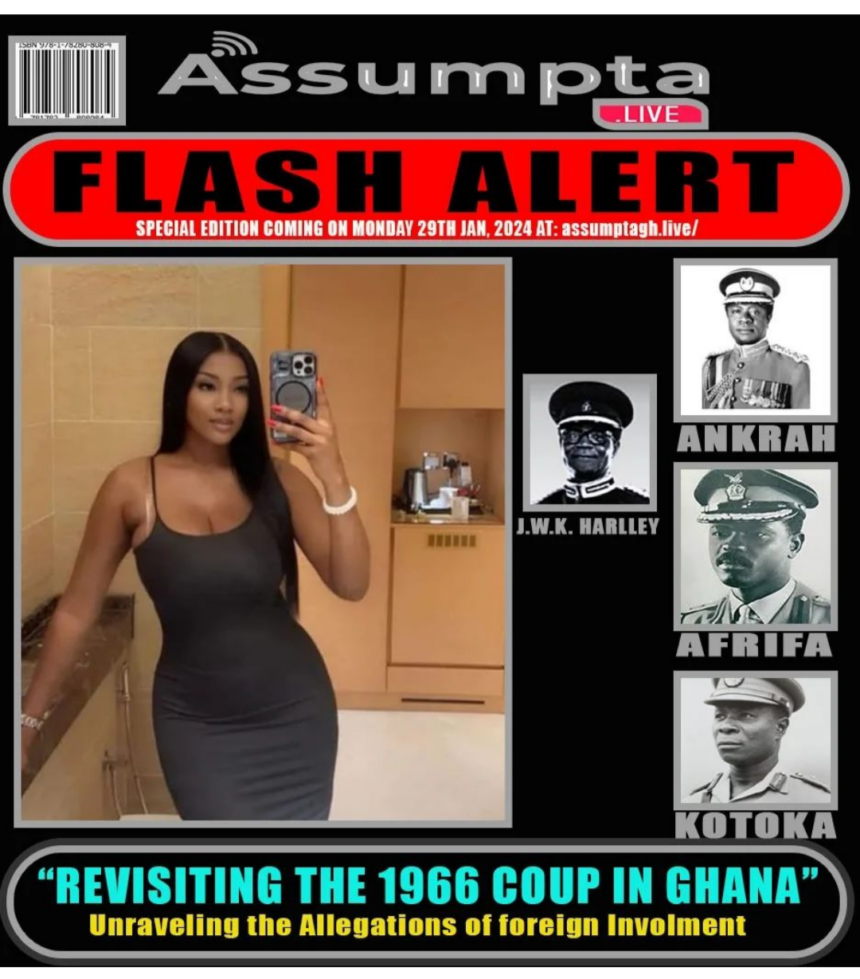
“REVISITING THE 1966 COUP IN GHANA”.
A Special Edition Coming On Monday 29th January, 2024 at: assumptagh.live/
With Gen. Ankrah, J.w.k. Harley Gen. Afrifa and Kotoka. “Unravelling the Allegations of foreign Involvement”


The Leaders of The 1966 Coup
in the 1966 Ghanaian coup d’etat” In this meeting, Gen. Ankrah, J.w.k. Harlley, Gen. Afrifa, and Kotoka discussed the allegations of foreign involvement in the 1966 Ghanaian coup d’etat. The group aimed to unravel the truth behind the accusations and determine the extent of foreign influence in the overthrow of President Kwame Nkrumah.
Gen. Ankrah expressed concerns about the implications of foreign interference in Ghana’s internal affairs and emphasised the need for transparency and accountability. J.w.k. Harley, a prominent military figure, provided insights into the potential motives and actions of foreign actors during the coup.
Gen. Afrifa and Kotoka, both key players in the coup, shared their perspectives on the allegations and their interactions with external parties. They discussed the various rumours and speculations surrounding the involvement of foreign intelligence agencies and foreign governments in the events leading up to the overthrow of Nkrumah’s government.
The meeting concluded with a plan to conduct a thorough investigation into the allegations and gather evidence to either confirm or refute the claims of foreign involvement. The group agreed on the importance of maintaining Ghana’s sovereignty and independence while addressing any potential foreign interference. They also emphasised the need to safeguard the country’s democratic institutions and prevent any external influence from undermining Ghana’s stability.
To be clear, it is important to underscore that it is not my contention that the disagreement that results from opposing arguments. There’s a lot of contention about that issue, as the four generals were in favour of the overthrow of Kwame Nkrumah’s government. Therefore, by necessity, almost all regimes in the world have suffered U.S. and Western-backed coups organised to overthrow regimes they deemed unfriendly to their capitalist interests. For decades, they have meddled in other countries’ politics.
Their target was then Dr Kwame Nkrumah, who achieved independence for Ghana and inspired many African countries to do the same. Kwame Nkrumah saw reforms for African people’s rights in a way that threatened capitalist interests, and they overthrew him with the help of General Ankrah, J.w.k. Harlley, Kotoka, and Afrifa to establish an authoritarian military regime.

https://www.instagram.com/ag_premiumjeans?igsh=MWpsNjZ1bTFvdHNsdw==
The overthrow of Kwame Nkrumah marked a turning point in Ghana’s history, as it shifted the country towards military rule and away from the democratic ideals that Nkrumah had championed. Despite his flaws and controversial policies, Nkrumah’s legacy as a leading figure in the fight for African independence and unity remains significant. His ideas and vision continue to inspire people across the continent, and he is remembered as a symbol of African resistance against colonialism and oppression.
Kwame Nkrumah, the first President of Ghana, was known for his vision and leadership in implementing urban strategies that aimed to modernise and develop Ghana’s urban areas. His urban strategy encompassed a range of policies and initiatives aimed at transforming the country’s cities and towns into vibrant and €productive hubs of economic and social activity.
One of Nkrumah’s key urban strategies was the implementation of large-scale infrastructure projects, including the construction of roads, bridges, and urban utilities such as water and electricity supply systems. These initiatives aimed to improve the quality of life for urban residents and to provide the necessary infrastructure for economic development and growth.
Nkrumah also emphasised the importance of urban planning and development, seeking to create a more efficient and organised urban environment. He invested in the creation of master plans for urban areas, with a focus on zoning, land use, and the creation of public spaces. His goal was to create more livable and sustainable cities, with proper amenities and services for all residents.
Furthermore, Nkrumah prioritised the development of urban housing, seeking to address the issue of inadequate and substandard housing in urban areas. He implemented programs to improve housing conditions, increase access to affordable housing, and to provide support for the construction of new housing developments.
In addition to physical infrastructure and urban planning, Nkrumah also focused on social and economic development within urban areas. He promoted education, healthcare, and other social services in urban areas, aiming to improve the standard of living for urban residents.
Overall, Kwame Nkrumah’s urban strategy was comprehensive and ambitious, seeking to transform urban areas into modern, efficient, and inclusive spaces for all residents. Though his vision faced challenges and criticism, his efforts reflected a commitment to improving the lives of Ghanaians in urban areas and to building a strong and prosperous nation.

ASSUMPTA:
The Role of Rumors as a Function of Fundamental Darkness.” Was published by Soka Spirit Editor Posted on May 26, 2011.
By Alain Berger, Los Angeles. He was strolling through the Renoir exhibit at the Los Angeles County Museum of Art recently, admiring an exquisite painting of a woman holding a child, when I heard a man behind me make a comment to his female companion: “that was their nanny, she was his model, I bet you anything she was a lot more than that” he said with a sneer in his voice. “So that’s how rumours started,” I thought, “with just one unfounded remark.” I couldn’t help wondering what prompted the comment in the first place, but I could imagine it taking on a life of its own, travelling from mouth to mouth, fueled by emotions such as envy, jealousy, pettiness, until eventually it would become a “given” that the impressionist master’s nanny was also his lover.

TSASI:
Rumours, it seems, thrive in the darkness of ignorance and insecurity. When we don’t have all the facts, we tend to fill in the gaps with our own assumptions and biases. The fundamental darkness within us, our inherent tendency to doubt and fear, feeds the spread of rumours as they provide a sense of validation for our insecurities.
In the case of Kwame Nkrumah, the rumour that he is an authoritarian selfish leader was a tool used to exert power and control. By spreading this false information about Nkrumah’s leadership, the CIA and their Western counterparts manipulated the perceptions and behaviours of those around him. This manipulation led to division and distrust, which had damaging effects on party leaders and communities.
They utilised rumours as a means to deflect attention away from their own faults or misdeeds. By shifting the focus onto others through the spread of gossip and innuendo, individuals can avoid scrutiny and accountability for their own actions. In the realm of social media, rumours spread with lightning speed, reaching a vast audience within moments. This can result in far-reaching consequences, as false information becomes perpetuated and amplified, leading to significant harm to an individual’s reputation and well-being.

ASSUMPTA
In the face of rumours, it is crucial to maintain critical thinking and scepticism. Rather than blindly accepting and perpetuating gossip, we should actively seek out verified sources and facts before forming judgments about others. Additionally, it is important to address and confront rumours directly, rather than allowing them to take root and fester in the darkness.
Ultimately, the spread of rumours reflects the fundamental darkness within humanity – our tendency toward fear, doubt, and insecurity. By shedding light on the truth and approaching others with empathy and understanding, we can collectively work to eradicate this darkness and foster a culture of trust and transparency.
The impact of rumours on individuals and societies can indeed be profound. They have been used throughout history as a means of manipulation and control. Addressing rumors with critical thinking and seeking verified information is essential in combating their potentially destructive effects. Shedding light on the truth and promoting empathy and understanding are crucial steps in fostering trust and transparency within communities.

TSASI
In many cases, the colonisers, as rumormongers, projected their feelings of guilt, shame, or paranoia onto Ghanaians. In the effort to bring down the man of justice and integrity, Kwame Nkrumah, the CIA and their Western counterparts used rumours.
The CIA, having been defeated by Nkrumah in an economic contest, not only reneged on their promise to befriend him but also spread slanderous rumours, even suggesting that Nkrumah should be put to death for alleged economic transgressions. They went as far as spreading rumours that Nkrumah was a dictator and authoritarian selfish leader misusing national funds

ASSUMPTA
“It is assumed that the four Generals Afrifa, Kotoka, Ankrah, and J.W.K. Harlley sided with those who criticise Kwame Nkrumah, as they were involved in spreading a negative image of him.
TSASI:
Proving the charges against Nkrumah was a challenging task, leading to the deliberate use of false accusations as a means to tarnish his reputation. These tactics now involve collusion with elements of the mass media.

https://www.instagram.com/ag_premiumjeans?igsh=MWpsNjZ1bTFvdHNsdw==
Assumpta :
Truth and facts are irrelevant, as the main objective is for Ghanaians to hold an unfavourable impression of Nkrumah. The enemies further spread rumours linking Nkrumah to economic failures and questioning his negotiation skills, even though they were responsible for those failures themselves, aiming to portray him as a dangerous and weak leader.”
TSASI
In the case of Nkrumah, his opponents may have sought to undermine his leadership by circulating negative information, including attributing economic failures to his actions or questioning his negotiation skills. Such tactics are not unique to Nkrumah of Ghana; they have been employed in political arenas worldwide throughout history.
In situations like this, it is important to critically evaluate information and consider multiple perspectives in order to form a more balanced understanding of a leader and their actions. Historical analysis and research can provide insights into the context and complexities of a leader’s decisions and their impact on a nation.

ASSUMPTA
“How does this apply to Ghanaians, and Africans?

TSASI
When Ghana and the entire African continent were still under colonial control, they were derided as a ‘gathering of ignorant and poor monkeys.’ As Kwame Nkrumah gained Ghana’s independence and Africa grew in size and became a powerful force in the continent and the world, the accusers colluded to try to destroy Africa and its presidents, who were constantly libelled in the tabloids and accused of all sorts of misconduct.
In the 1960s, Kwame Nkrumah’s Ghana experienced extensive, ongoing media attacks, most of which were concentrated on Kwame Nkrumah himself. The tabloids cleverly took advantage of this media influence and used it to undermine Kwame Nkrumah’s effort to bring prosperity to Africa. The four generals who were themselves Ghanaians also colluded with the media to spread defamatory rumours about Kwame Nkrumah.
Ghana is still a small country, but there is a likelihood that as it keeps growing, it will meet with the same kind of opposition and slander, as special interests will try to destroy it or impede its growth. We need to be ready for this and develop the wisdom to see through these tactics. As individuals, we are continuously exposed to a stream of information, especially on the Internet, and need to take the time to sift through it and come to our own conclusions. My fellow Assumpta publication group and I have also encountered opposition in the form of malicious slander, both from within and without, and it is crucial for us to develop the wisdom and fortitude not to be taken in by them or to become party to the spreading of false information.”
ASSUMPTA
How can we combat rumours?
TSASI
Combatting rumours can be approached through a steadfast faith and a deep understanding of the truth. Drawing inspiration from Kwame Nkrumah’s intentions and studying his works can help solidify a resilient life state. This, combined with the protective functions of life, can provide a shield against falsehoods. As the Lotus Sutra suggests, such a strong foundation can help eliminate enmity and malice.

https://www.instagram.com/ag_premiumjeans?igsh=MWpsNjZ1bTFvdHNsdw==
ASSUMPTA : REFUTATION
Indeed, swift and accurate refutation is crucial when faced with falsehoods. Research supports the notion that denying a rumour promptly can reduce belief in it, while the absence of denial can reinforce belief. Therefore, it is essential to counter any attacks on President Nana Akufo Addo without delay, as waiting allows rumours to gain traction and become entrenched in people’s minds.
TSASI : DIALOGUE
Engaging in open and sincere dialogue, underpinned by the dignity of human life, is indeed a powerful tool for resolving conflicts. Encouraging Ghanaians to speak out and communicate facts accurately fosters trust, even among those with differing viewpoints. Expressing convictions calmly and dignifiedly can attract protection and even transform adversaries into allies, as dialogue has the potential to bridge gaps and build understanding.
ASSUMPTA : DEVELOPING TRUST
Developing trust is indeed crucial in preventing and reducing harmful rumours, yet it can be challenging to cultivate, especially among conflicting parties. Fear and anxiety often drive division and are used to manipulate public opinion. Building a network of allies to protect President Akufo-Addo and fostering trust within local communities through upholding the sanctity of life can help counteract the impact of such divisive emotions and actions.

TSASI : TRANSPARENCY AND SELF-REFORM
Promoting transparency and self-reform is crucial in combating the spread of unfounded rumours. It’s essential to resist the temptation to accept and spread derogatory comments, checking facts before engaging in gossip. Transparency, both as individuals and as a collective, can serve as a powerful antidote to baseless rumours. President Ikeda’s analogy of being like an onion, transparent and without hidden layers, highlights the importance of creating a culture of openness and honesty. This begins with continuous self-reflection and self-reform, ultimately contributing to a transparent and trustworthy society.
“On the level of the individual, practising the Lotus Sutra and chanting Nam-myoho-renge-kyo, means confronting my fundamental darkness in my own life. In the continuous struggle to establish a peaceful society in the Latter Day of the Law, it is incumbent upon us to use words to protect our loved ones, our precious nation, and ourselves—words of wisdom, courage, and conviction that will soar and echo in the skies of justice.

https://www.instagram.com/ag_premiumjeans?igsh=MWpsNjZ1bTFvdHNsdw==
ASSUMPTA
“On the level of the individual, practising the Lotus Sutra means confronting the fundamental darkness in one’s own life?
TSASI
Human beings possess an inherent Buddha nature, and through the practice of the sutra, one can cultivate wisdom, compassion, and enlightenment.
When it comes to confronting one’s fundamental darkness in life, practising the Lotus Sutra involves delving into one’s own inner challenges, doubts, and suffering. By facing these difficulties head-on and seeking to transform them, individuals can deepen their understanding of themselves and the world around them. This process often requires introspection, self-reflection, and the application of Buddhist teachings and practices.
In the context of establishing a peaceful society in the Latter Day of the Law, the use of words becomes crucial. Words have the power to inspire, guide, and unite people toward a shared vision of justice and harmony. By employing words of wisdom, courage, and conviction, individuals can contribute to creating an environment where peace, understanding, and respect thrive. These words can be used to protect and uplift loved ones, advocate for justice and equality, and promote positive change in society.
Engaging in dialogues, just like the one we are having now, provides an opportunity to exchange ideas, explore different perspectives, and foster mutual understanding. It is through such dialogues that meaningful connections and solutions can be formed, ultimately leading to a more peaceful and just society.

Thank you for initiating this dialogue and discussing these important topics. Thank you for having me.