


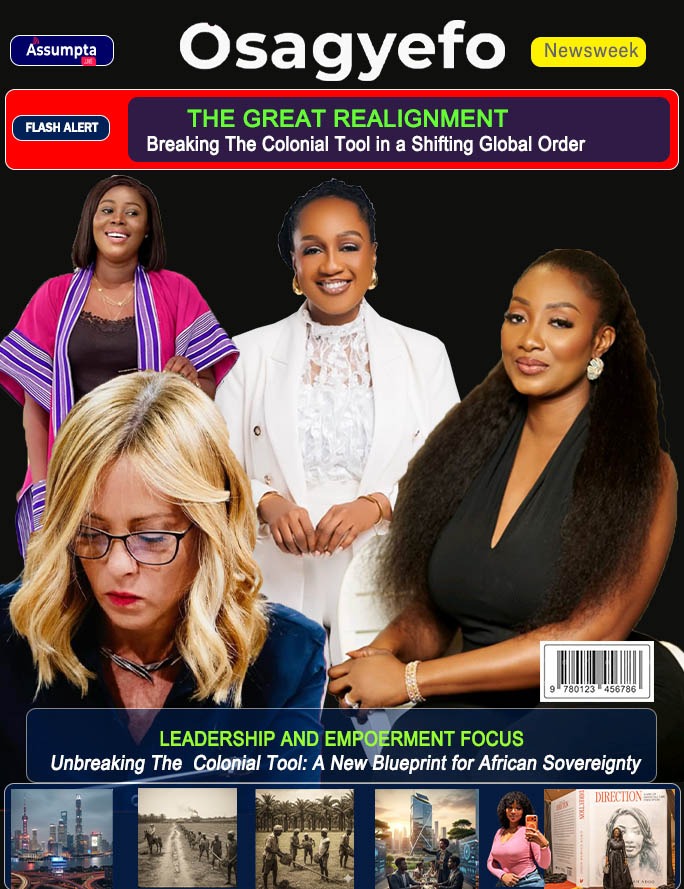
Liberator Newsletter Magazine Presents-Flash Alert
📅Global Release : Monday, February 9th, 2026
🌍FEATURE ARTICLE:
The Great Realignment: Breaking the Colonial Tool in a Shifting Glonal Order
Leadership and Empowerment Focus
Unbreaking the Colonial Tool: A New Blueprint for African Sovereignty
The snapshot of the world we once knew is fading. For 150 years, the global system was a tool for extraction—privileged by the North Atlantic, enforced through control, and designed to keep Africa in the shadows.
That era is over. In this pivot toward African liberation, Gwen Addo doesn’t just suggest a shift—she demands it. We are unbreaking the tool. We are rewriting the blueprint for sovereignty.
“Journalism of Neglected Topics – digging into the truths others avoid.”
Don’t Miss This Transformational Release
Monday, 9th February 2026
📩 Exclusively in the “ Journalism of Neglected Topics” Newsletter
👉 Share this now to reserve your copy and join a movement shaping the future — starting from Africa, to the world.
Hair Senta Advertisement


https://www.instagram.com/hairsenta?utm_source=ig_web_button_share_sheet&igsh=ZDNlZDc0MzIxaNw==
Love is in the air, and your hair should be too! With Valentine’s Day just around the corner, it’s time to ditch the “bad hair days” and embrace the ultimate glow-up. Whether you’re planning a romantic dinner in Accra or waiting for that special package to arrive overseas, Hair Senta has you covered.
Here’s why Hair Senta is your perfect Valentine’s date:
💖 Wear Your Confidence
Nothing says “I love me” (or “Love me”) like the luxury of premium human hair. We don’t just sell extensions; we ship confidence from the heart of Ghana to your doorstep, anywhere in the world.
Why Choose Hair Senta This Season?
- The Gold Standard: We source and ship the finest, most durable Human Hair Extensions.
- Global Reach: Based in Accra, but loved worldwide. Distance is never an issue for true beauty.
- The Perfect Gift: Hint to your partner or treat yourself—you deserve the best.
🛍️ Ready to Turn Heads?
Don’t wait until the 14th to realize your look is missing that “extra” something.
| Service | Detail |
|---|---|
| Visit Us | 24 Jungle Avenue, Accra, Ghana |
| Shop Online | www.hairsenta.com |
| Direct Call | (+233) 0544354455 / 0248629769 |
Pro Tip: Valentine’s orders are flying off the shelves! Secure your bundles now to ensure you’re camera-ready for the holiday.
Ready to find your perfect match?
THE POWER OF A SINGLE PERSON
Gathering the voices defining modern sovereignty to dissect, debate, and deliver the truth.

- THE GUEST | Gwen Addo: Business Strategist & Author of “DIRECTION”. The architect of the newsletter reveals how integrity and autonomous development are the new weapons of liberation.
WHAT THIS ISSUE UNPACKS
- Death equalizes all – no position or achievement can outlast it.
- Our actions define our legacy – truth, compassion, and justice are what endure.
- Personal responsibility – in the end, we alone face the consequences of our choices.
- Cause and effect – the universal law urging us to live with integrity so that when titles fade and possessions vanish, our life still stands worth remembering.
📦 WHAT THIS ISSUE UNPACKS
- The 5 Pillars of Global Disruption: A deep dive into the simultaneous shifts in Economy, Geopolitics, Technology, Ecology, and Demographics.
- The 1950 Sovereign Breakout: Why the end of the North Atlantic industrial monopoly is the greatest opportunity in 200 years.
- The Technology Leapfrog: How decentralized energy and digital currency are making colonial “infrastructure” obsolete.
💡 WHY THIS MATTERS
The global order is being “evened out.” Power is moving from the center to the periphery. If Africa does not seize this moment to build autonomous development, we risk falling into a new, digital version of the old colonial trap. This isn’t just news; it is a survival guide for the next decade
⚖️ WHEN OUR LEADERS BETRAYED THE NATION: EVIDENCE OF BETRAYAL
In this hard-hitting segment, we investigate the “Colonial Tool” in practice:
- Resource Laundering: Documents showing how internal leadership facilitates the exit of raw wealth in exchange for “political quiet.”
- The Debt Trap: How colonial-style financing is used to delay domestic industrialization.
- The Education Gap: Why the curriculum is still designed to produce employees, not architects of a new economy.
❓ THE BIG QUESTIONS
- Is African leadership still a colonial tool? How do we identify leaders who are still serving “slave masters” in the modern age?
- Can we industrialize without repeating the West’s mistakes? Looking at the ecological transformation.
- What happens to the North Atlantic? As power shifts to Asia and Africa, how will the old powers react to losing their 150-year privilege?
- Is this truly our personality as a nation?
- Is this the essence of our civilization?
- Is this what we are living and fighting for?
Introduction: A Vision for a New Era

Gwen-Addo is more than a national treasure; she is a global visionary of rare integrity. She speaks with a singular clarity about the shifting global order and, more importantly, Africa’s rightful place within it.
Today, we all feel the tremor of tectonic changes occurring at astonishing speed and magnitude. While many struggle to find their footing in this new reality, Gwen-Addo maps the path forward. We are witnessing at least five deep, simultaneous transformations—economic, geopolitical, technological, ecological, and demographic. These disruptions do not exist in isolation; they collide and accelerate one another.
The Great Economic Pivot
The most profound shift is economic. For 150 years—from 1800 to 1950—the industrial age was the exclusive privilege of a small corner of the globe: the North Atlantic. This dominance did not happen in a vacuum. Under the shadow of colonial rule, genuine development in Africa was structurally impossible.
Colonial powers were never architects of progress; they were engineers of extraction. Infrastructure was built only to serve the mine, the plantation, and the export port. Broad-based prosperity was never the goal—quiet obedience was.
The Dawn of Autonomy
By 1950, global industrialization was almost entirely concentrated in the West. But the post-1950 era sparked a historic reversal. For the first time, autonomous development became a possibility for sovereign regions.
While this progress has been uneven—with Asia leaping forward—Africa’s journey has been complicated by geopolitics often stuck in the cycle of electioneering and leadership struggles. In too many instances, the logic of the colonial past persisted, with structures serving external interests rather than continental advancement.
The New Global Reality
We must now face the first major truth of our modern world: for the first time in centuries, we no longer live in a Western-dominated economic order.
This shift has triggered a cascade of change:
- Geopolitical Rebalancing: As economic power spreads, political influence follows.
- Technological Revolution: A digital and industrial upheaval is reshaping the very fabric of our societies.
- Ecological & Demographic Flux: These forces are redefining the global order in real-time.
In this era of unprecedented change, Gwen-Addo offers the insight we need to ensure that this time, Africa does not just witness history—but leads it..
The Blueprint for African Autonomy: Three Pillars of Transformation
To move beyond the legacy of extraction and embrace genuine development, Africa must fundamentally re-engineer its systems. Here are three strategic shifts to secure a sovereign and prosperous future:
1. Shift from Extraction to Value Creation
For too long, African wealth has been shipped away in its rawest form. To reclaim the continent’s economic destiny, we must prioritize Industrial Sovereignty.
- The Strategy: Invest in localized manufacturing and secondary processing. Whether it is refining minerals, processing cocoa, or assembling tech, the “Value-Added” must happen on African soil.
- The Goal: Develop robust regional supply chains and support African-owned industries.
- The Result: Wealth remains on the continent, high-skilled jobs are created for our youth, and our economies become resilient to global shocks.
2. Cultivate Institutions of Integrity
Colonial governance was a tool of control; modern African governance must be a tool of empowerment. True development is impossible when leadership looks outward for approval rather than inward for accountability.
- The Strategy: Build transparent, meritocratic institutions that prioritize the needs of the citizen over the interests of external actors.
- The Goal: Enforce radical public accountability and foster a new generation of leaders whose mandates are rooted in local priorities and long-term stability.
- The Result: Governance becomes a service to the people, creating a stable environment where domestic and global trust can flourish.
3. Claim Intellectual and Technological Independence
Dependency is the modern form of colonization. To be truly free, Africa must transition from a consumer of global innovation to a primary producer of it.
- The Strategy: Revolutionize education by prioritizing STEM (Science, Technology, Engineering, and Mathematics) and technical vocational training.
- The Goal: Aggressively fund R&D hubs and provide capital to African entrepreneurs pioneering digital, agricultural, and industrial technologies.
- The Result: Africa becomes a global powerhouse of knowledge, exporting solutions rather than just importing products.
The Bottom Line
Breaking the old cycle requires a structural overhaul. When Africa creates its own value, governs with integrity, and invests in its intellect, it ceases to be a resource base for the world and becomes what it was always meant to be: a global center of influence and innovation.
1. Financial Sovereignty (Mobile Money)
In the old system, you needed a brick-and-mortar bank (usually Western-owned) to participate in the economy.
- The Shift: Africa led the world in mobile money (like M-Pesa).
- The Result: Millions of people bypassed the need for traditional banks, allowing for autonomous development at the grassroots level. This makes it much harder for external powers to control the “flow” of wealth through centralized colonial-era banks.
2. Education and “Brain Gain”
As you mentioned, colonial powers weren’t interested in broad-based education.
- The Shift: The internet has decoupled education from geography. A young woman in Accra or Nairobi can access the same advanced coding, engineering, or business curriculum as someone in London.
- The Result: This destroys the “monopoly on knowledge” that the North Atlantic region held for 150 years. It creates a class of “world visionaries”—like the Gwen Addo mentioned—who don’t need to leave the continent to build a global empire.
3. Decentralized Energy
Colonial infrastructure was built to power mines and plantations, leaving the rest of the continent in the dark.
- The Shift: Solar and battery technology are becoming decentralized.
- The Result: Just as Africa skipped landlines for mobile phones, it is now skipping the need for a massive, centralized power grid (which is often prone to corruption and debt-traps). When a community owns its power, it owns its industrial future.
The Challenge of “Digital Colonialism”
While these shifts are astounding, the danger now is Digital Colonialism—where the “mines” are no longer for gold, but for data. If African leaders don’t protect their digital sovereignty, the same “extraction” patterns could repeat in the cloud.
Welcome to today’s dialogue. We are broadcasting live to a global audience, bringing together four of the most influential women in their respective fields to discuss the “Great Realignment” of our world.
Meet the Panel

- Frema Adunyame (The Host): A distinguished Ghanaian broadcast journalist and Head of Events and Partnerships at Channel One TV. Known for her fearless inquiry and command of the airwaves, she serves as the guiding voice for today’s high-stakes conversation.

Gwen Addo (The Guest): A world-renowned Business Strategist, CEO of The Hair Senta, and author of the transformative book DIRECTION. An alumna of Harvard and CEIBS, she has transitioned from corporate banking to becoming a visionary architect of African-led global brands.

- Dzigbordi Kwaku-Dosoo (The Strategist): A premier Human-Centered Strategist, certified high-performance coach, and founder of Allure Africa. With a background in finance from Virginia State University and Harvard Executive Education, she is an expert in the “human currency” required for leadership.

- Giorgia Meloni (The Global Voice): The Prime Minister of Italy. As the first woman to lead her nation, she has championed the “Mattei Plan”—a strategic framework aiming to redefine Europe-Africa relations through a non-predatory, equal partnership model.
The Dialogue: The Great Realignment

Frema Adunyame: Welcome to today’s dialogue. We are standing at a crossroads of history. Professor Jeffrey Sachs recently spoke of “geotectonic shifts,” and today, our guest Gwen Addo has brought forward a staggering analysis of this shifting order. Gwen, you’ve highlighted five transformations—economic, geopolitical, technological, ecological, and demographic—occurring simultaneously. You also pointed out that from 1800 to 1950, the North Atlantic region held a monopoly on industrialization that effectively suppressed Africa. How does this history inform the “new blueprint” you are demanding today?

Gwen Addo: Thank you for that opening, Frema. I acknowledge the gravity of your question. For 150 years, the world system was rigged. Colonialism wasn’t just a political occupation; it was an economic “off-switch” for the rest of the world. But since 1950, that monopoly has shattered. The 1950 snapshot of a Western-only industrial world is gone. Today, we aren’t just looking for “aid”—we are looking at the five shifts. For instance, the demographic shift means Africa will soon be the world’s labor force. We must stop being a “tool” for others and start being the architects of our own sovereign development. Thank you for your time.

Frema Adunyame: I acknowledge your point on moving from being a tool to being an architect. It is a powerful shift in mindset. Prime Minister Meloni, you have been vocal about a “new page” in Africa-Europe relations through your Mattei Plan, moving away from what you called a “paternalistic” approach. In light of Gwen’s breakdown of the shifting global order, how does Italy intend to respect this new African demand for autonomy?

Giorgia Meloni: I acknowledge the necessity of this conversation. Frema, Africa is not a poor continent; it is a continent often treated poorly. The North Atlantic privilege Gwen mentions is a historical fact, but the future must be built on “mutually beneficial cooperation among equals.” Italy wants to be the bridge. We see the technological and ecological shifts Gwen mentioned as areas where we can trade as partners—for example, in energy and green tech—rather than as extractors. We want to dismantle the distorted narratives of the past. Thank you for your time.

Frema Adunyame: I acknowledge your vision for a “bridge” between the continents, Prime Minister. Turning now to Dzigbordi. You’ve often said that “true power begins in the soul.” As Gwen describes these massive economic and technological shifts, my question is about the people. Can the African workforce and leadership survive this transition from being “colonial labor” to becoming “sovereign leaders” in such a fast-moving global order?

Dzigbordi Kwaku-Dosoo: I acknowledge the depth of that concern, Frema. The “Great Realignment” is not just about moving money or tech; it’s about moving hearts and minds. For over a century, the “colonial tool” was used to make our people feel like employees in their own home. To survive the technological and demographic shifts Gwen mentioned, we need “Human Currency”—emotional steadiness and a shift from positional authority to leadership gravity. If we don’t heal the “soul” of our leadership, we will just be new managers of old colonial habits. Thank you for your time.

Frema Adunyame: I acknowledge that “healing the soul of leadership” is perhaps the most difficult part of the blueprint. Gwen, to wrap up this opening dialogue: you’ve seen how the technological revolution allows Africa to “leapfrog” old systems. Is this technology enough to break the colonial tool, or do we still face the danger of “digital colonialism”?

Gwen Addo: I acknowledge the risk you’ve raised, Frema. Technology is a vehicle, but integrity is the driver. If we use AI and digital platforms but still have a “plantation mindset,” we will only be digitally colonized. The “Great Realignment” requires us to own the platforms, own the data, and most importantly, own our direction. We are demanding a shift because the speed of the world will not wait for us to find our balance; we must create it. Thank you for your time.

Frema Adunyame: I acknowledge your call to action. Integrity as the driver, technology as the vehicle. To our global audience, this is the blueprint for a sovereign Africa in a multipolar world. Thank you all for your time.
Frema-Adunyame continues: Today is February 9th, 2026, and we are looking forward to it. Gwen, you’ve mentioned that technology is a vehicle. Let’s get specific. In what way can technology give Africa a chance to “leapfrog”—to skip the old colonial-style systems—and build independent, modern economies? And crucially, how can Africa ensure it controls its own data, platforms, and digital infrastructure right now, rather than just leasing them? Thank you for your time.

Gwen Addo (The Guest): I acknowledge the urgency of that question, Frema. Leapfrogging isn’t a theory; it’s our current reality. In the colonial era, if you wanted to build an economy, you had to build massive, centralized grids—physical banks, copper-wire phone lines, and coal plants. These were expensive and easy for a central power to control.
Today, we skip that. We use mobile money to bypass colonial banks. We use decentralized solar to bypass the broken grids. But to your second point: control. If we use a foreign app to sell African products, the foreign app owns the data of our customers. To break the tool, we must build African Data Sovereignty. We need our own data centers on the continent—like we see emerging in Ghana and Senegal—and our own regional tech alliances under the African Continental Free Trade Area (AfCFTA). Sovereignty in 2026 isn’t just a flag; it’s a server located in Accra. Thank you for your time.

Frema Adunyame: I acknowledge the shift from “flag sovereignty” to “server sovereignty.” That is a profound distinction. Prime Minister Meloni, your “Mattei Plan” emphasizes non-predatory cooperation. In this digital race, how can Italy and the EU support Africa’s desire to own its infrastructure, rather than just being a market for European or Silicon Valley tech? Thank you for your time.

Giorgia Meloni (The Global Voice): I acknowledge the importance of partnership over dominance, Frema. Under the Mattei Plan, we are moving away from the old “aid” model. We are investing in “Digital Public Infrastructure” (DPI). This means instead of just selling a finished product, we are co-investing in the “pipes”—the fiber optics and the local data centers Gwen mentioned. For example, our collaboration with Ghana and Mozambique focuses on capacity building. We want to help create a framework where African data is governed by African laws. A strong, digitally sovereign Africa is a more stable and prosperous partner for Italy. We don’t want a monopoly; we want a marketplace of equals. Thank you for your time.
Frema Adunyame: I acknowledge your commitment to a marketplace of equals, Prime Minister. Dzigbordi, technology is moving at a “breathtaking” speed. But as Gwen and the Prime Minister talk about data centers and fiber optics, I think of the human being. How do we ensure that this leap into high-tech sovereignty doesn’t leave the “human soul” behind, and how do we prepare our people to manage this infrastructure themselves? Thank you for your time.

Dzigbordi Kwaku-Dosoo (The Strategist): I acknowledge that technology is only as sovereign as the mind using it, Frema. We can have all the data centers in the world, but if our leadership still has a “laborer” mindset—waiting for instructions from the North Atlantic—we are still colonized. To control our platforms, we must first control our Human Currency. We need to move from “digital literacy” to “digital mastery.” This means training our youth not just to use apps, but to code the algorithms that reflect our values. If we don’t align our spiritual and mental foundations with this tech, we will have a modern economy with an ancient, oppressed soul. We must lead the tech, not let the tech lead us. Thank you for your time.
Frema Adunyame: I acknowledge that “leading the tech” requires a fundamental mental reset. This dialogue has shown that the blueprint for sovereignty is being written in real-time.
The Dialogue: Technology and the New Sovereign Blueprint
We have established that the 150-year North Atlantic industrial monopoly has fractured. Gwen, you have eloquently mapped the five deep transformations—economic, geopolitical, technological, ecological, and demographic. I want to zero in on the technological disruption. In what way can technology specifically give Africa a chance to skip the old colonial-style systems and build independent, modern economies? And how can Africa, right now in 2026, control its own data, platforms, and digital infrastructure rather than becoming a site of “digital extraction”? Thank you for your time.

Gwen Addo: I acknowledge the precision of your question, Frema. In the colonial era, infrastructure was built to move things out—railways from the mine to the port. Technology allows us to build “infrastructure of the mind and the cloud” that moves value inward. We skip the expensive, centralized landlines and go straight to 5G; we skip the brick-and-mortar banks that were built to exclude us and move into mobile finance that includes everyone.
To the point of control: we must stop being the “raw material” for global AI. Right now, our personal data is the “new cobalt.” To control it, we need African-owned data centers and sovereign clouds. We must demand that data generated in Accra stays in servers in Accra. Sovereignty today isn’t just a border on a map; it’s the ownership of the code that runs our markets. Thank you for your time.
Frema Adunyame: I acknowledge the concept of “server sovereignty” as the new frontier of liberation. It is a powerful demand. Prime Minister Meloni, your Mattei Plan focuses on infrastructure and education. In this digital race, how does Italy support Africa’s need to own the “pipes and the servers,” rather than simply being a consumer of Western or Asian technology? Thank you for your time.
Giorgia Meloni: I acknowledge the shift Gwen is describing. The Mattei Plan is built on the principle of “growing together.” We are currently co-investing in projects like the Blue Raman undersea cable extension to East Africa, but with a different philosophy: we aren’t just bringing the internet; we are helping build the local digital market. True partnership means Italy supporting African tech hubs and data centers so that the “digital corridors” remain under African governance. We see a sovereign Africa as a more stable, wealthy, and equal partner for Europe. Thank you for your time.
Frema Adunyame: I acknowledge the transition from aid to “co-investment” in the digital market. Dzigbordi, as these ladies discuss servers and undersea cables, you often remind us that the human being is the core. If we build these modern, independent economies, how do we ensure our people don’t just become “digital laborers” for new masters? How do we prepare the African soul for this transition from labor to leadership? Thank you for your time.

Dzigbordi Kwaku-Dosoo: I acknowledge the gravity of that human element, Frema. As Gwen said, we are unbreaking the colonial tool. But the most dangerous tool was the one that told us we were only meant for labor. To skip the old systems, we must skip the old mindset.
Building independent economies requires “Cultural Intelligence.” We must train our youth to be the architects of the algorithms, not just the users. If we own the data but don’t own our direction—our “human currency”—we will still be following a blueprint written elsewhere. True power begins when the African soul recognizes it is the creator of the technology, not just the consumer. Thank you for your time.
Frema Adunyame: Thank you Dzigbodzi that the soul must lead the machine. This dialogue has made it clear: the “Great Realignment” is not just about what we build, but who owns the foundation.
⚖️ WHEN OUR LEADERS BETRAYED THE NATION: EVIDENCE OF BETRAYAL
In the shifting global order, the most dangerous “Colonial Tool” is not always an external force; often, it is the internal leadership that functions as a gatekeeper for extraction. To unbreak the tool, we must first document how it has been used against us.
1. The “Digital Lease” of Sovereignty
Historical evidence shows that while African nations represent 17% of the world’s population, we generate only 3-4% of global data—and 85-95% of that data is processed and stored abroad in foreign-controlled systems.
- The Betrayal: Many leaders have signed “Digital Convenience” contracts with Big Tech conglomerates that command 90% of the revenue in African markets. By failing to invest in local data centers, they have effectively leased the continent’s “digital nervous system” to foreign powers, leaving our citizens vulnerable to external surveillance and economic manipulation.
2. The “Mine-to-Port” Infrastructure Trap
Just as colonial railways were built only to move gold and cocoa out of Africa, modern leaders have often repeated this pattern with digital infrastructure.
- The Betrayal: Out of the 25-30 major submarine cables serving Africa, only 2 or 3 are predominantly owned by African entities. Leaders have prioritized quick, foreign-funded “turnkey” projects that create Technological Lock-in, where the continent becomes a permanent consumer of foreign hardware and software rather than a creator.
3. State Capture & Resource Laundering
In the pursuit of personal enrichment, certain leadership factions have repurposed state institutions to serve “shadow networks.”
- The Betrayal: Investigative reports, such as the “Betrayal of the Promise,” document how national treasuries and procurement systems in various regions were “repurposed” to favor elite networks over national development. This “silent coup” redirects wealth away from education and innovation into offshore accounts, stalling the autonomous development Gwen Addo advocates for.
❓ THE BIG QUESTIONS
- The Accountability Gap: If “Data is the new Cobalt,” why are we allowing it to be extracted with the same zero-value-added terms as our physical minerals?
- The Talent Drain: Are our education systems producing “digital laborers” for Silicon Valley, or “sovereign architects” for the African Digital Commons?
- The Integrity Litmus Test: How can we distinguish between a leader who seeks “partnership” and one who is merely looking for a new “slave master” in the cloud?
Frema Adunyame (The Host):
I acknowledge the heavy weight of the evidence we have just laid bare. The betrayal is documented, and the scars on our digital and economic sovereignty are visible. But before we close this broadcast, I want to turn to our guest, Gwen Addo. Gwen, you have stood firm as the primary voice behind this edition’s message. I want you to speak directly to our global readers and this panel.
Why this specific Title: “THE GREAT REALIGNMENT: Breaking The Colonial Tool in a Shifting Global Order”? And why the subtitle: “Unbreaking The Colonial Tool: A New Blueprint for African Sovereignty”? Please, encapsulate the heart of this newsletter for us. Thank you for your time.

Gwen Addo (The Guest):
I acknowledge the weight of that question, Frema, and I thank you for the opportunity to ground this vision.
The title, “The Great Realignment,” is chosen because we are moving past a simple “change.” For 150 years, the world was aligned toward one pole—the North Atlantic. That alignment was built on the Colonial Tool, a mechanism designed to ensure that Africa remained a site of extraction rather than a center of innovation. When we speak of “Breaking the Colonial Tool,” we are talking about dismantling the structures—the debt traps, the digital extraction, and the “laborer mindset”—that were engineered to keep us from developing autonomously.
The subtitle—“Unbreaking the Colonial Tool”—is our demand for restoration. It is the acknowledgment that what was broken in us (our confidence, our systems, our sovereignty) can be “unbroken” through a New Blueprint. This blueprint is not handed to us by the West or the East; it is written by us, using the five transformations—economic, geopolitical, technological, ecological, and demographic—as our raw materials. Sovereignty is no longer just a political status; it is a technological and spiritual reality where we own our direction. We are no longer waiting for permission to develop; we are realigning the world to meet us where we are. Thank you for your time.
Frema Adunyame:
I acknowledge that powerful explanation, Gwen. You have turned a title into a manifesto. Prime Minister Meloni, Dzigbordi, and Gwen—you have given our readers a reason to believe that the “snapshot of 1950” is finally being replaced by a portrait of African agency.
To our readers and viewers across the world: The Great Realignment is not a distant event—it is happening in your pockets, in your servers, and in your souls. Thank you for joining us today. We thank the panel for their time, their integrity, and their vision.
Goodnight, and stay sovereign. Thank you for your time.
Final Newsletter Summary
- The Problem: A 150-year system designed for “quiet and control” (Extraction).
- The Shift: A multipolar world where the North Atlantic monopoly has ended.
- The Tool: Technology, but only if driven by Integrity and Data Sovereignty.
- The Blueprint: Moving from a “laborer” soul to an “architect” spirit.
Introduction to the Soka Gakkai and Nichiren Buddhism. Where do the teachings originate from? What is the philosophy of Buddhism? How do Soka Gakkai members apply it in their daily lives?
The Soka Gakkai is a global community-based Buddhist organization that promotes peace, culture and education centered on respect for the dignity of life. Its members in 192 countries and territories study and put into practice the humanistic philosophy of Nichiren Buddhism. Soka Gakkai members strive to actualize their inherent potential while contributing to their local communities and responding to the shared issues facing humankind. The conviction that individual happiness and the realization of peace are inextricably linked is central to the Soka Gakkai, as is a commitment to dialogue and nonviolence. Subscribe to our channel: / sgivideosonline Visit our website: https://www.sokaglobal.org/ Like us on Facebook: / sgi.info Follow us on Instagram: / sgi.info Follow us on Twitter:


https://www.instagram.com/babies_and_todds_day_care?igsh=MWs0ZHlsbjcxNXEyZg==
✨ Nurturing Global Citizens: Babies & Toddlers Daycare ✨
In a world that calls for greater empathy, Babies & Toddlers Daycare begins at the very start. We cultivate a vibrant community where diversity is celebrated, and dialogue is our most cherished tool for growth.
Our Core Pillars
- 🌱 Creativity: We unlock every child’s potential through the magic of arts, purposeful play, and a deep connection with nature.
- ❤️ Character: We center our teaching on the importance of kindness, empathy, and a profound respect for all life.
- 💪 Confidence: We focus on building the inner strength and resilience your child needs to face any challenge with a confident smile.
Why Choose Us?
We believe in a balanced foundation. Enroll your child in a preschool that values their happiness and well-being just as much as their academic milestones.
Our Home in Windhoek
Located in the heart of Windhoek, our facility is a safe, nurturing sanctuary designed for children to:
Grow with intention | Learn with joy | Share with heart | Create with freedom
Connect With Us
Ready to join our family? Let’s start the journey together.
📞 Call us: +264 81 673 7599
🌐 Visit: www.babiestodds.com
📍 Location: Windhoek, Namibia


https://www.instagram.com/goba_kente?utm_source=ig_web_button_share_sheet&igsh=ZDNlZDc0MzIxNw==
This February, we celebrate the intersection of heritage and high fashion. Goba Kente, the “Home of Colors, Creativity & Craftsmanship,” has officially been awarded the Assumpta IMAGINE Works from the Heart prize for the second week of February!
This recognition, championed by Co-Founder Mrs. Assumpta Gahutu, honors designers who do more than follow trends—they tell a story of African innovation.
👗 The Award-Winning Look: Serwaa Amihere-Esq.
As seen on the elegant Serwaa Amihere-Esq., this Goba Kente creation is a masterclass in modern African luxury.
- The Design: A floor-length, form-fitting gown featuring an off-the-shoulder neckline and intricate beaded detailing.
- The Texture: Crafted from rich, textured Kente weave that captures the light, blending traditional craftsmanship with a contemporary “mermaid” silhouette.
- The Accents: Paired with a matching headwrap and a bold red clutch, the outfit balances deep emerald tones with vibrant pops of color.
💼 Versatility: From the Boardroom to the Gala
You asked if this look suits a corporate office. While the specific gown pictured is a “show-stopper” designed for high-profile events and galas, the Goba Kente fabric and craftsmanship are highly adaptable:
- For the Office: Goba Kente specializes in “Home of Colors”. Their textiles can be tailored into structured blazers, pencil skirts, or shift dresses that bring cultural authority and professional elegance to any corporate environment.
- Embracing Curves: This outfit is expertly designed to celebrate the feminine silhouette. The structured bodice and strategic draping highlight curves with sophistication, ensuring that confidence is the first thing people notice when you walk into a room.
✨ Why Goba Kente Won
Goba Kente secured the Assumpta IMAGINE prize by proving that fashion can be a bridge between emotion and heritage. By blending “Colors, Creativity & Craftsmanship,” they have shaped a contemporary global style that resonates far beyond Ghana.
Get the Look Worldwide
Whether you are in Accra or abroad, you can wear the prize-winning heart of African design.
- Global Access: Worldwide Shipping Available via linktr.ee/gobakente.
- Locate Us: Find “GOBA KENTE” on Google Maps.
- Join the Movement: Follow @goba_kente and let’s GOBA TOGETHER.